
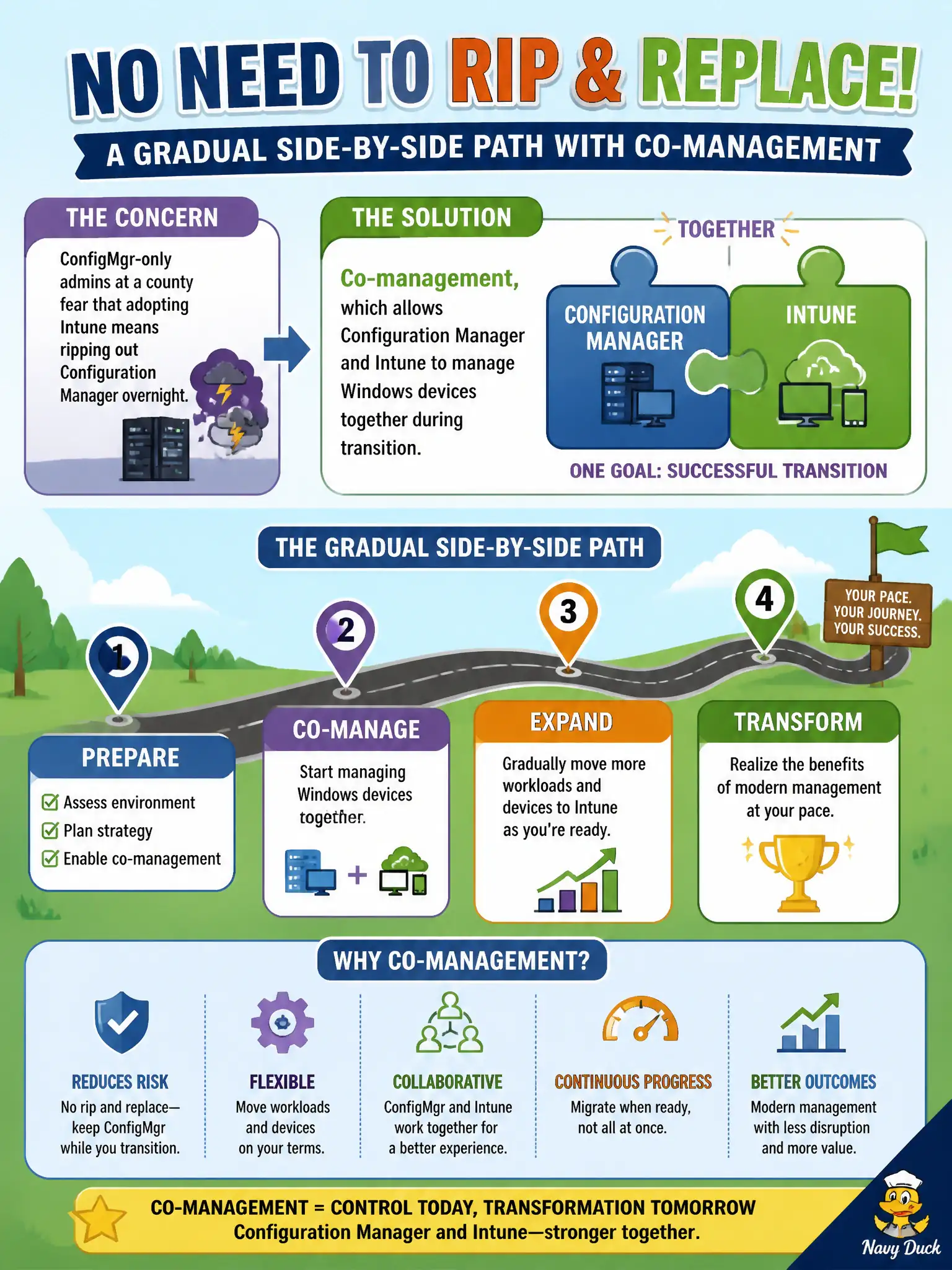
ConfigMgr-only admins at a county fear that adopting Intune means ripping out Configuration Manager overnight. Which approach describes a gradual side-by-side path?
Select an answer to reveal the explanation.
Short Explanation
Co-management is the ‘both tools on the field’ bridge—not a cliff jump off ConfigMgr. Forms and Stream don’t manage PCs. You can move workloads over without a midnight cutover myth.
Full Explanation
ConfigMgr-only admins at a county who fear that adopting Intune means ripping out Configuration Manager overnight should hear co-management, which allows Configuration Manager and Intune to manage Windows devices together during transition. Co-management is the “both tools on the field” bridge: workloads move when readiness and change control allow, not when fear peaks. Municipal IT rarely survives politically if modernization is sold as a cliff jump off ConfigMgr on Friday.
Immediate retirement of all on-premises management with no transition period fails change management and contradicts the purpose of co-management. Replacing Intune with Microsoft Forms surveys about laptop satisfaction only fails because surveys collect opinions; they do not manage PCs. Using Microsoft Stream to stream ConfigMgr consoles to the cloud as the official migration fails as a non-strategy that confuses video with endpoint management modernization.
Exam caveat: co-management = gradual side-by-side ConfigMgr + Intune. It is the antidote to overnight rip-and-replace messaging on MS-900.
Operational check: enable co-management for a pilot, pick early workloads to shift toward Intune, keep ConfigMgr for what still needs it, communicate the bridge to ConfigMgr-centric admins, and reject Forms/Stream as fake migration platforms.