
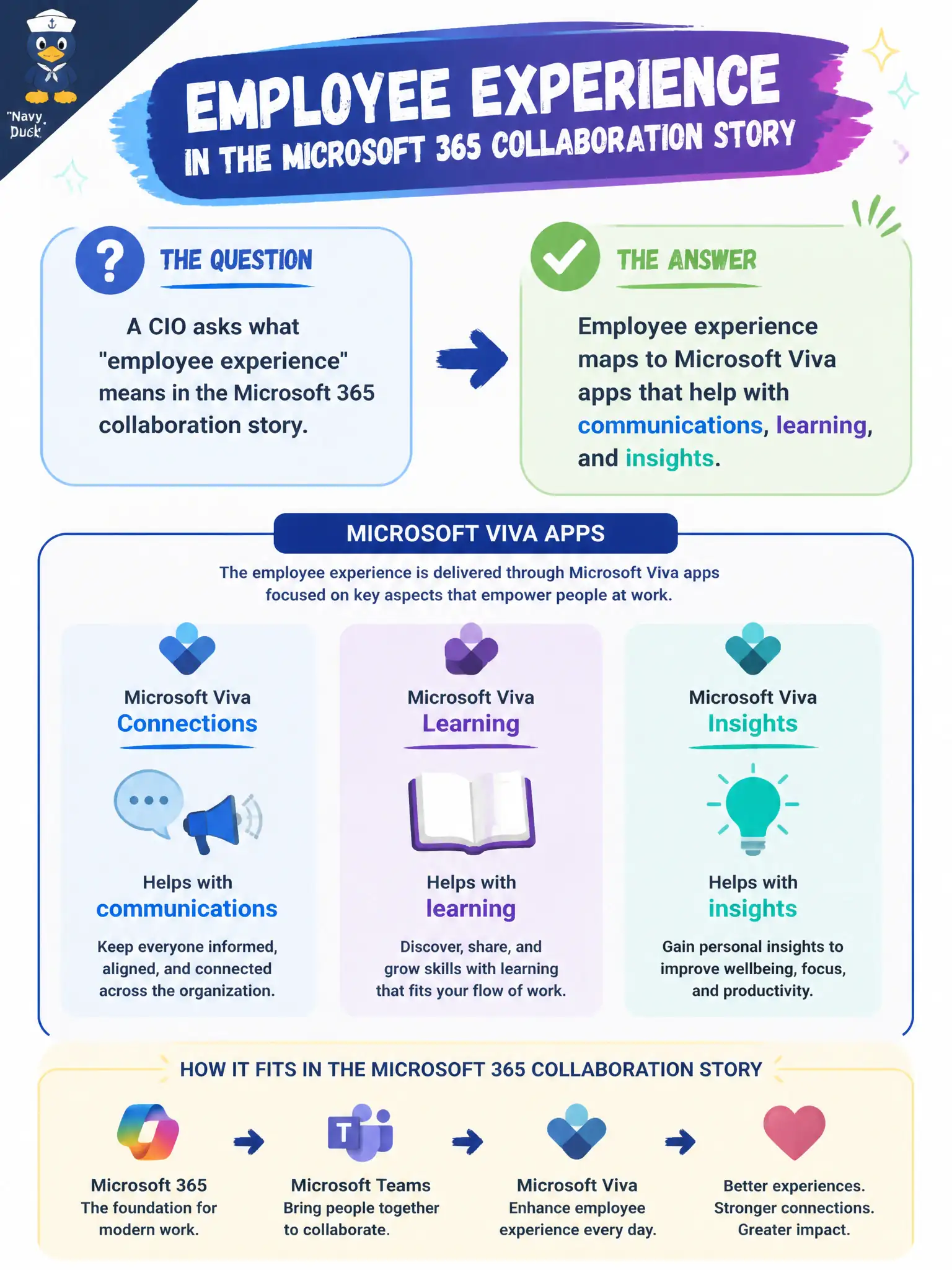
A CIO asks what “employee experience” means in the Microsoft 365 collaboration story. Which answer best maps the concept at fundamentals depth?
Select an answer to reveal the explanation.
Short Explanation
In Microsoft 365 speak, “employee experience” is the Viva headline—communications, learning, insights, engagement. It is not journaling-only, Autopatch rings, or Azure storage geography.
Full Explanation
When a CIO asks what “employee experience” means in the Microsoft 365 collaboration story, the fundamentals mapping is Microsoft Viva apps that help with communications, learning, and insights. Employee experience is the product narrative for helping people feel informed, connected, and supported at work—not a synonym for journaling, patch rings, or Azure region picking.
Saying employee experience means only Exchange Online journaling fails because journaling is a compliance/mail concept, not the engagement-apps family. Equating it to Windows Autopatch deployment rings fails because update management is an endpoint servicing concern. Referring solely to Azure region selection for storage redundancy fails because geo-redundancy design is not the employee-experience collaboration story on MS-900.
Exam caveat: “maps to Viva” at describe depth does not require listing every Viva module SKU. It requires recognizing the family and its communications/learning/insights intent versus unrelated admin or infrastructure knobs.
Operational check: in architecture briefings, define employee experience as Viva-centered communications, learning, and insights; keep Exchange journaling, Autopatch, and Azure regions in their proper workstreams; and measure pilots on engagement and clarity of internal communications rather than on storage SKUs or patch rings.