
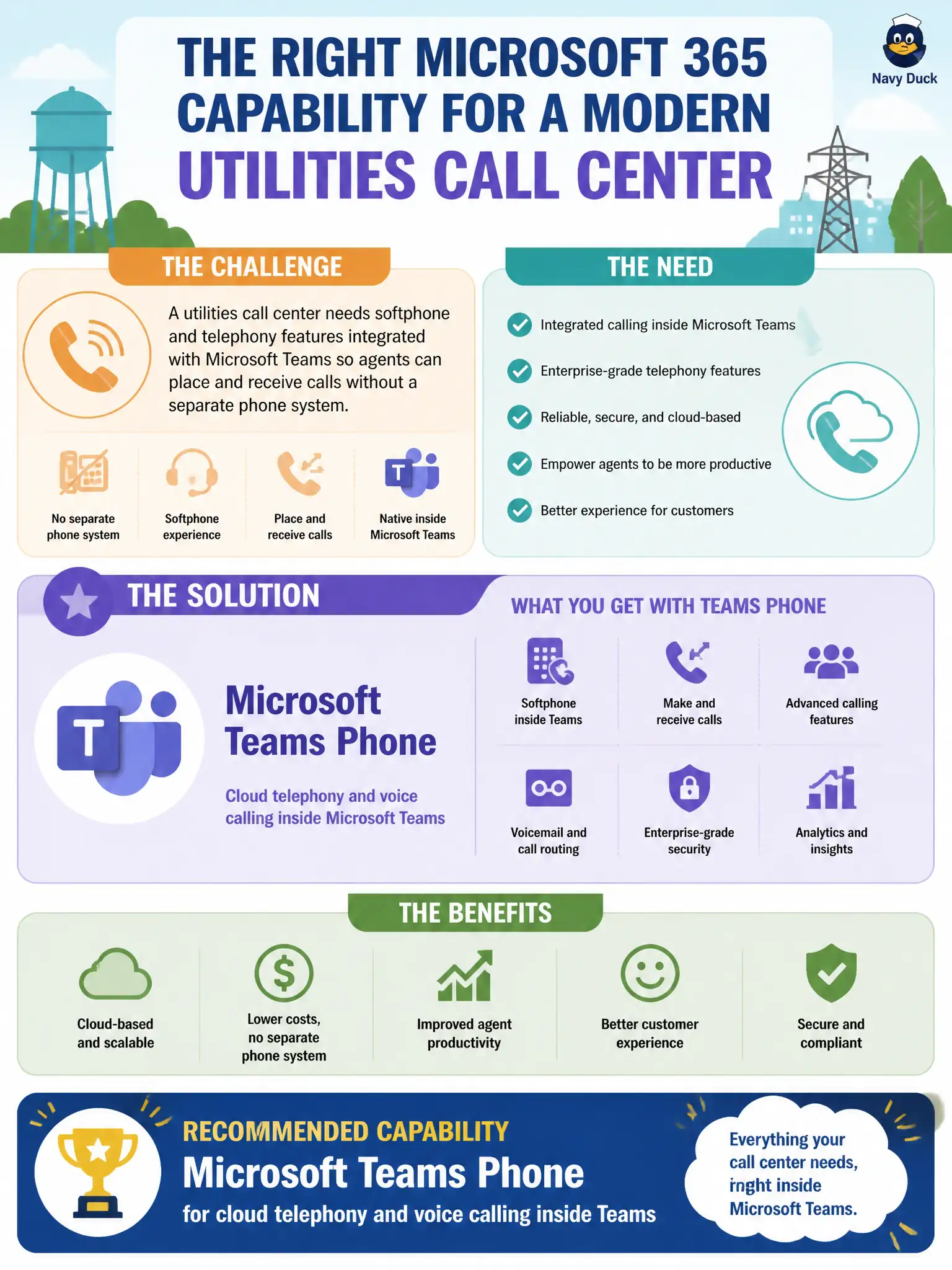
A utilities call center needs softphone and telephony features integrated with Microsoft Teams so agents can place and receive calls without a separate phone system. Which Microsoft 365 capability should the city choose?
Select an answer to reveal the explanation.
Short Explanation
Think of Teams Phone like plugging a desk phone into the same hub the agents already live in. Softphone and PSTN-style calling sit inside Teams instead of a second console. The call center keeps chat, presence, and voice in one place.
Full Explanation
Municipal utilities call centers live and die by whether agents can answer residents without juggling a separate PBX console beside Teams. The correct choice is Microsoft Teams Phone for cloud telephony and softphone calling inside Teams. Teams Phone brings PSTN-style place-and-receive calling into the same hub where presence, chat, and collaboration already run, so the city can reduce dual-system training and keep call handling aligned with the agent’s digital workspace. At MS-900 describe depth, softphone and telephony integrated with Teams maps to Teams Phone—not to adjacent Microsoft 365 apps that never terminate voice calls.
Exchange Online alone fails the scenario because mailbox delivery and calendaring do not provide softphone call control, call queues, or PSTN connectivity for agents. Stream fails because publishing recorded training videos is a content-distribution problem, not live call routing or agent telephony. OneDrive fails because personal draft storage has no relationship to inbound/outbound call handling or phone-system replacement.
Exam caveat: selecting Teams Phone does not automatically mean every legacy trunk is retired on day one, nor does it imply that email or chat disappear; it means the voice-calling workload is designed to live inside Teams. Do not confuse “integrated telephony in Teams” with “any Microsoft 365 app that agents happen to open.”
Operational check: confirm the call center requires softphone/PSTN features in Teams (not just chat), inventory whether agents already live in Teams for presence, validate licensing and calling-plan or operator-connect readiness at a describe level, and ensure help-desk runbooks distinguish Teams Phone from Exchange, Stream, and OneDrive so staff do not mis-ticket voice issues to the wrong queue.