
A 311 resident-service assistant program must maintain a defensible record of every configuration change made to its deployed agent, ahead of an upcoming compliance review. Which combination of services builds that auditable trail?
Select an answer to reveal the explanation.
Short Explanation
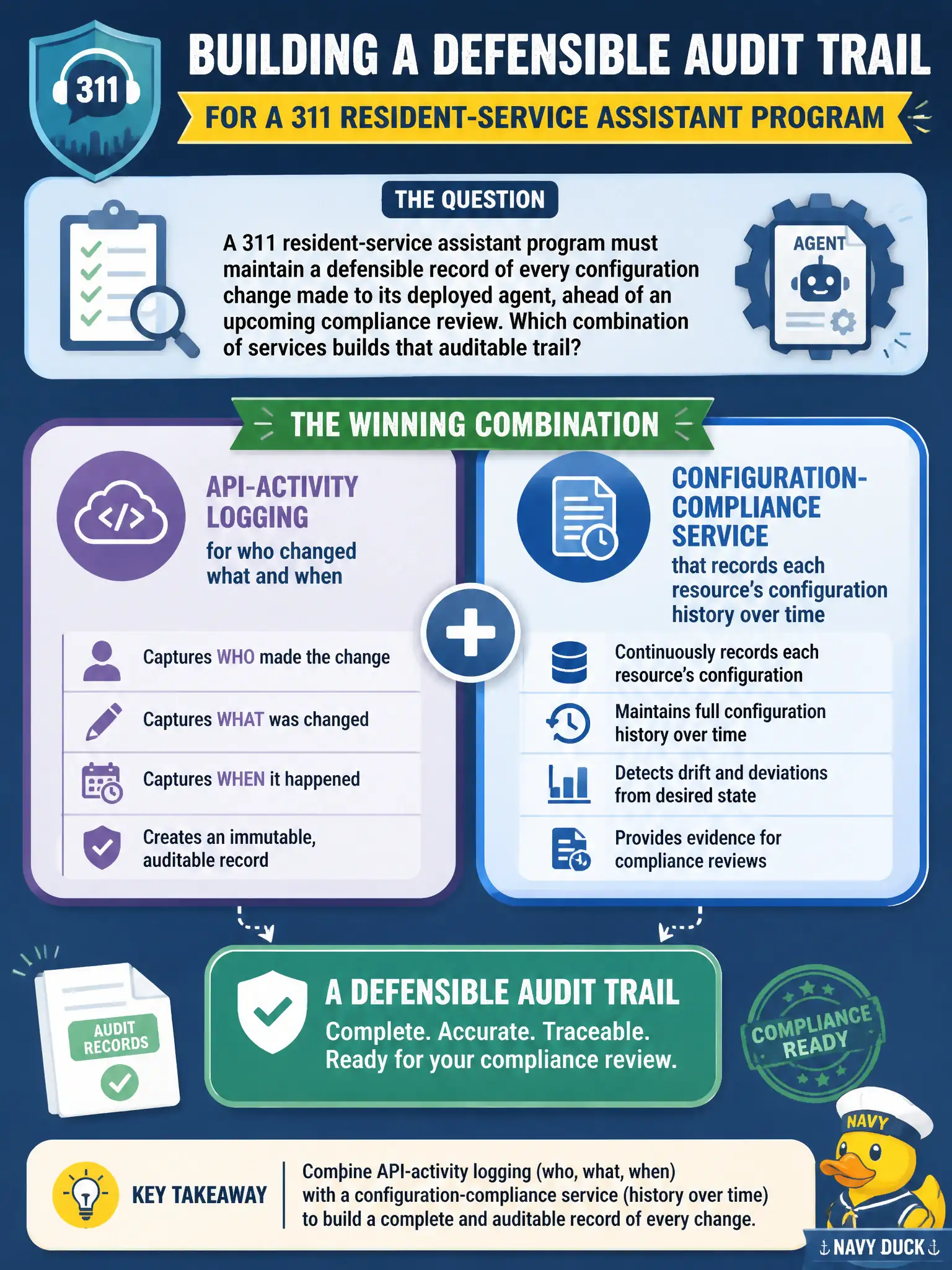
A compliance reviewer wants a paper trail, not someone's memory of what changed last Tuesday. Pairing activity logging with a service that tracks configuration history over time gives you both who touched it and what it looked like before and after. A dashboard snapshot or a sticky note doesn't survive an audit.
Full Explanation
A defensible compliance record needs two things together: a log of who changed what and when, and a history of what each resource's configuration actually looked like over time — account-activity logging supplies the first, and a configuration-compliance service that tracks configuration history supplies the second, and combined they let an auditor reconstruct both the action and its effect. A CloudWatch dashboard only shows the current configuration state at whatever moment someone views it; it doesn't retain a history of prior states or attribute changes to a specific actor. A shared spreadsheet updated manually depends entirely on engineers remembering to log every change, which is exactly the kind of gap an auditor will find and flag. Resident conversation transcripts capture what the agent said to residents, not what engineers changed in its configuration — the two records track entirely different things. Scope caveat: confirm both logging and configuration tracking are enabled well before the compliance window begins, since neither service can retroactively produce a history for a period when it wasn't turned on. Operational check: pick a known past configuration change and confirm both the activity log and the configuration history can independently corroborate it.