
A school-district assistant team wants to validate a newer foundation model against the currently deployed one before swapping the production model ID. Which approach gives them a reliable basis for that decision?
Select an answer to reveal the explanation.
Short Explanation
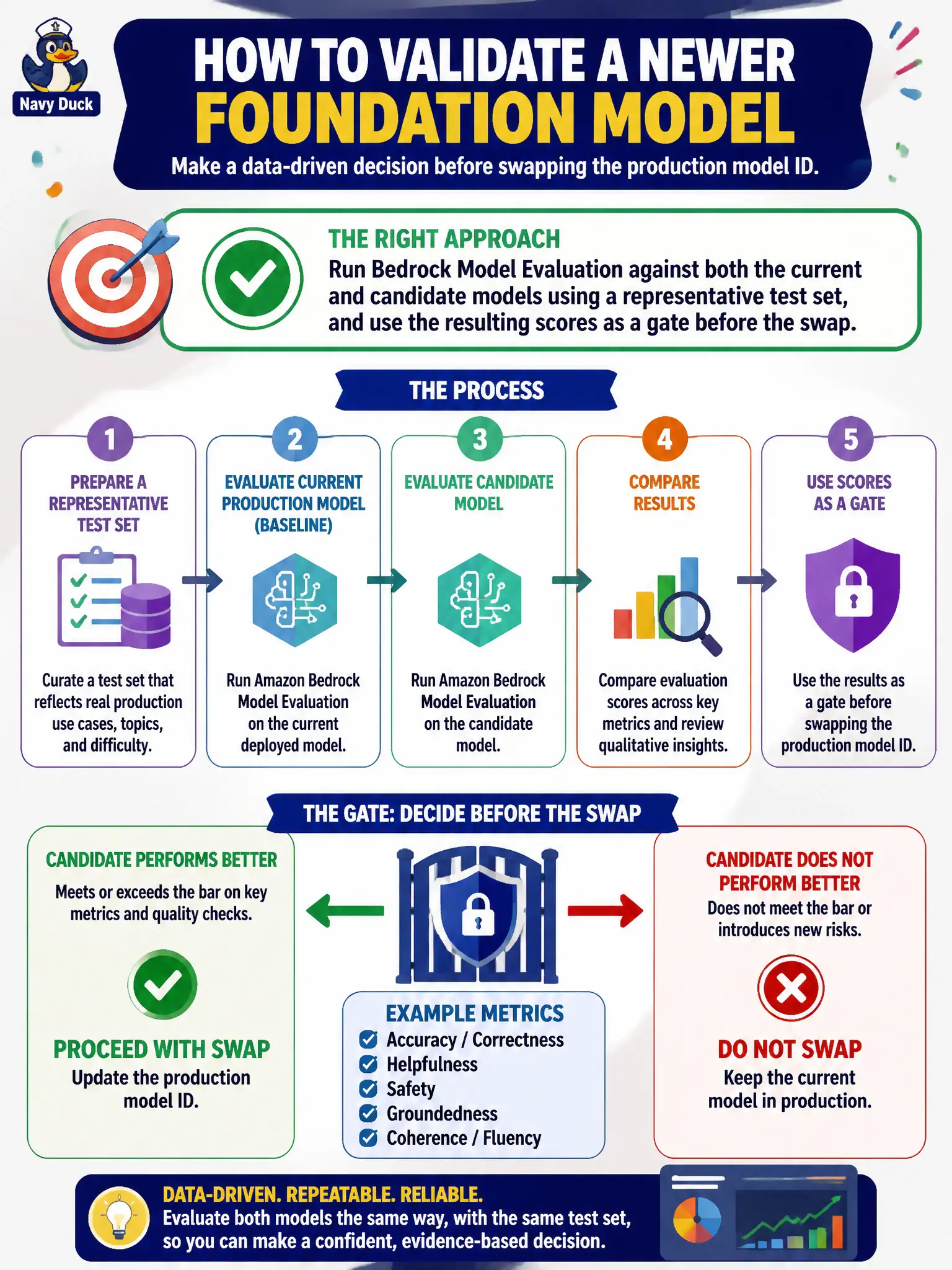
Trusting a published, general benchmark to predict how a model behaves on your own district's content is a bit like judging a chef by someone else's restaurant review instead of tasting the food. Running Bedrock Model Evaluation against both models with a test set built from actual district content gives a direct, comparable basis for the swap decision. That's a real gate, not a guess dressed up as due diligence.
Full Explanation
Running Bedrock Model Evaluation against both the current and candidate models using a representative test set produces comparable, quantified scores on the specific task and content the district cares about, giving the team an evidence-based gate to clear before swapping the production model ID. Swapping first and watching for a support-ticket spike inverts the safety order: district content gets evaluated live against real users, with problems only discovered after the fact rather than before the swap. A single staff member's informal thumbs-up or thumbs-down is subjective, covers a handful of prompts, and doesn't scale to catching edge cases a representative test set would surface. Comparing published general-purpose benchmark scores shows how each model performs on generic, public tasks, which may not reflect how either model handles district-specific content review, terminology, or formatting. Scope caveat: even a passing evaluation score is a point-in-time signal, so the swap decision should also account for how the evaluation test set will be kept current as district content evolves. A concrete operational check: confirm the evaluation test set includes actual district document samples, not just generic public prompts, before trusting the comparison.