
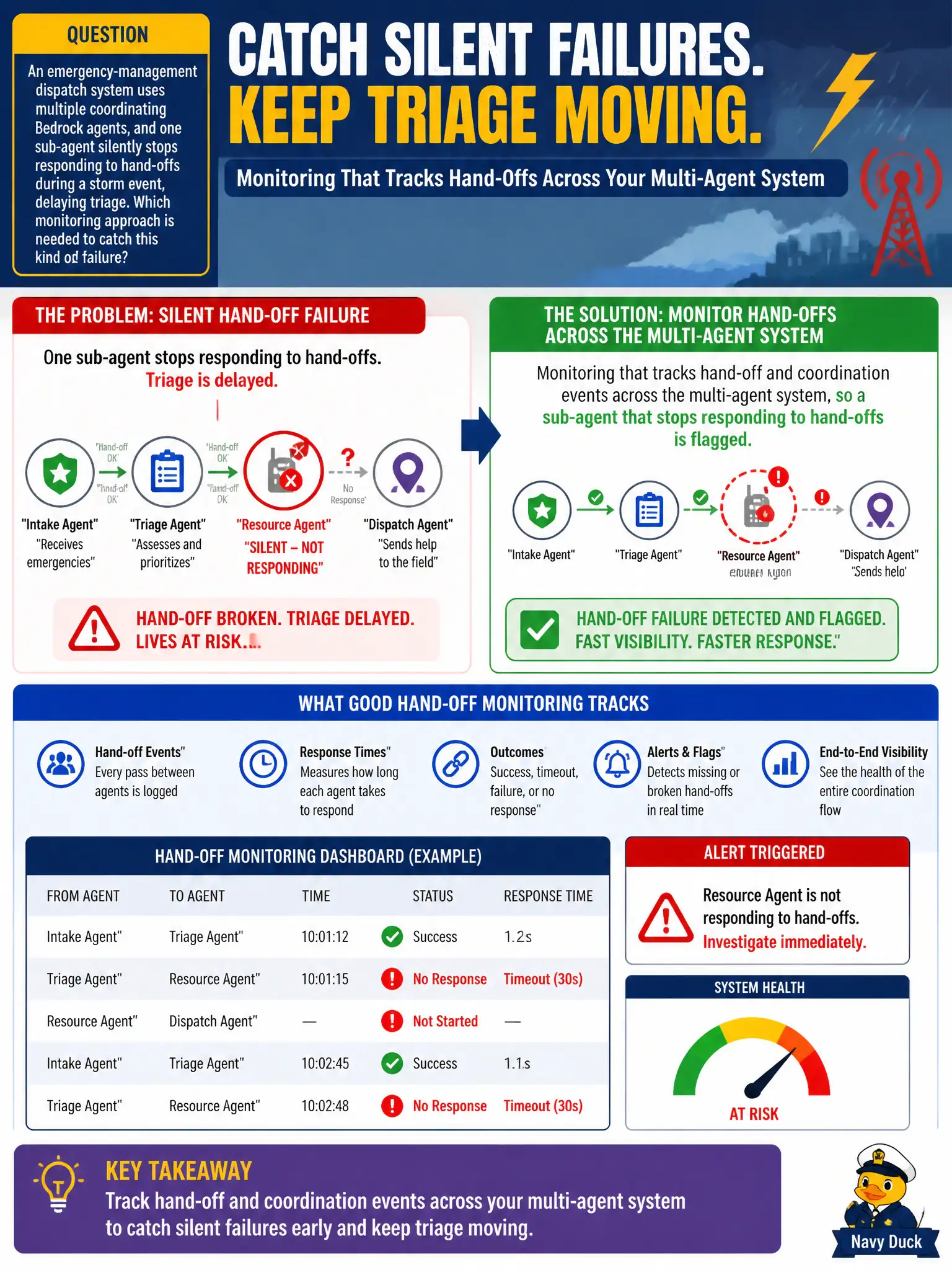
An emergency-management dispatch system uses multiple coordinating Bedrock agents, and one sub-agent silently stops responding to hand-offs during a storm event, delaying triage. Which monitoring approach is needed to catch this kind of failure?
Select an answer to reveal the explanation.
Short Explanation
Think of multi-agent coordination like a bucket brigade; checking that every firefighter is still standing doesn't tell you the bucket stopped moving between two of them. Monitoring the hand-offs themselves catches a sub-agent that's alive but has gone silent on its part of the relay. That's a different failure than a single agent simply being down.
Full Explanation
Coordination-level monitoring tracks the hand-off events between agents, whether a sub-agent acknowledges, processes, and returns a hand-off within an expected window, which is the way to detect a sub-agent that's technically running but has stopped participating in the workflow, exactly the failure described here. A per-agent health check that confirms an endpoint responds to a direct ping can pass cleanly even while that same agent ignores hand-offs from its peers, since responding to a health probe and responding to a coordination request are different code paths. Aggregate token usage across the agent fleet combines healthy and unhealthy agents into one number, so a single silent sub-agent barely moves the total and gets buried in the noise. Overall average end-to-end response time is diluted the same way, since many requests may not route through the stalled sub-agent, keeping the average deceptively normal. Scope caveat: coordination monitoring needs to be paired with clear timeout expectations for each hand-off type, since 'silent' and 'slow' look similar without a defined threshold. A concrete operational check: during the storm-event window, pull the hand-off log for the affected sub-agent and confirm where the acknowledgment chain actually broke.