
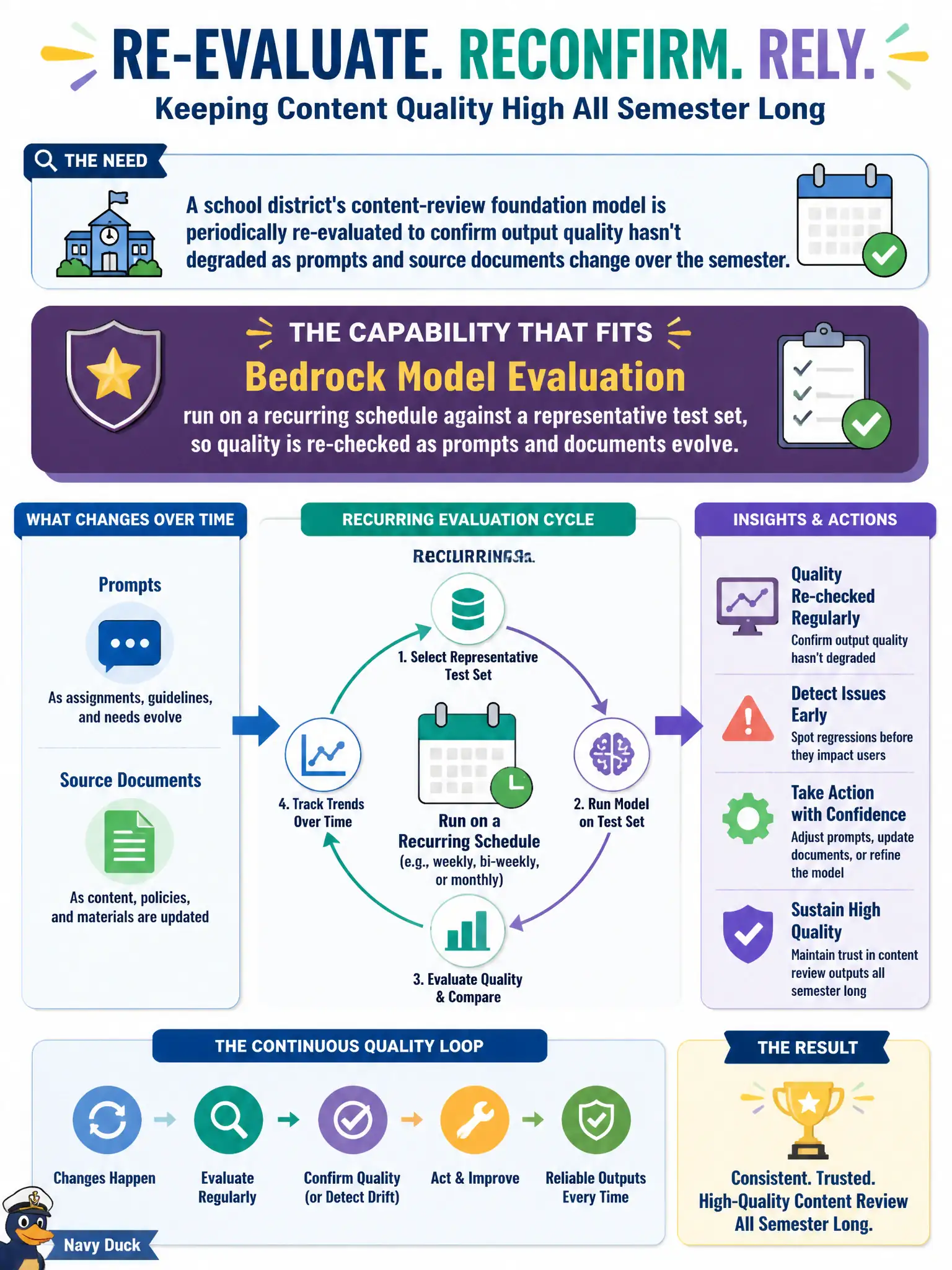
A school district's content-review foundation model is periodically re-evaluated to confirm output quality hasn't degraded as prompts and source documents change over the semester. Which capability fits this recurring re-evaluation need?
Select an answer to reveal the explanation.
Short Explanation
Quality checks that happen once at launch are like a health checkup never repeated; fine at the time, not so useful six months later. Running Bedrock Model Evaluation on a recurring schedule against a representative test set means quality gets re-checked every time prompts and source documents shift, not just on day one. That's the difference between a snapshot and an ongoing habit.
Full Explanation
Recurring evaluation runs re-score the model against a representative test set on a schedule, catching quality regressions caused by prompt changes, source-document drift, or subtle model behavior shifts over the semester, the exact scenario here, where nothing about the deployment changed but the inputs did. A one-time benchmark documents a starting point but says nothing about quality months later, since it's never rerun. Ad hoc manual review triggered by a raised concern is reactive by design; it depends on someone noticing a bad output first, defeating the purpose of catching degradation proactively. A cost report on inference call volume measures usage and spend, not output quality, so it can't detect that the review model's judgments have gotten worse. Scope caveat: recurring evaluation is only as good as the representativeness of its test set, so the set needs periodic refreshing itself as the semester's source documents change, or the evaluation keeps testing against stale examples. A concrete operational check: confirm the evaluation test set was updated to include this semester's document types before trusting a passing score.