
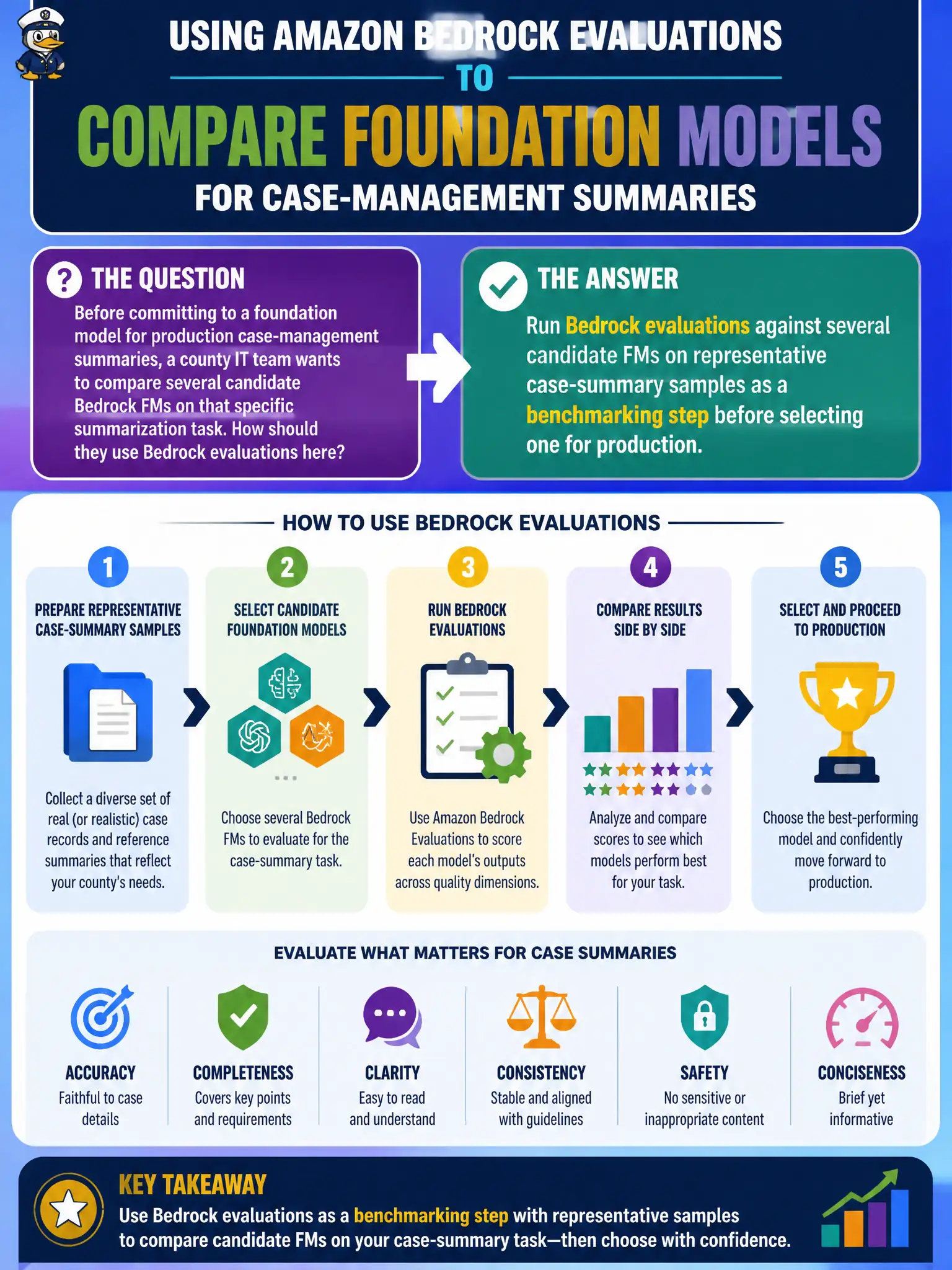
Before committing to a foundation model for production case-management summaries, a county IT team wants to compare several candidate Bedrock FMs on that specific summarization task. How should they use Bedrock evaluations here?
Select an answer to reveal the explanation.
Short Explanation
Choosing an FM without testing it on your own task is like hiring someone off a resume alone. Bedrock evaluations let the team run each candidate against real case-summary samples and compare results side by side before anyone commits. That turns FM selection into a benchmarking exercise instead of a guess.
Full Explanation
Bedrock evaluations let a team score multiple candidate foundation models against the same representative dataset and task-specific criteria, producing comparable results that support a selection decision before any model reaches production. Using the largest model as a proxy for quality mistakes model scale for task fit; a bigger FM is not guaranteed to summarize county case records better, and the only way to know is to test it on that specific task. Deploying first and evaluating afterward inverts the purpose of benchmarking: by then the county has already committed engineering effort and citizen-facing risk to a choice that evaluation was supposed to inform. Waiting for complaints turns evaluation into incident response rather than a preventive step, and it means the first people to notice a bad model are the residents it's meant to serve. Scope note: benchmark results reflect the sample data used, so refresh the evaluation set periodically as case types shift. Operational check: confirm the evaluation dataset includes edge-case records (multi-language filings, unusually short or long cases) before trusting the comparison.