
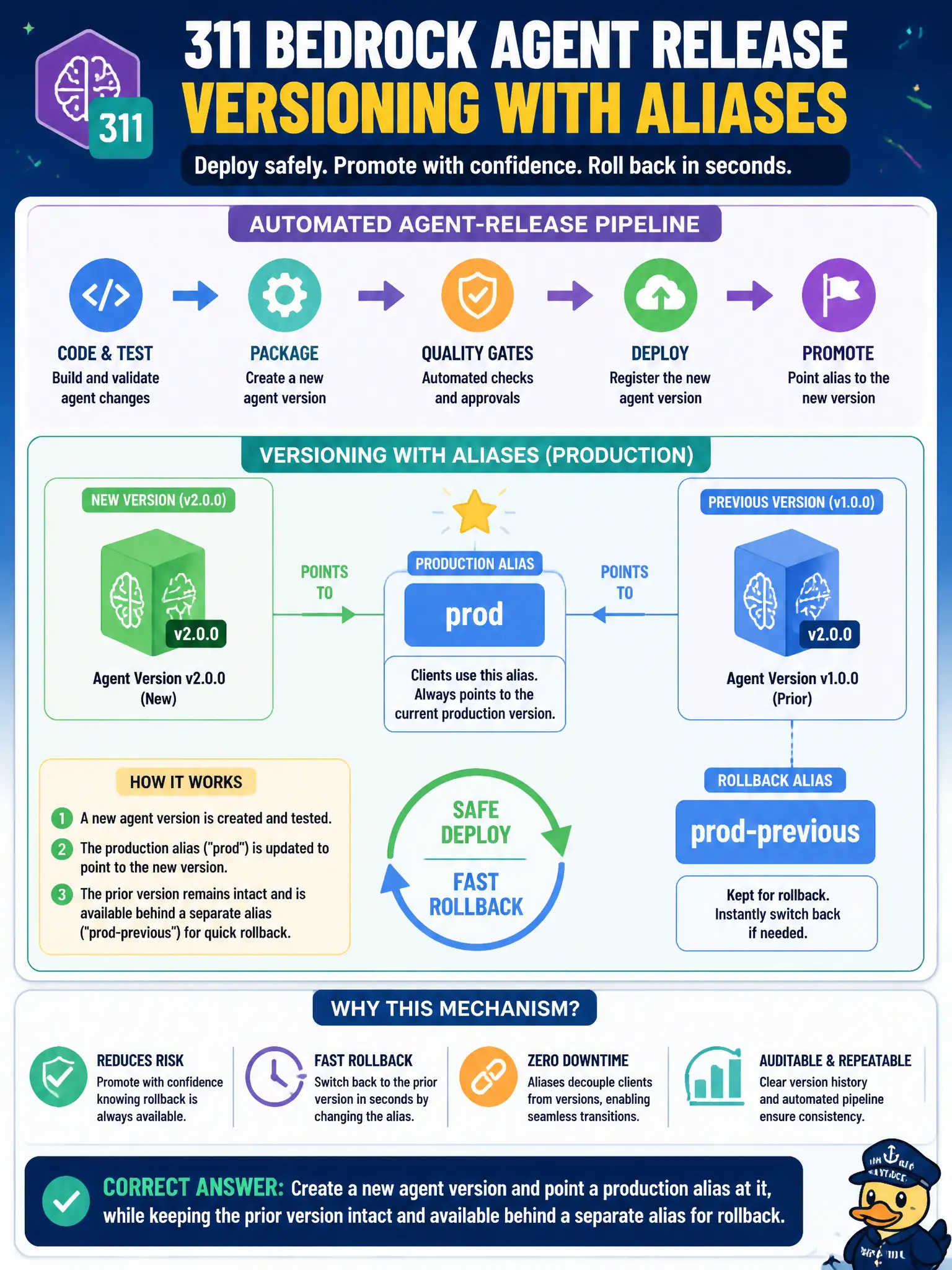
A 311 Bedrock agent needs a new version promoted to production behind an alias, while the previous version stays available so the team can roll back if needed, as part of an automated agent-release pipeline. Which mechanism supports this?
Select an answer to reveal the explanation.
Short Explanation
Overwriting an agent in place is like repainting over a mural with no photo of the original — if the new version has a problem, there's nothing left to go back to. Creating a new agent version and pointing a production alias at it, while the old version stays intact under its own alias, keeps a genuine fallback in place: pointing the alias back is all rollback takes.
Full Explanation
Bedrock agents support versioning, where each version is a distinct, immutable snapshot of the agent's configuration, and aliases act as pointers that can be moved between versions — so promoting a new version means creating it and repointing the production alias, while the prior version remains available and can be restored by simply repointing the alias back to it. Overwriting the agent definition in place destroys the very thing rollback depends on: a distinct, preserved prior version to fall back to. A manual configuration export as a backup file has no built-in mechanism tying it to a live, addressable version the running system can switch to — restoring from it would require manual reconstruction rather than a quick alias change. Deploying a completely separate agent under a new name for every change avoids overwriting the old one, but it abandons the alias mechanism entirely and pushes the coordination burden onto every client integration, which now has to be manually updated each release. Scope caveat: rollback via alias repointing only restores the agent's own configuration — any downstream resources the new version introduced (like a new action-group function) may need separate handling during rollback. Operational check: after promoting a new version, confirm the rollback path works by repointing the alias to the prior version in a test environment and verifying it responds as it did before.