
A water utility's anomaly-detection model needs to retrain automatically once monitoring detects that incoming usage data has drifted meaningfully from the training distribution, without anyone manually starting the job. Which design achieves this?
Select an answer to reveal the explanation.
Short Explanation
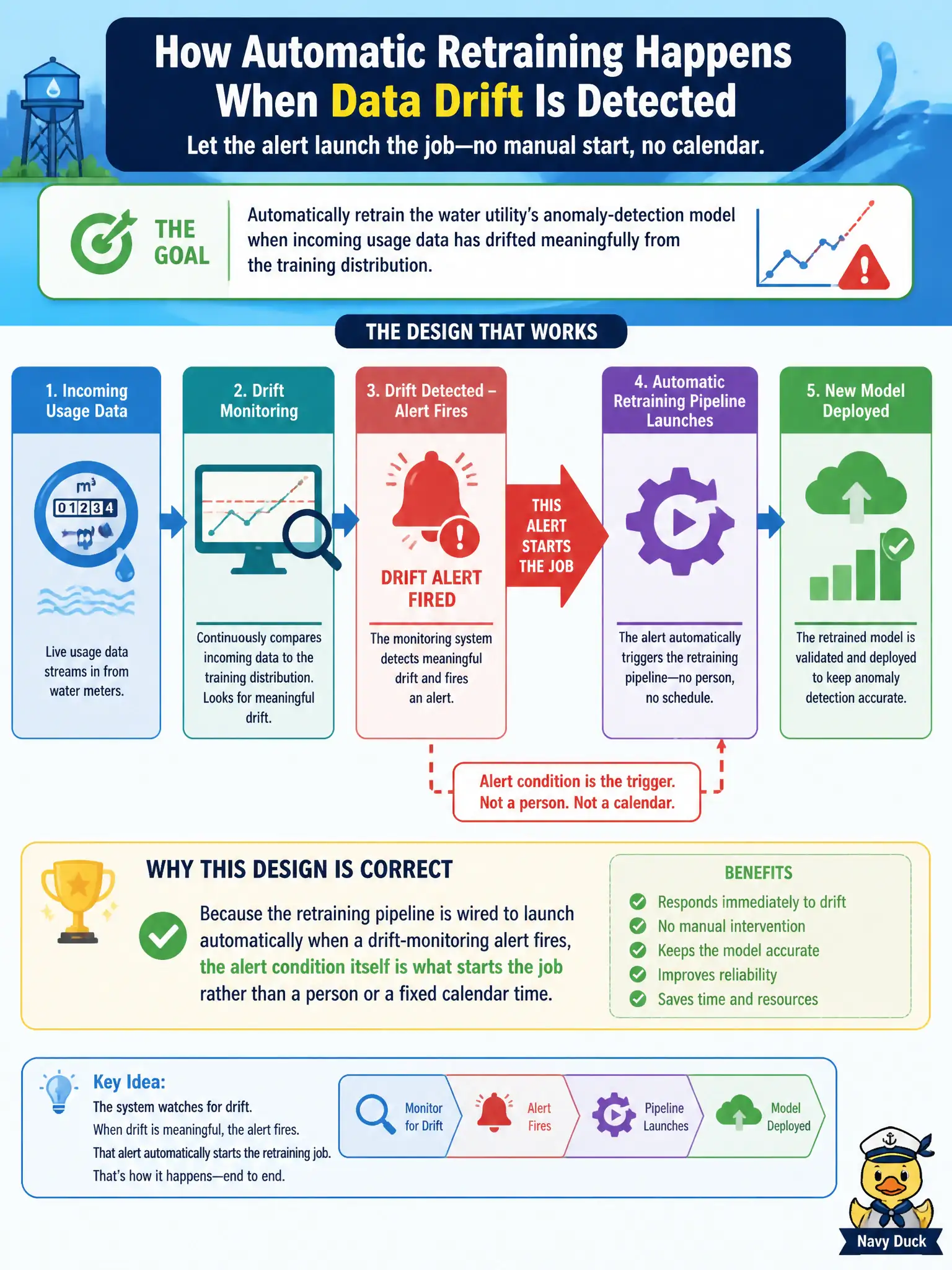
Waiting for someone to notice a drift alert and remember to start a retraining job is like relying on a driver to glance at a low-fuel light instead of the car doing anything about it. Wiring the retraining pipeline so the drift alert itself is the trigger — no person required — is what actually closes the loop between detecting a problem and doing something about it.
Full Explanation
An automated retraining trigger connects a drift-detection signal directly to pipeline execution, so the moment monitoring determines that incoming data has meaningfully diverged from the training distribution, that condition itself launches the retraining job without a person deciding to start it. Manual weekly checks introduce both a delay (drift can develop and persist for days before the next check) and a dependency on someone remembering to look, which defeats the point of having automated drift detection in the first place. A fixed nightly retraining schedule ignores whether drift has actually occurred, so it either retrains unnecessarily on data that hasn't meaningfully changed, wasting compute, or fails to react quickly if drift happens mid-cycle and the utility waits for the next scheduled run. Sending an alert to a messaging channel improves visibility but stops short of automation — the actual retraining still depends entirely on a person reading the message and choosing to act on it. Scope caveat: an automatically triggered retraining job should still go through the normal evaluation and approval gates before its output is promoted, so drift detection starts retraining but doesn't bypass quality checks. Operational check: simulate a drift condition in a test environment and confirm the retraining pipeline launches on its own without any manual trigger.