
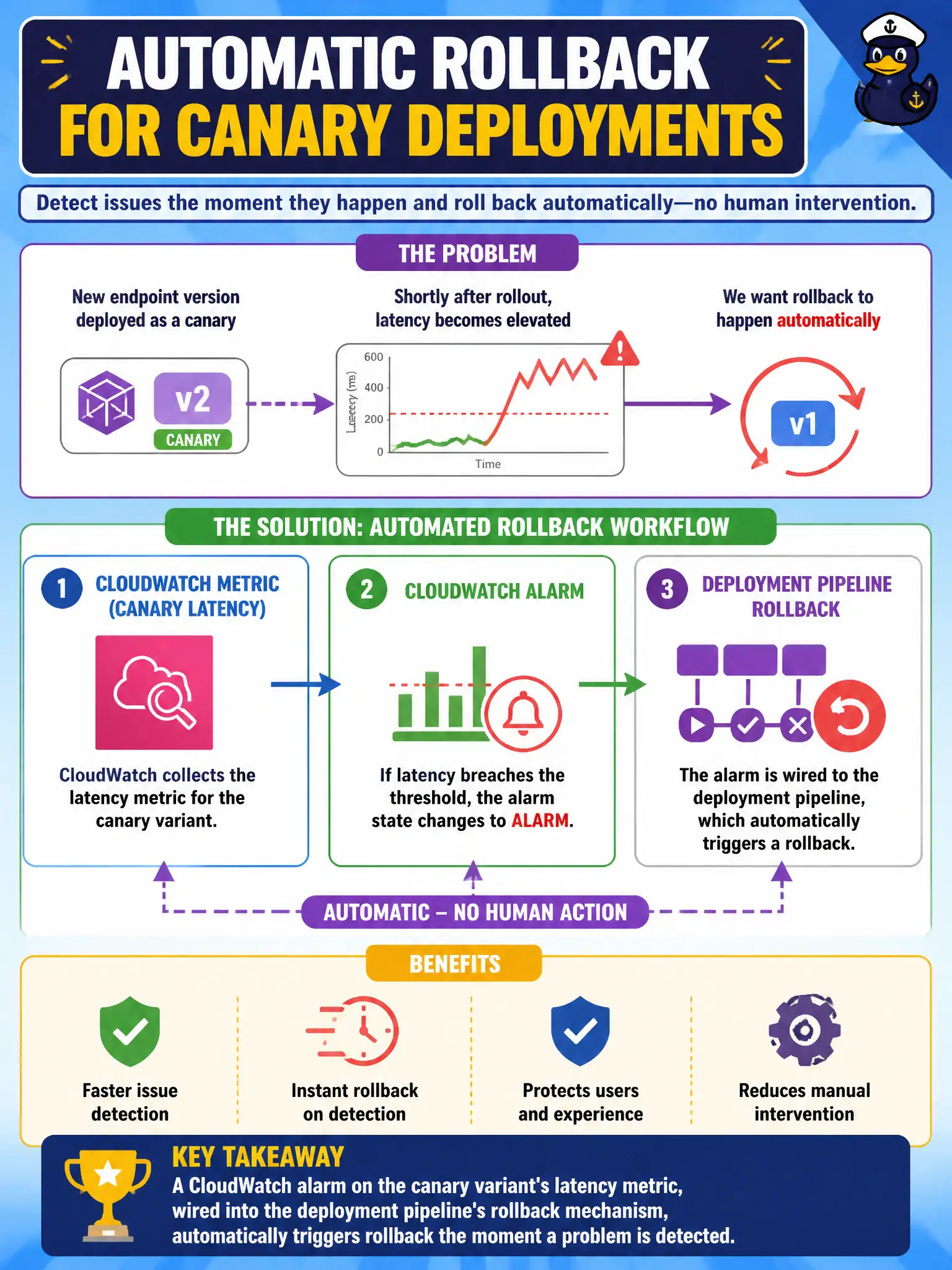
A 311 assistant's new endpoint version, deployed as a canary, starts showing elevated latency shortly after rollout. The team wants the rollback to happen automatically the moment the problem is detected, rather than depending on someone noticing and intervening manually. Which mechanism achieves this?
Select an answer to reveal the explanation.
Short Explanation
Waiting for a person to notice a latency spike and roll it back by hand is a lot like waiting for a smoke detector to be someone glancing at the ceiling — it might work, but only if the timing lines up. Wiring a CloudWatch alarm on the canary's latency metric directly into the pipeline's rollback step means the system reacts the instant the threshold is breached, no glance required.
Full Explanation
Automated rollback requires the alarm condition and the rollback action to be connected programmatically: a CloudWatch alarm continuously evaluates the canary variant's latency metric against a threshold, and when the deployment pipeline is configured to watch that alarm's state, a breach triggers the rollback step automatically as part of the deployment mechanism itself. A scheduled review meeting introduces a delay measured in days, during which residents keep experiencing degraded latency — it's detection without automation and far too slow for an active incident. A dashboard, no matter how well designed, still depends on a person watching it at the right moment and then manually initiating the rollback, which is the exact single point of failure the team is trying to remove. An email alert improves on silence but still ends in a manual follow-up step; the alert notifies, it doesn't act, so the rollback still waits on someone reading and responding to it. Scope caveat: the latency threshold on the alarm should reflect a level that genuinely indicates degraded service, not routine variance, or automated rollbacks can fire on noise. Operational check: intentionally introduce elevated latency in a test canary deployment and confirm the alarm state change actually triggers the pipeline's rollback step without any manual action.