
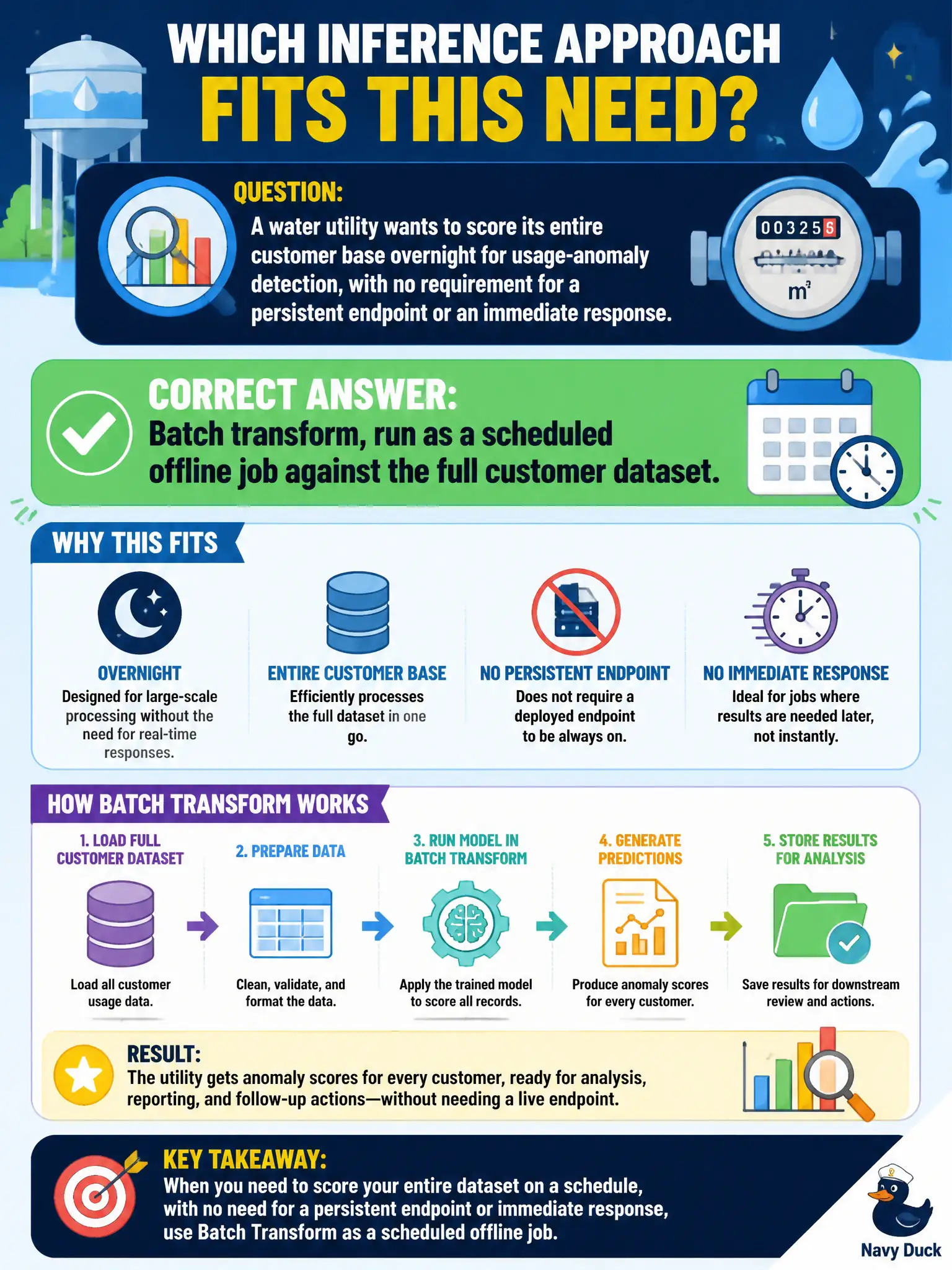
A water utility wants to score its entire customer base overnight for usage-anomaly detection, with no requirement for a persistent endpoint or an immediate response. Which inference approach fits this need?
Select an answer to reveal the explanation.
Short Explanation
Scoring an entire customer base with no one waiting on an answer is a batch job, plain and simple — there's no reason to keep an endpoint standing by for it. Batch transform spins up compute, works through the whole dataset, and shuts back down when it's done. You only pay for the hours the job actually runs.
Full Explanation
Batch transform is purpose-built for exactly this shape of workload: it takes a full dataset, runs inference across it as one offline job, and tears down the compute when finished, with no standing endpoint required and no per-request latency expectation to meet. Leaving a real-time endpoint running overnight keeps compute provisioned and billed the whole time even though nothing needs an immediate response, which is the exact cost waste a persistent endpoint creates for offline workloads. A serverless endpoint invoked once per customer record turns one dataset-wide job into thousands of individual invocations, adding per-call overhead and losing the efficiency of processing the dataset as a single batch. Asynchronous inference is built for large or slow individual requests that still need a per-request completion signal, which adds unnecessary queuing and notification machinery to a job that's really one scheduled sweep over the whole customer base rather than many discrete interactive requests. Scope note: batch transform output still needs a downstream process to flag anomalies and route them to utility staff. Operational check: confirm the batch job's runtime stays within the overnight maintenance window as the customer base grows.