
A municipal permitting office trains a resident-facing chatbot on historical request transcripts, and a bias metric shows most training examples originated from a single council district. What should the team do to correct this imbalance before continuing model development?
Select an answer to reveal the explanation.
Short Explanation
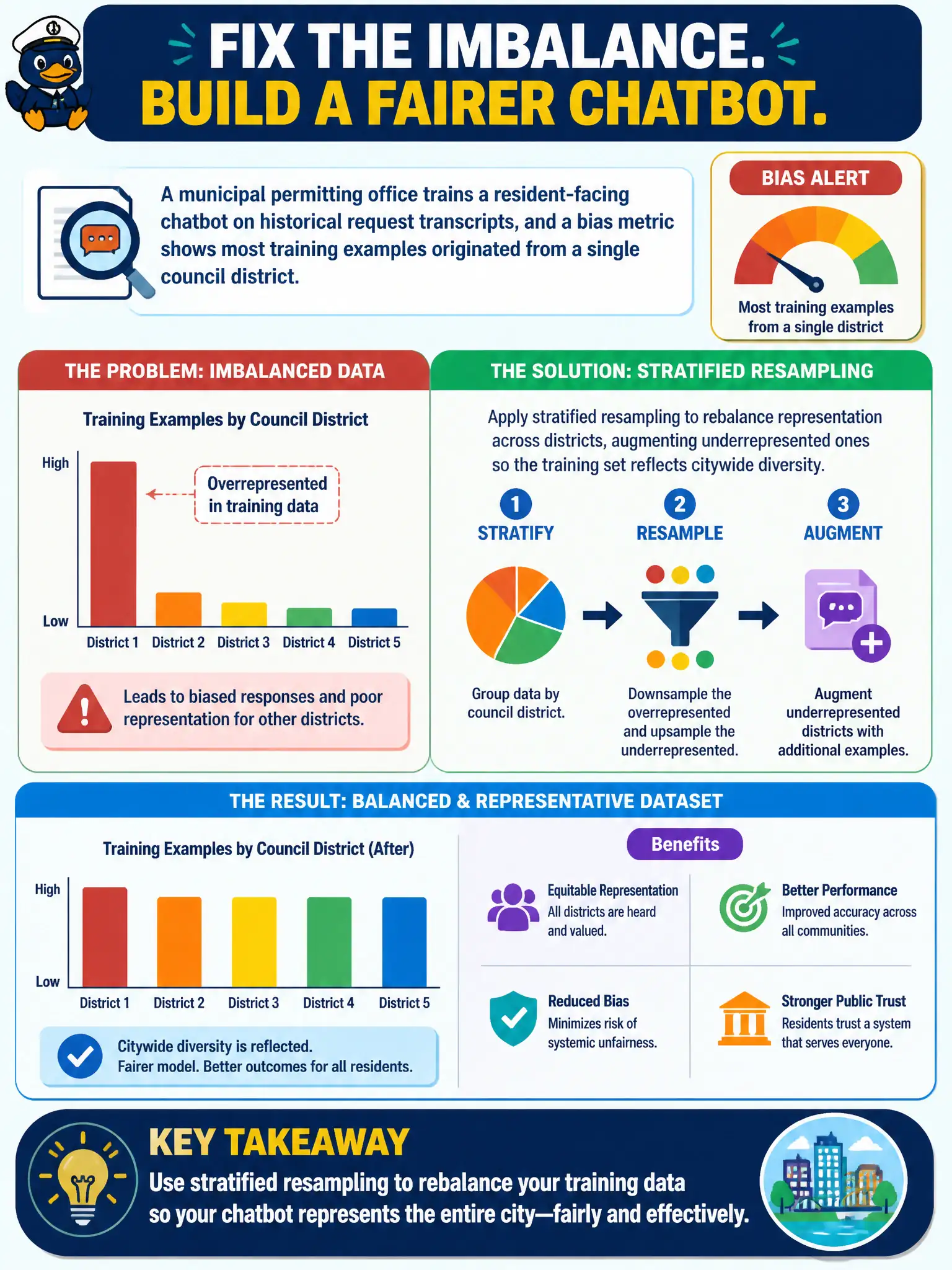
Think of training data like a jury pool: if one neighborhood fills most of the seats, the verdicts start reflecting that neighborhood instead of the whole city. Stratified resampling reshuffles the pool so every district gets fair representation before the model ever sees a training batch. It's a data fix, not a training-loop fix — no epoch count or learning rate can rebalance a skewed sample.
Full Explanation
Geographic representation bias means the model's learned patterns are pulled toward the majority district's language, request types, and outcomes, which degrades accuracy for everyone else. Stratified resampling — oversampling underrepresented districts, undersampling or augmenting as needed — restores a distribution that mirrors the population the chatbot actually serves, and it happens at the dataset stage, before any training run. Adjusting epoch count only changes how many times the model iterates over the same skewed distribution, so the imbalance compounds rather than resolves. Learning rate governs how aggressively weights update per step; it has no mechanism for correcting which examples are present in the first place. Deleting the majority district's records looks like balance but destroys real signal and shrinks the dataset. A useful scope caveat: resampling fixes representation, not necessarily the quality of labels within each district, so pair it with a quality check. Operationally, recompute the bias metric per district after resampling and confirm the skew has narrowed before moving to feature engineering.