
A document-understanding assistant for permit applications needs to answer questions using both the scanned permit-form images and their OCR-extracted text, along with metadata like permit type. During data preparation, what is essential to preserve so retrieval and generation work correctly at query time?
Select an answer to reveal the explanation.
Short Explanation
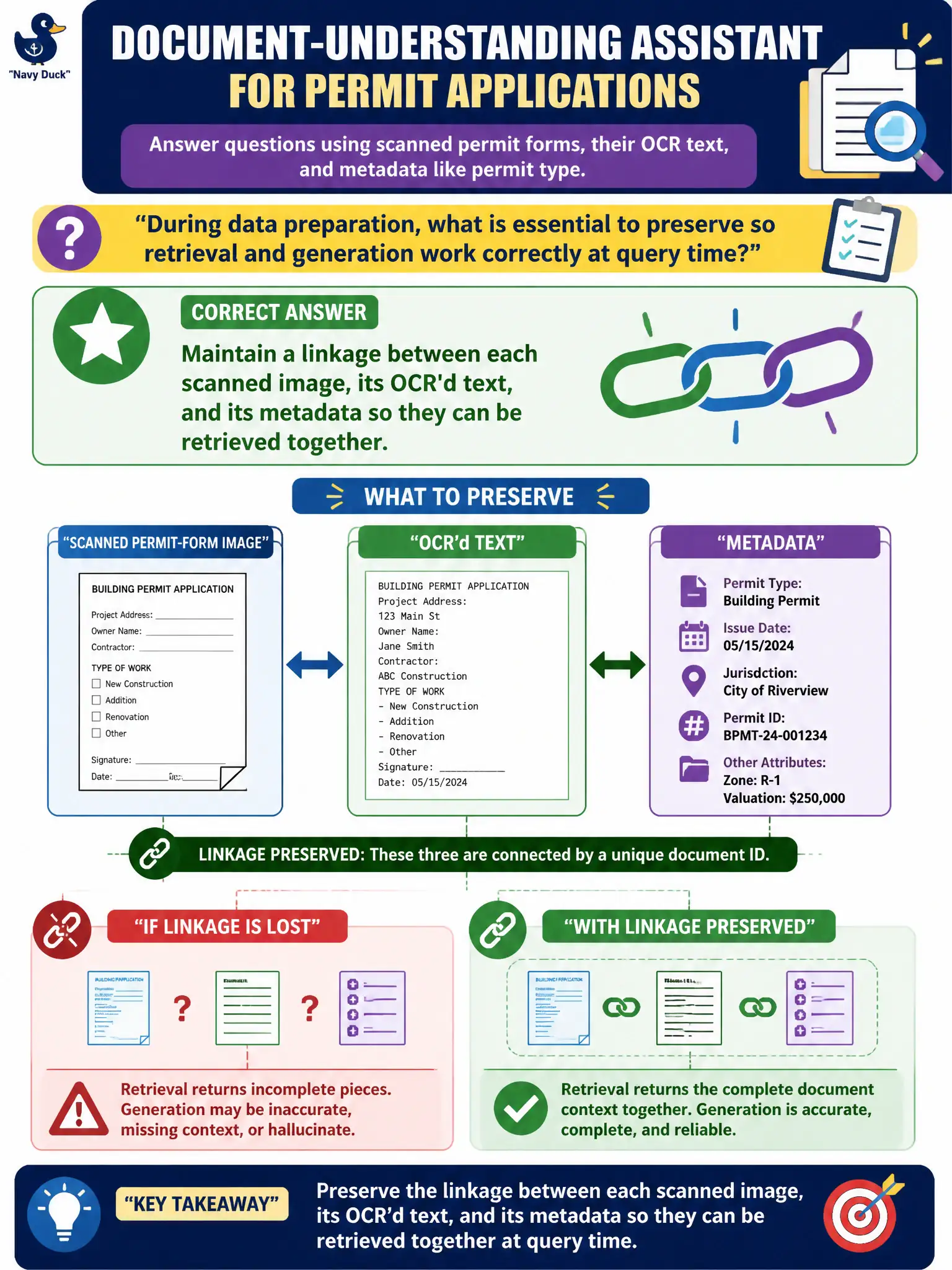
Keep the photo, its caption, and its file tag stapled together instead of tossing them into three separate unlabeled piles. That linkage is what lets the assistant pull the right image, text, and metadata back as one unit when a resident asks a question.
Full Explanation
Mechanism: a multimodal RAG pipeline needs each scanned image, its corresponding OCR'd text, and its metadata to stay linked through a shared identifier, so that when the text embedding is retrieved for a query, the system can also pull the associated image and metadata to ground and enrich the generated answer, breaking that linkage breaks the pipeline's ability to reference the source document as a coherent unit. Why the wrong options fail by concept: discarding the original images after OCR eliminates the visual grounding the assistant needs when a question depends on something the OCR text alone can't capture, like a form's layout or a handwritten annotation. Merging all permit forms into a single document before OCR destroys the per-document boundaries and metadata association that retrieval depends on, making it impossible to trace a retrieved passage back to its specific permit and permit type. Converting OCR text into a standardized numeric feature vector describes tabular numeric feature engineering, not how text is prepared for embedding-based retrieval in a RAG system, and it would strip the text of its usable form. Scope caveat: OCR accuracy varies with scan quality, and garbled OCR text degrades retrieval even when the linkage to the image and metadata is preserved correctly. Operational check: retrieve a sample permit record by its query and confirm the returned result includes the matching image, OCR text, and metadata together, not just one component in isolation.