
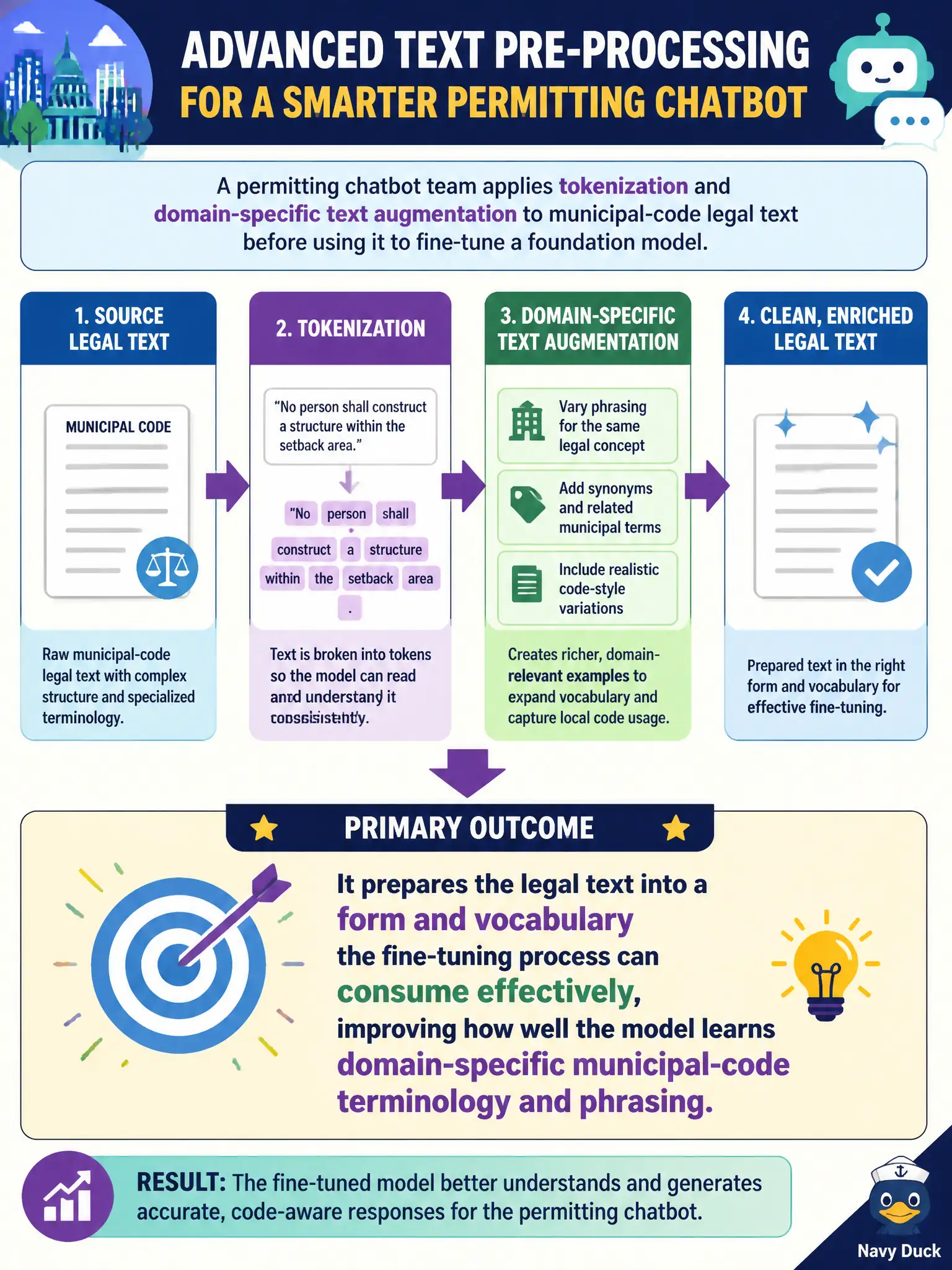
A permitting chatbot team applies tokenization and domain-specific text augmentation to municipal-code legal text before using it to fine-tune a foundation model. Which outcome is this advanced text pre-processing step primarily intended to achieve?
Select an answer to reveal the explanation.
Short Explanation
Think of tokenization and domain augmentation like teaching someone courtroom jargon before they sit in on a trial: you're shaping the vocabulary they'll actually hear. That prep shapes municipal-code text into a form the fine-tuning process can learn from, so the model picks up the domain's terminology instead of stumbling over it.
Full Explanation
Tokenization breaks text into the units a model's vocabulary can represent, and domain-specific augmentation (paraphrasing, synonym variation, structural examples drawn from municipal-code language) expands and shapes the training set so a fine-tuning process sees enough varied, representative examples of legal and regulatory phrasing to learn it, rather than treating unfamiliar terminology as rare or out-of-vocabulary tokens. Describing this step as replacing the embedding step confuses two different pipeline stages — tokenization prepares text for a model to consume during training, while embedding generation (for retrieval or as part of a model's own input layer) is a separate transformation with a different purpose; one doesn't substitute for the other. Claiming it removes the need for human review of legal accuracy overstates what text pre-processing can guarantee — better training data improves how well a model learns patterns, it does not eliminate the risk of a fine-tuned model producing an inaccurate or misleading answer on a legal question, which still needs human oversight given the stakes. Claiming the fine-tuned model will outperform the base model on downstream tasks well beyond its training domain misunderstands what domain-specific fine-tuning does — it specializes a model toward the fine-tuning domain, and that specialization does not reliably transfer to unrelated tasks the model wasn't tuned for. Scope note: augmentation should preserve legal meaning precisely; a paraphrase that subtly changes a regulatory requirement could train the model on incorrect information. Operational check: have a subject-matter reviewer spot-check a sample of augmented training examples against the original municipal-code text for factual and legal accuracy before fine-tuning begins.