
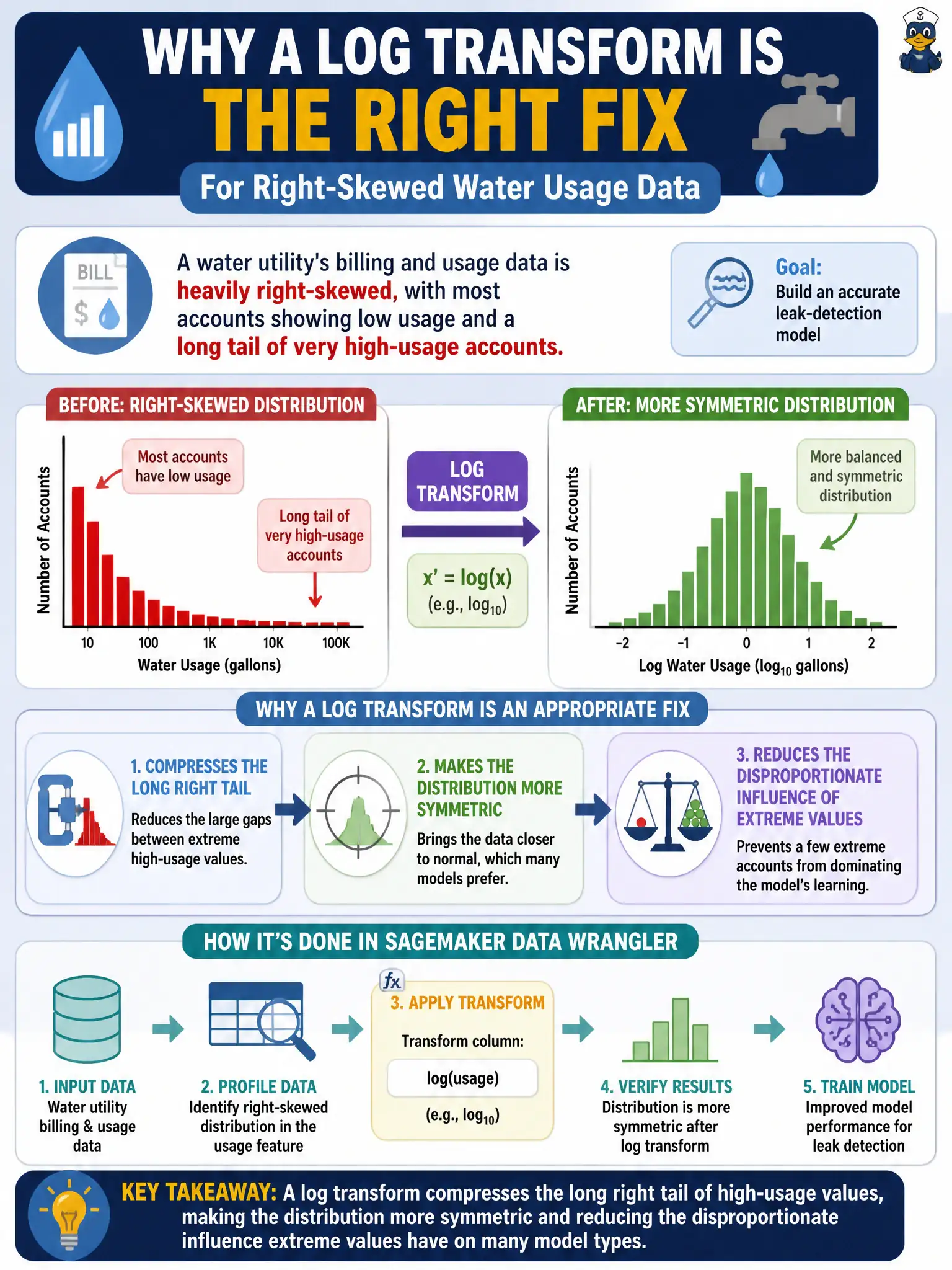
A water utility's billing and usage data is heavily right-skewed, with most accounts showing low usage and a long tail of very high-usage accounts. The team applies a log transform to this feature in a SageMaker Data Wrangler flow before training a leak-detection model. Why is a log transform an appropriate fix here?
Select an answer to reveal the explanation.
Short Explanation
Think about a handful of mansions sitting next to hundreds of small houses on a street — if you're describing typical usage, those mansions can drag the average way off from what most households actually look like. A log transform squashes that long tail down, so the huge outliers stop dominating the picture and the bulk of ordinary accounts become easier for the model to learn from. It reshapes the distribution, it doesn't throw away or hide the high-usage accounts.
Full Explanation
A log transform compresses large values proportionally more than small ones, which pulls in a long right tail and makes a heavily skewed distribution closer to symmetric — that matters because many model types, particularly linear and distance-based models, are sensitive to extreme values dominating the loss function or distorting learned relationships, so reducing that disproportionate pull tends to improve training stability and generalization. Turning usage into a categorical feature is a different transformation (binning) with a different purpose — grouping into interpretable ranges — and it isn't what a log transform does; log transforms keep the feature continuous while reshaping its distribution. Removing high-usage accounts entirely is data deletion, not a distribution transform, and for a leak-detection model specifically, high-usage accounts are exactly the population most likely to contain the leaks the model is trying to catch — dropping them would remove the signal the model needs to learn. Describing the fix as rescaling to a fixed 0-to-1 range confuses log transforms with min-max normalization; normalization changes the range of values without addressing skew, while a log transform changes the shape of the distribution itself, which is the actual problem here. Scope note: a log transform requires strictly positive values, so zero-usage accounts need an adjustment, such as log(x+1), before applying it. Operational check: plot the usage feature's distribution before and after the log transform to confirm the skew has visibly reduced before proceeding to training.