
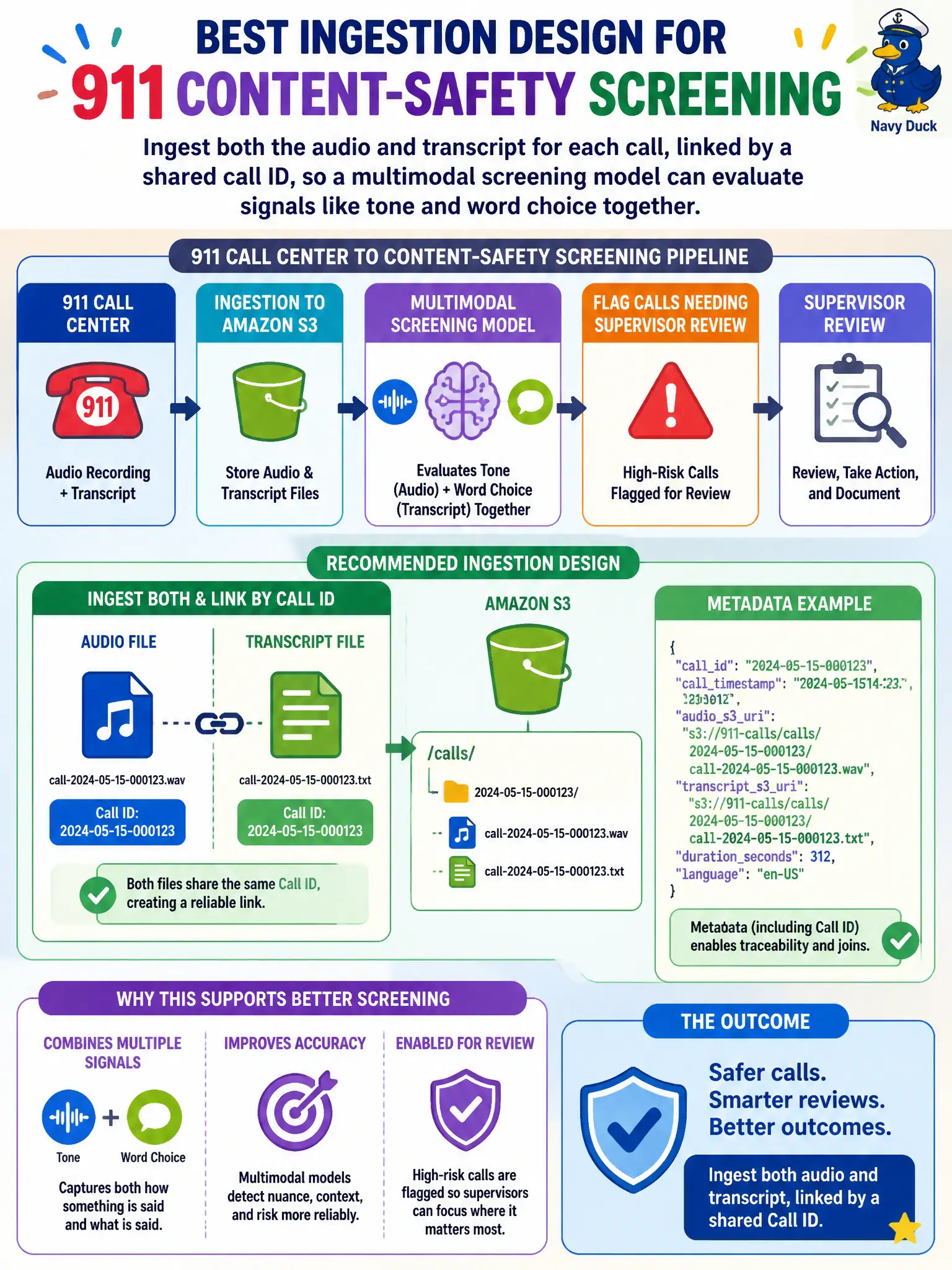
A 911 call center ingests audio recordings and their transcripts into Amazon S3 to feed a multimodal content-safety screening pipeline that flags calls needing supervisor review. Which ingestion design best supports this downstream screening step?
Select an answer to reveal the explanation.
Short Explanation
Think about how you'd judge a heated phone call yourself — the words matter, but so does the tone of voice, and you'd want both before deciding it needs a supervisor's attention. A multimodal screening model works the same way: it needs the audio and the transcript together, linked by a shared call ID, to weigh signals like tone alongside word choice. Split them apart or drop one modality, and the model is left guessing with half the picture.
Full Explanation
A multimodal content-safety screening model is designed to combine signals from more than one modality — acoustic cues like tone, volume, and stress in the audio alongside word choice and phrasing in the transcript — so ingesting both, tied together by a shared call ID, gives the model the paired input it needs to make that combined judgment. Relying on transcripts alone discards the acoustic signal entirely, and tone or distress in a caller's voice can carry safety-relevant information that the words alone don't capture, which undercuts the premise of using a multimodal model in the first place. Storing audio and transcripts in separate buckets with unrelated key structures breaks the very linkage the screening pipeline needs to pair them per call; without a reliable join key, the pipeline either can't combine modalities or has to reconstruct the pairing after the fact, adding risk of misalignment. Discarding the original waveform after converting to spectrograms removes a reprocessing option — if the screening model or its input representation changes later, or a flagged call needs human audio review, the raw waveform is what a reviewer actually needs to listen to. Scope note: retention policy for raw 911 audio should follow the department's existing records-retention rules, not just pipeline convenience. Operational check: confirm a sample of call IDs resolve to exactly one audio file and one transcript each before the screening pipeline goes live.