
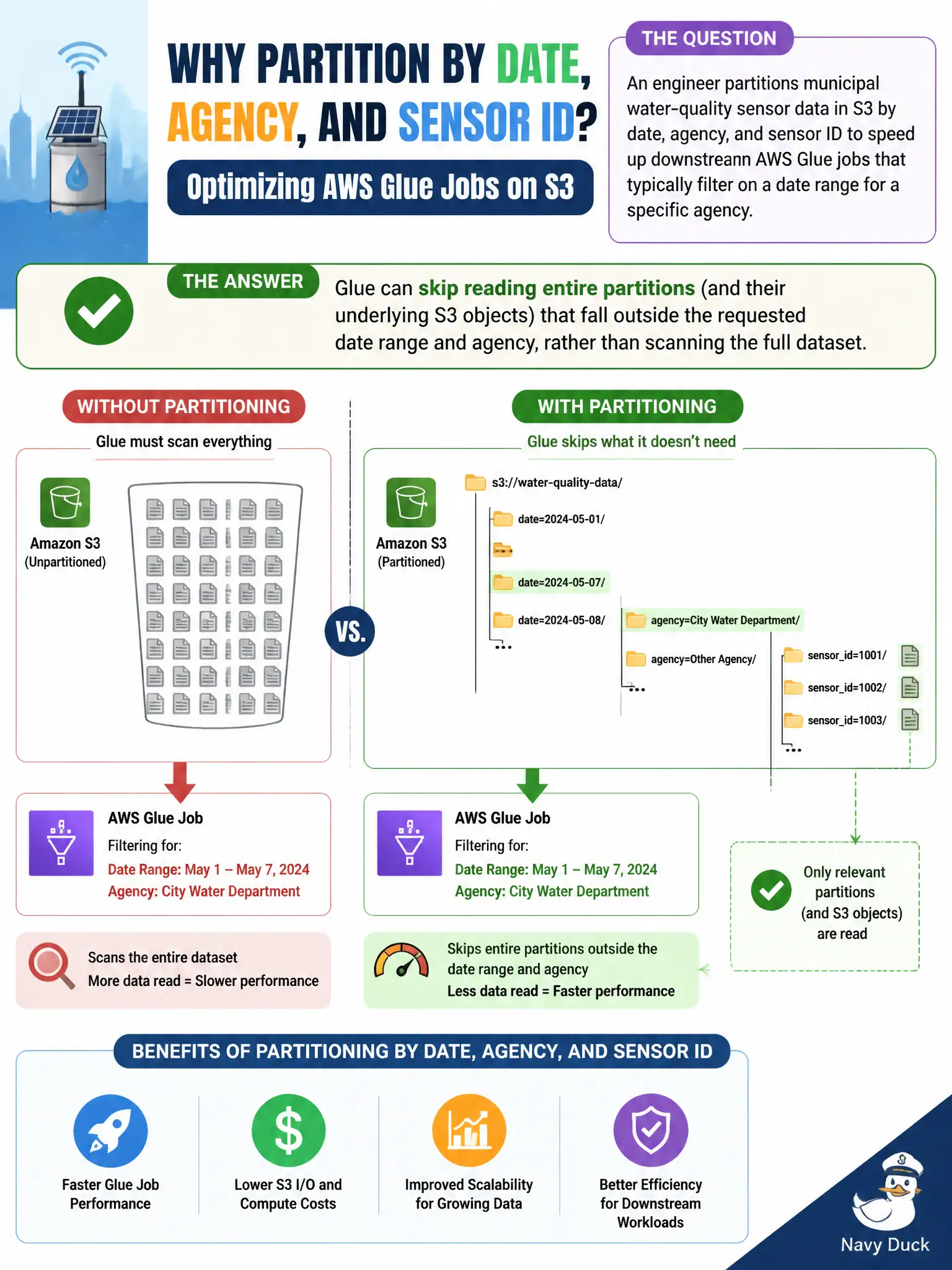
An engineer partitions municipal water-quality sensor data in S3 by date, agency, and sensor ID to speed up downstream AWS Glue jobs that typically filter on a date range for a specific agency. Why does this partitioning scheme improve Glue job performance?
Select an answer to reveal the explanation.
Short Explanation
Think of the partitions like labeled drawers in a filing cabinet — 2026, Water Bureau, Sensor 12 — so when a Glue job only needs one agency's March records, it opens just that drawer instead of dumping the whole cabinet onto the floor. Partition pruning lets Glue skip the S3 objects outside the matching date and agency entirely. That's a scan-avoidance trick, not compression or a format change.
Full Explanation
Partitioning data by fields commonly used in filters — here, date and agency — lets Glue's partition pruning identify which S3 prefixes correspond to the query's filter conditions and skip reading every object outside those prefixes, which directly cuts scanned bytes and job runtime for the common date-range-plus-agency query pattern. Crediting the speedup to automatic compression misattributes the mechanism: partitioning organizes objects by folder structure, it does not itself compress file contents, and any compression benefit comes from the file format and codec chosen independently. Crediting a row-to-columnar conversion similarly conflates two separate optimizations — partitioning is about which files get read at all, while columnar formats like Parquet affect which columns within a file get read; both help, but partitioning alone doesn't change row-based files into columnar ones. Claiming it reduces the number of Glue Data Catalog tables queried misunderstands the catalog structure — a partitioned dataset is typically still one table with many partitions registered under it, not multiple tables. Scope note: over-partitioning (too many small partitions) can hurt performance by adding metadata overhead, so partition granularity should match actual query patterns. Operational check: run a representative Glue job before and after partitioning and compare the reported bytes scanned to confirm pruning is actually taking effect.