
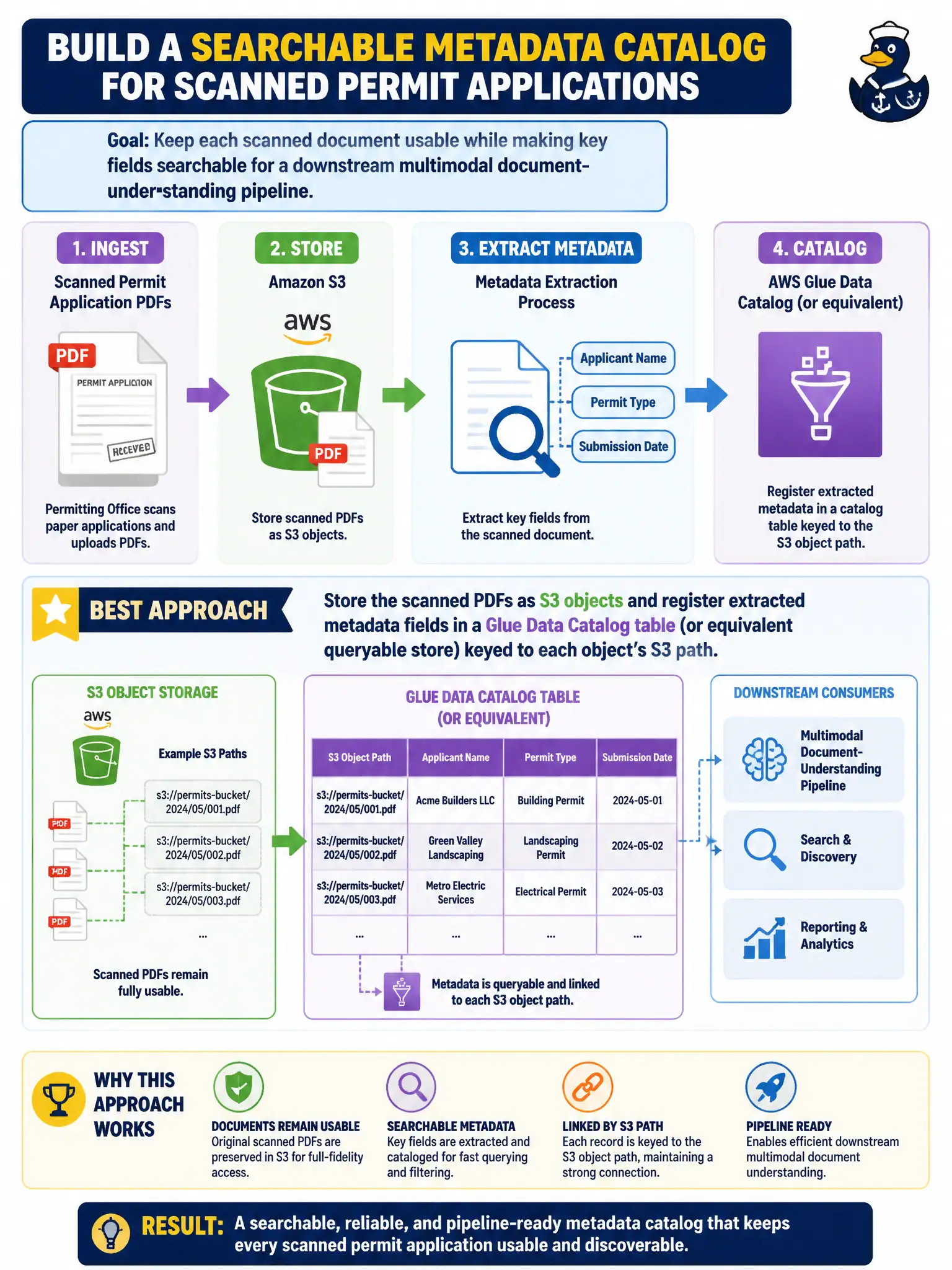
A permitting office ingests scanned permit-application PDFs into Amazon S3 and needs a metadata catalog that keeps each scanned document usable together with its searchable fields (applicant name, permit type, submission date) for a downstream multimodal document-understanding pipeline. Which approach best supports this?
Select an answer to reveal the explanation.
Short Explanation
Picture a library: the books sit on the shelves — that's S3 holding your scanned PDFs — while the card catalog up front tells you where each book is and what it's about. A Glue Data Catalog table keyed to each PDF's S3 path plays that card-catalog role, so a query can find the right document by applicant, permit type, or date without re-reading every scan. Skip the catalog and every search turns into walking the shelves one book at a time.
Full Explanation
Registering extracted metadata fields in a Glue Data Catalog table (or a similarly queryable store) keyed to each PDF's S3 location lets downstream jobs and query engines like Athena filter documents by applicant, permit type, or date without touching the scanned images themselves, while the PDFs stay in S3 where object storage handles large binary files efficiently. Embedding PDF bytes as DynamoDB item attributes runs into DynamoDB's per-item size ceiling and wastes a low-latency key-value store on bulk binary content it wasn't designed to hold. Skipping a metadata catalog and re-extracting fields from the raw scan on every query means paying the cost of document understanding (OCR, field extraction) repeatedly instead of once, which doesn't scale as query volume grows. Discarding the original scanned PDFs after extraction destroys the source-of-truth document — audits, appeals, and future re-extraction with an improved model all need the original scan, not just the metadata pulled from it once. Scope note: the catalog schema should track extraction confidence or version so downstream consumers know when a field was auto-extracted versus verified. Operational check: spot-check that a sample of catalog metadata rows resolve to the correct S3 object and reflect the actual document content before the pipeline goes live.