
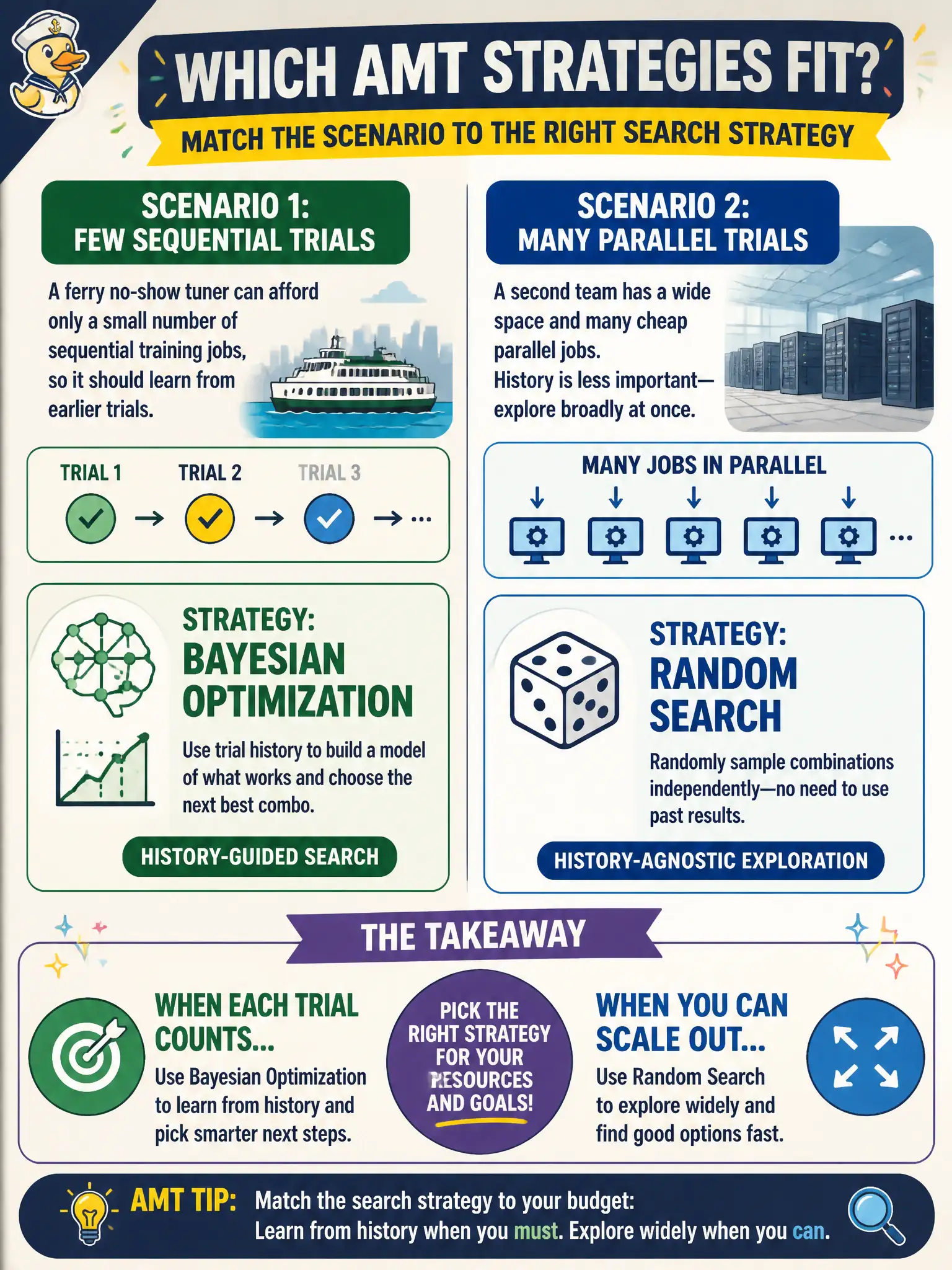
A ferry no-show tuner can afford only a small number of sequential training jobs, so it should learn from earlier trials. A second team has a wide space and many cheap parallel jobs. Which AMT strategies fit?
Select an answer to reveal the explanation.
Short Explanation
Think of a small sequential budget that should learn from earlier trials, versus a wide space with many cheap parallel jobs. Bayesian optimization for the first. Random search for the second. Grid search is not both.
Full Explanation
Bayesian optimization uses earlier trial results to pick the next combination, which fits a small sequential budget. Random search fits a wide space with many cheap parallel jobs and does not use history. Grid search explodes on wide spaces. Polly is not an AMT strategy.