
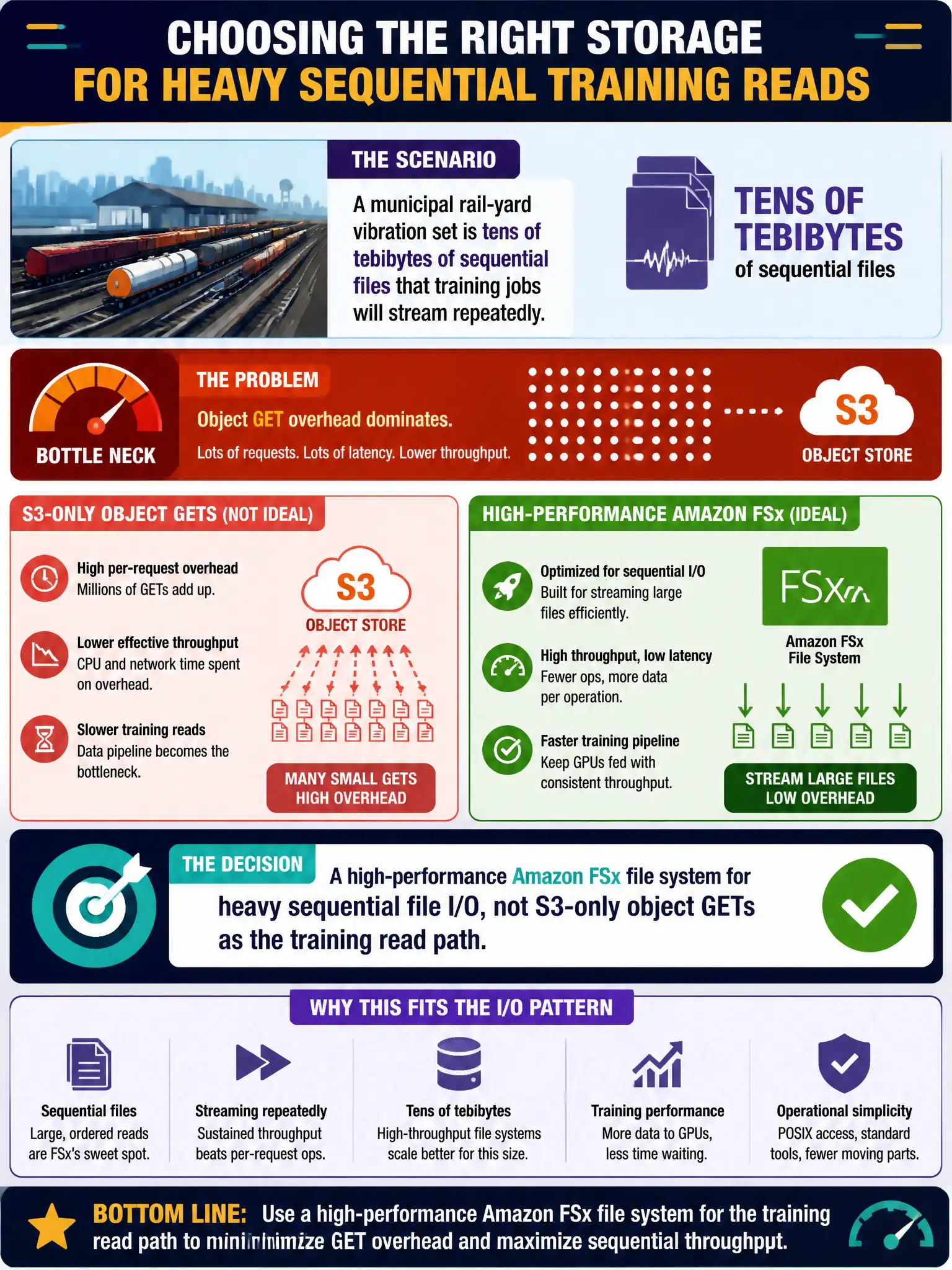
A municipal rail-yard vibration set is tens of tebibytes of sequential files that training jobs will stream repeatedly. Object GET overhead dominates. Which initial storage decision fits that I/O pattern?
Select an answer to reveal the explanation.
Short Explanation
Think of tens of tebibytes of vibration files that trainers will stream over and over, with object GET overhead eating the clock. Put that read path on a high-performance FSx file system. S3 can still land the bytes, but GET-only is the wrong training path.
Full Explanation
Heavy sequential file I/O favors a high-performance file system such as Amazon FSx (or EFS) over S3-only object GETs. S3 remains a cheap landing zone, but GET overhead is the wrong training read path here. Athena and Polly are not that file system.