
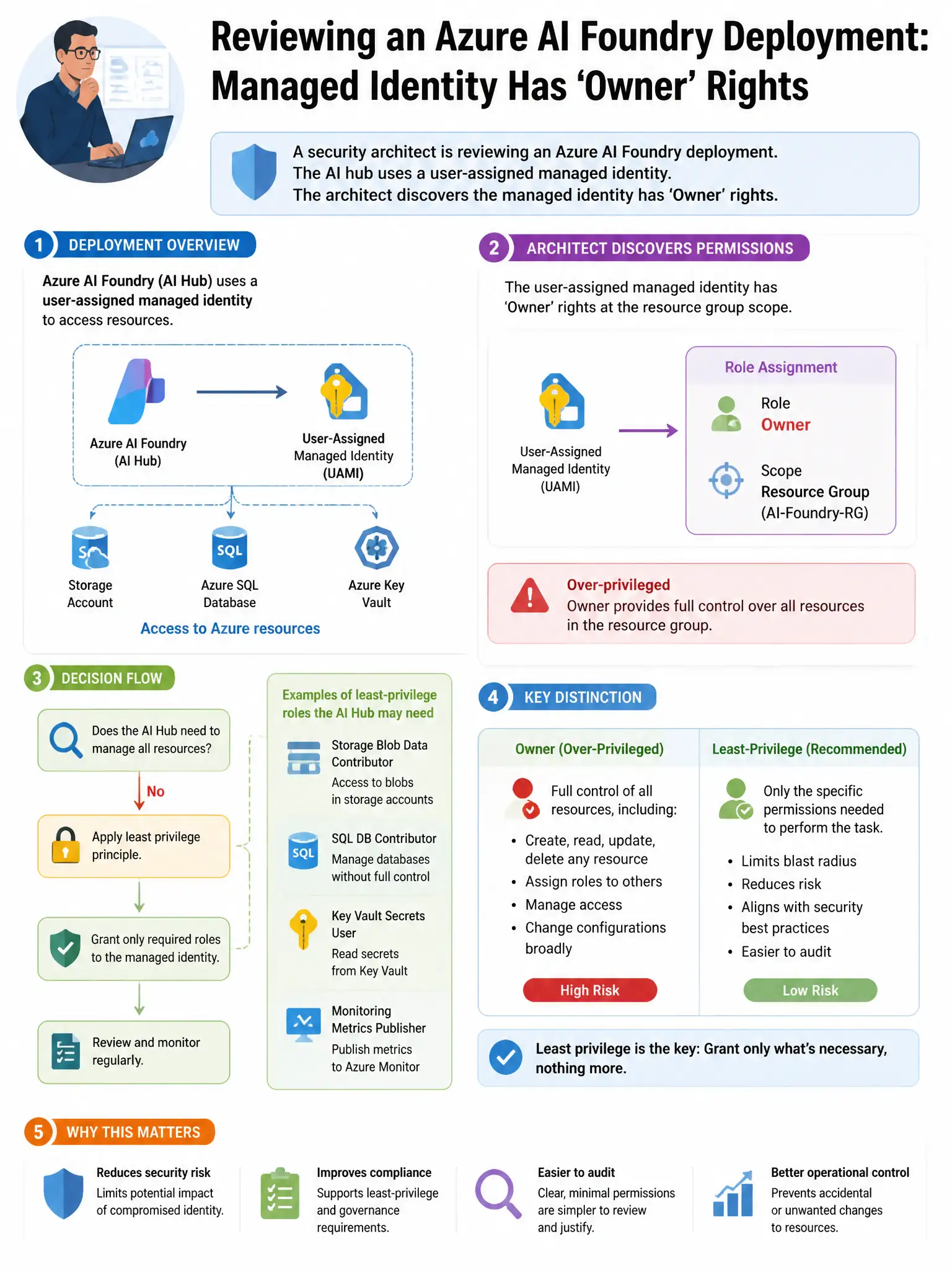
A security architect is reviewing an Azure AI Foundry deployment. The AI hub uses a user-assigned managed identity. The architect discovers the managed identity has 'Owner' rights on the resource group. What is the security risk and recommended remediation?
Select an answer to reveal the explanation.
Short Explanation
Here's the deal — you need to reduce the managed identity to least privilege because Owner lets it manage role assignments. If the AI workload gets compromised, an attacker could use that identity to grant more permissions to itself or other identities. Assign only the roles the AI hub actually needs, like Storage Blob Data Contributor, Key Vault Secrets User, and Cognitive Services OpenAI Contributor as needed.
Full Explanation
The option identifying the risk as the managed identity could grant itself or other identities additional permissions, with remediation to reduce it to minimum required roles such as Storage Blob Data Contributor, Key Vault Secrets User, and Cognitive Services OpenAI Contributor as needed, is correct. Owner includes Microsoft.Authorization/roleAssignments/write, so a compromised AI workload could use the identity to grant more permissions and escalate privileges. Remediation is least privilege: assign only the roles the AI hub needs. The option recommending Contributor instead of Owner is wrong because Contributor still allows broad resource modification and does not remove the role-assignment concern. The option recommending a resource lock is wrong because locks prevent deletion but do not stop privilege escalation. The option recommending subnet restriction is wrong because managed identities are not exposed to the internet in the traditional sense; the issue is permission scope.