
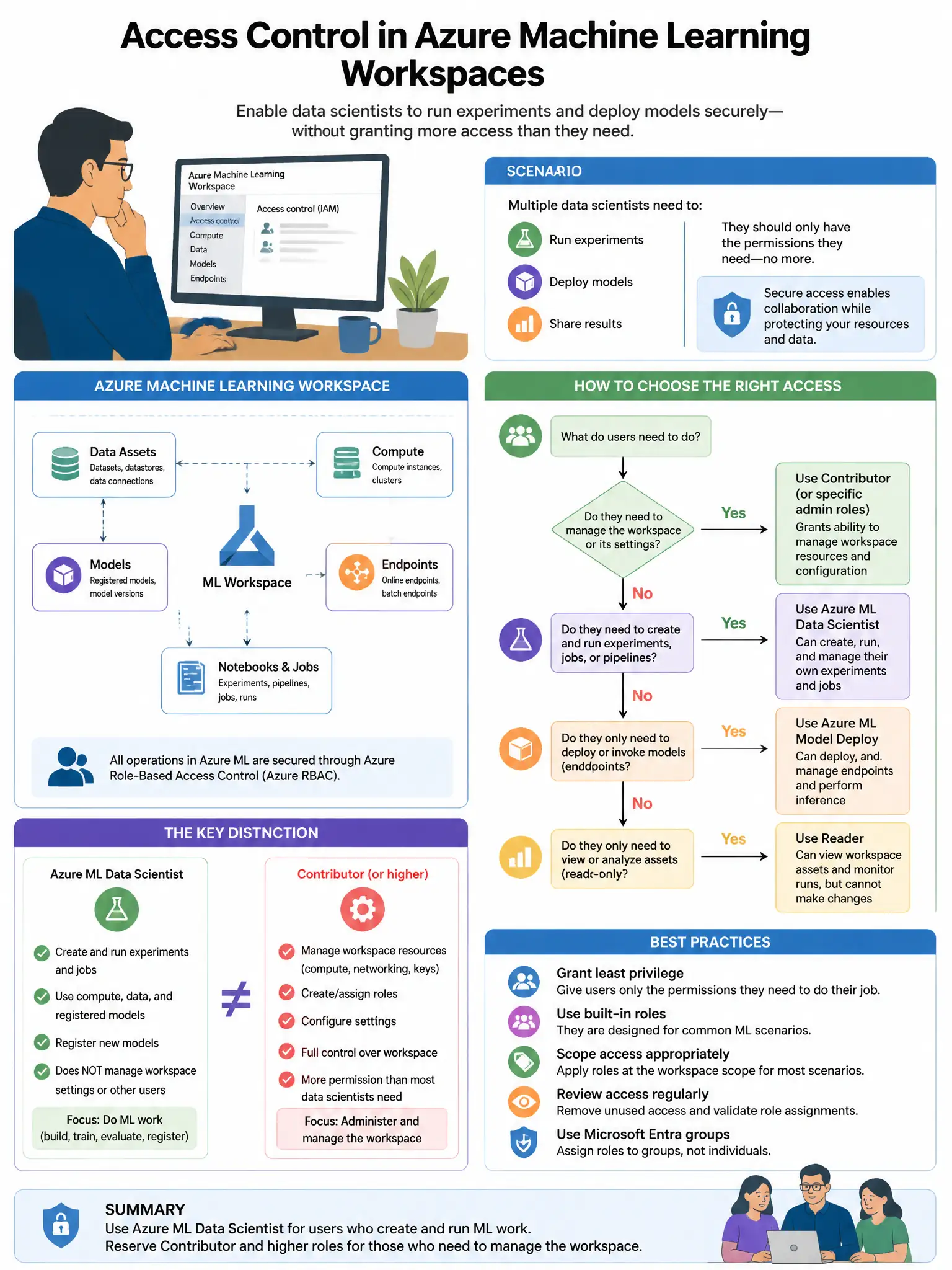
A security engineer is reviewing the access control configuration for an Azure Machine Learning workspace. Multiple data scientists need to run experiments and deploy models but should not be able to modify workspace-level settings or manage other users' permissions. Which built-in role should be assigned?
Select an answer to reveal the explanation.
Short Explanation
You want the AzureML Data Scientist built-in role because it lets data scientists run experiments, train models, and deploy models without changing workspace settings or managing permissions. It gives just enough access for the job without opening up workspace-level controls.
Full Explanation
The AzureML Data Scientist built-in role is the right choice because it is specifically designed for data scientists who need to run experiments, train models, and deploy to compute targets within an Azure Machine Learning workspace without having permission to modify workspace-level settings or manage RBAC assignments. The Contributor role is incorrect because it grants broad permissions, including the ability to modify workspace settings, which exceeds the required scope. The AzureML Compute Operator role is incorrect because it grants permissions related to compute resource management, not full data science workflow permissions. The Cognitive Services Contributor role is incorrect because it grants broad access to all Cognitive Services resources, not scoped Azure ML workspace permissions.