
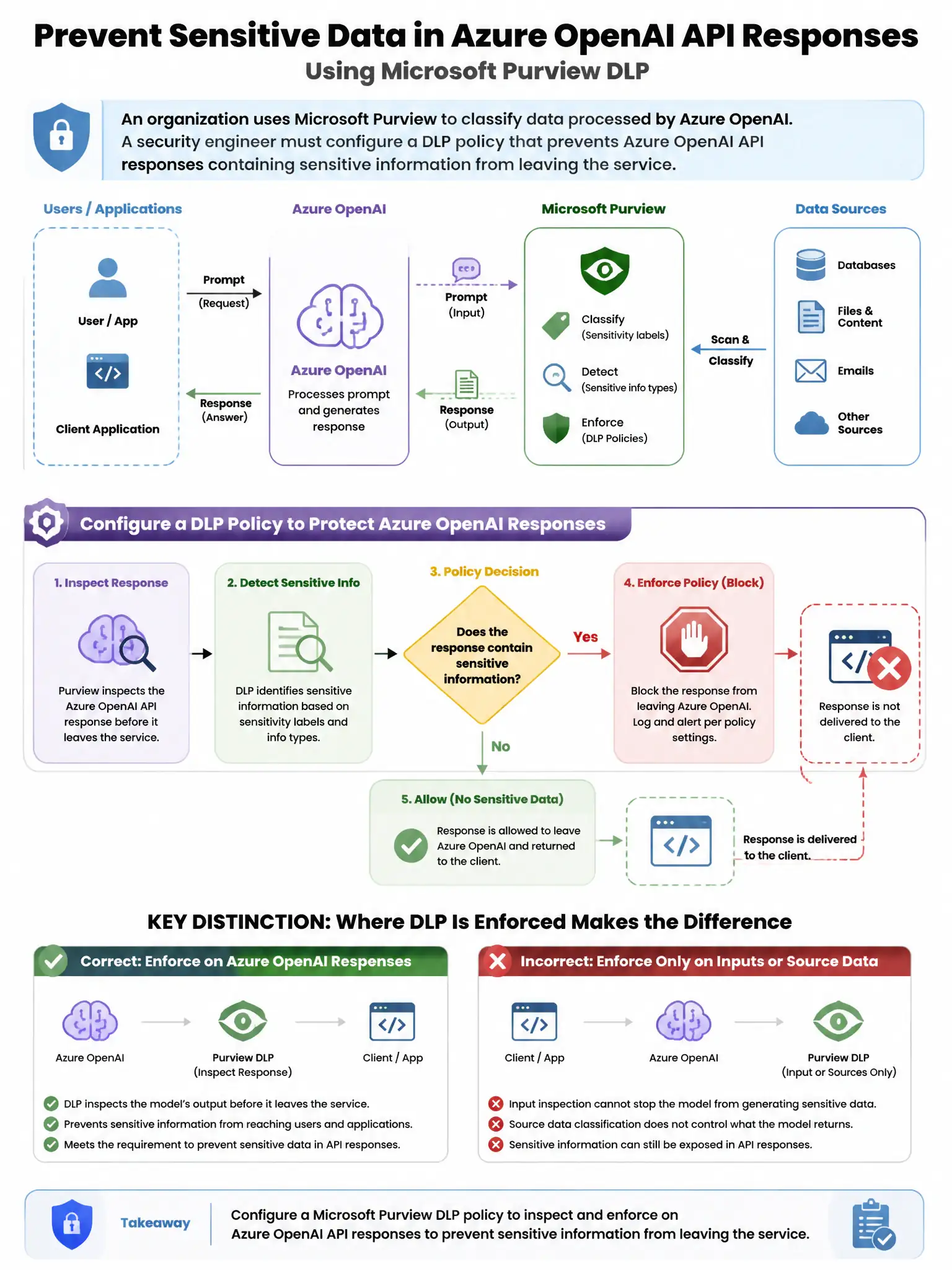
An organization uses Microsoft Purview to classify data processed by Azure OpenAI. A security engineer must configure a DLP policy that prevents Azure OpenAI API responses containing credit card numbers from being returned to the calling application. Which Microsoft Purview capability supports this scenario?
Select an answer to reveal the explanation.
Short Explanation
Here's the deal — you need a Microsoft Purview Data Loss Prevention policy scoped to Azure OpenAI because it can detect credit card numbers in prompts and responses and block them before the API returns them. The AI Hub gives visibility, but the DLP policy is what enforces the control.
Full Explanation
The Microsoft Purview Data Loss Prevention policy scoped to Azure OpenAI service is correct because Microsoft Purview DLP policies can be scoped to Azure AI services including Azure OpenAI, enabling detection of sensitive information types such as credit card numbers in AI model prompts and responses, and can be configured to block or alert when such content is detected. The Microsoft Purview AI Hub with sensitive information type detection in AI interactions is incorrect because while the AI Hub provides visibility into AI interactions, the active enforcement mechanism is the DLP policy. Endpoint DLP with browser extension monitoring is incorrect because endpoint DLP monitors browser-based data actions, not server-side Azure OpenAI API calls. Microsoft Purview Communication Compliance with keyword dictionary is incorrect because Communication Compliance is designed for human communications review, not API response content enforcement.