
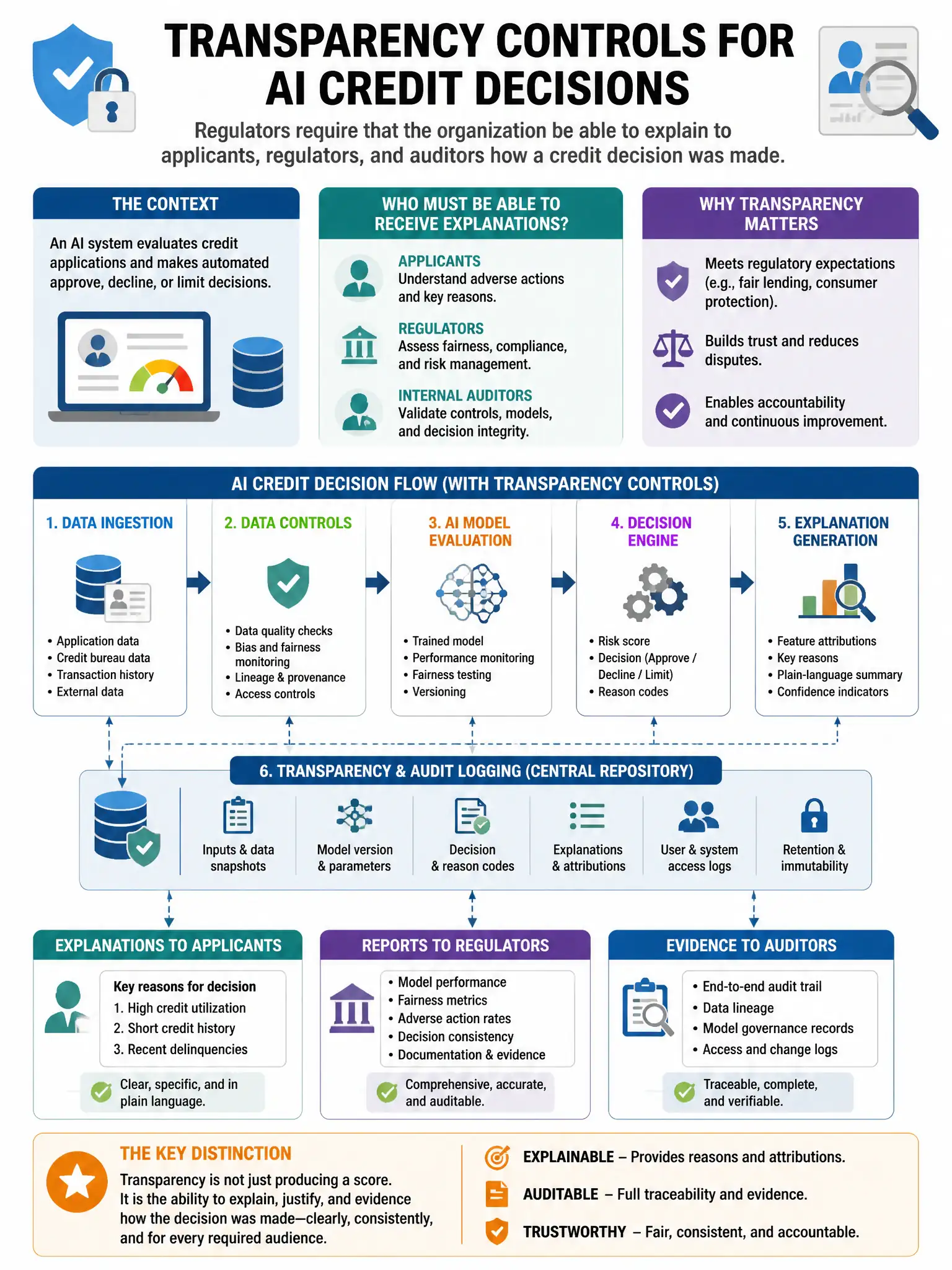
A security architect needs to implement transparency controls for an AI system that makes automated credit decisions. Regulators require that the organization be able to explain to any affected individual why they received a specific credit decision from the AI system, in plain language. Which combination of Azure services supports meeting this regulatory transparency requirement?
Select an answer to reveal the explanation.
Short Explanation
Here's the deal — you need real model explainability plus a customer-friendly translation layer. Azure Machine Learning's Responsible AI dashboard gives you feature importance for each prediction, and your app turns those SHAP values into plain-language reasons for the customer.
Full Explanation
The correct combination is the Azure Machine Learning Responsible AI dashboard explainability component to generate feature importance for each prediction, combined with an application layer that translates SHAP values into plain-language explanations for customer-facing communication, because meeting the regulatory transparency requirement for individual credit decisions requires two components: (1) technical explainability—Azure Machine Learning's Responsible AI dashboard with SHAP explainability generates quantitative feature importance values for each individual prediction, showing which factors (income, credit utilization, payment history) most influenced the decision; and (2) customer communication—the application layer translates the raw SHAP values into plain-language explanations (e.g., 'Your application was declined primarily because of a high debt-to-income ratio') suitable for communicating to affected individuals. Together, these meet the regulatory requirement for explainability. The Azure Monitor logging option is wrong because logging prediction inputs and outputs provides auditability (showing what was fed in and what came out) but does not explain why the model made its specific decision—logging alone does not satisfy explainability requirements. The Microsoft Purview option is wrong because Purview sensitivity labels classify and protect data but do not generate explanations of model decisions. The Azure OpenAI option is wrong because prompting a separate LLM to generate explanations is an unreliable approach that can hallucinate incorrect reasoning—SHAP-based explanations are grounded in the actual model's mathematical computation.