
A security engineer is implementing Microsoft Purview for an organization using Azure Machine Learning. The team needs to scan Azure ML datasets and automatically classify them as 'Confidential' if they contain more than 100 records with Social Security Numbers. Which Microsoft Purview component provides this threshold-based classification?
Select an answer to reveal the explanation.
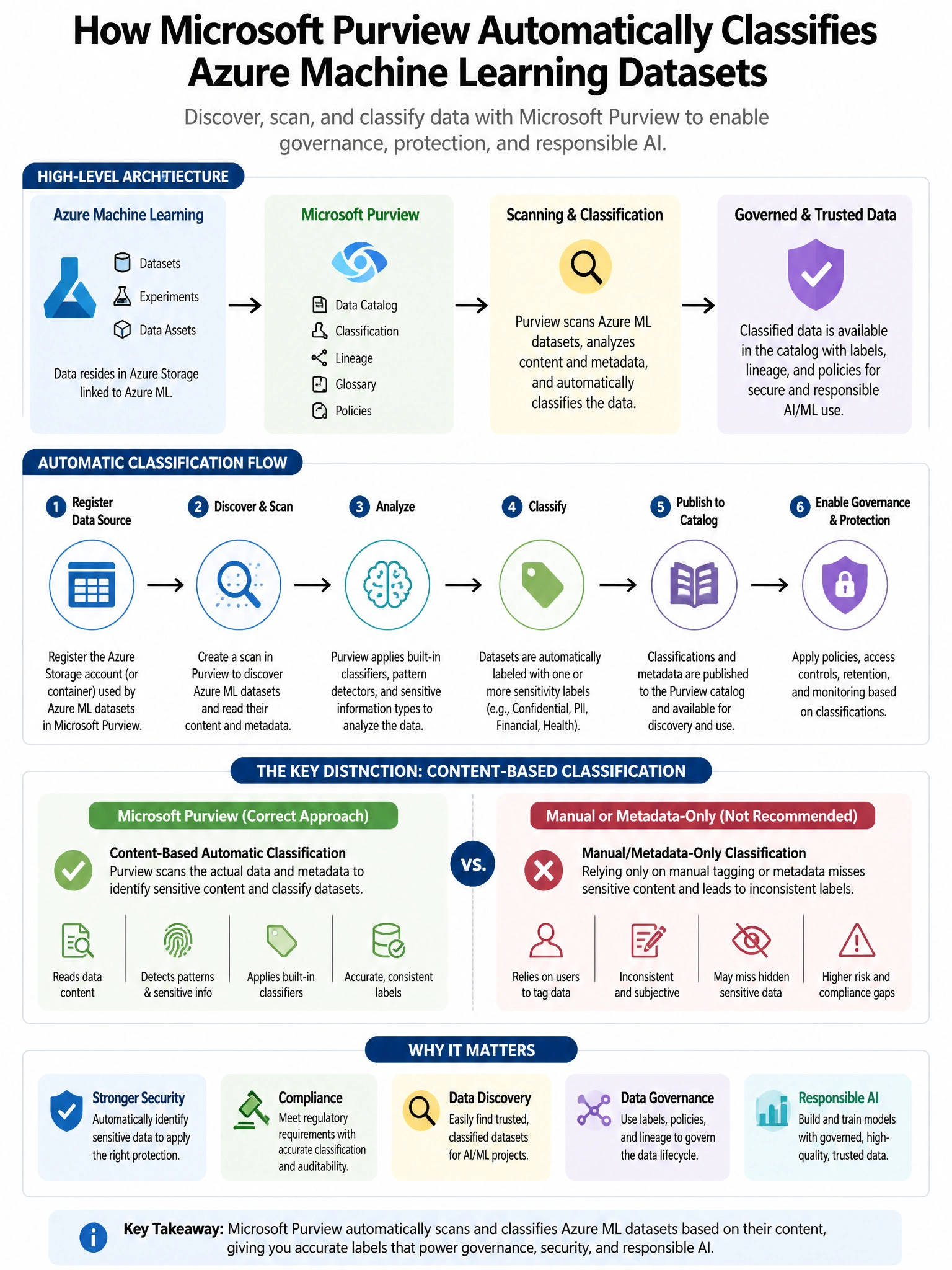
Short Explanation and Infographic
Here's the deal — a is correct because Microsoft Purview auto-labeling policies can be configured with conditions that use sensitive information types (such as U.S. Social Security Number) with minimum instance count thresholds.
Full explanation below image
Full Explanation
A is correct because Microsoft Purview auto-labeling policies can be configured with conditions that use sensitive information types (such as U.S. Social Security Number) with minimum instance count thresholds. By setting the condition to detect 'at least 100' SSN instances, the policy will only classify and label content that meets this threshold, preventing over-classification of content with incidental SSN matches. C is incorrect because while the Purview Data Map scanner uses classification rules to identify sensitive data, the threshold-based labeling (applying a 'Confidential' sensitivity label) based on instance count is configured in auto-labeling policies, not as a scanner classification rule property. B is incorrect because trainable classifiers learn document types based on examples (e.g., 'HR documents') rather than counting specific sensitive information type instances. D is incorrect because DLP policies enforce data handling rules (prevent sharing, alert) rather than applying sensitivity labels based on instance counts.