
A security engineer is reviewing the security posture of an Azure AI Foundry deployment. The Responsible AI (RAI) evaluation results show that the deployed model occasionally produces responses with high 'Groundedness' violation scores when processing certain user queries. What does this indicate about the model's behavior?
Select an answer to reveal the explanation.
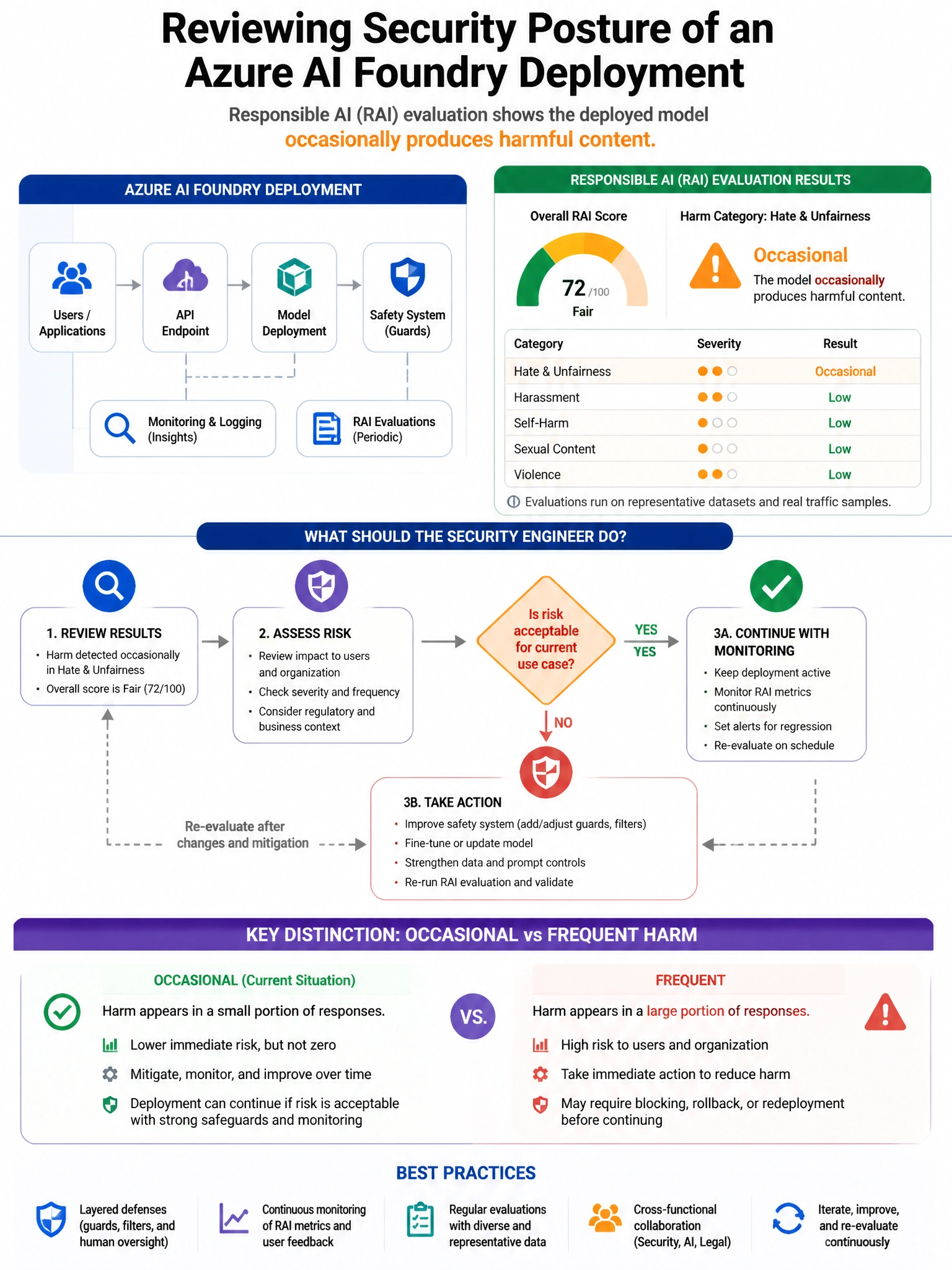
Short Explanation and Infographic
Here's the deal — a is correct because in Microsoft's Azure AI Foundry evaluation framework, 'Groundedness' measures whether the model's response is grounded in (supported by) the provided source documents or context. High groundedness violation scores indicate that the model is generating claims, facts, or content not supported by the provided context, which is a form of hallucination where the model 'makes up' information.
Full explanation below image
Full Explanation
A is correct because in Microsoft's Azure AI Foundry evaluation framework, 'Groundedness' measures whether the model's response is grounded in (supported by) the provided source documents or context. High groundedness violation scores indicate that the model is generating claims, facts, or content not supported by the provided context, which is a form of hallucination where the model 'makes up' information. B is incorrect because content safety violations are measured by separate evaluation metrics (violence, hate, sexual, self-harm categories), not groundedness. C is incorrect because training data disclosure (memorization attacks) is a different evaluation concern separate from groundedness. D is incorrect because prompt injection detection is also a separate evaluation metric; groundedness specifically measures factual consistency with provided context.