
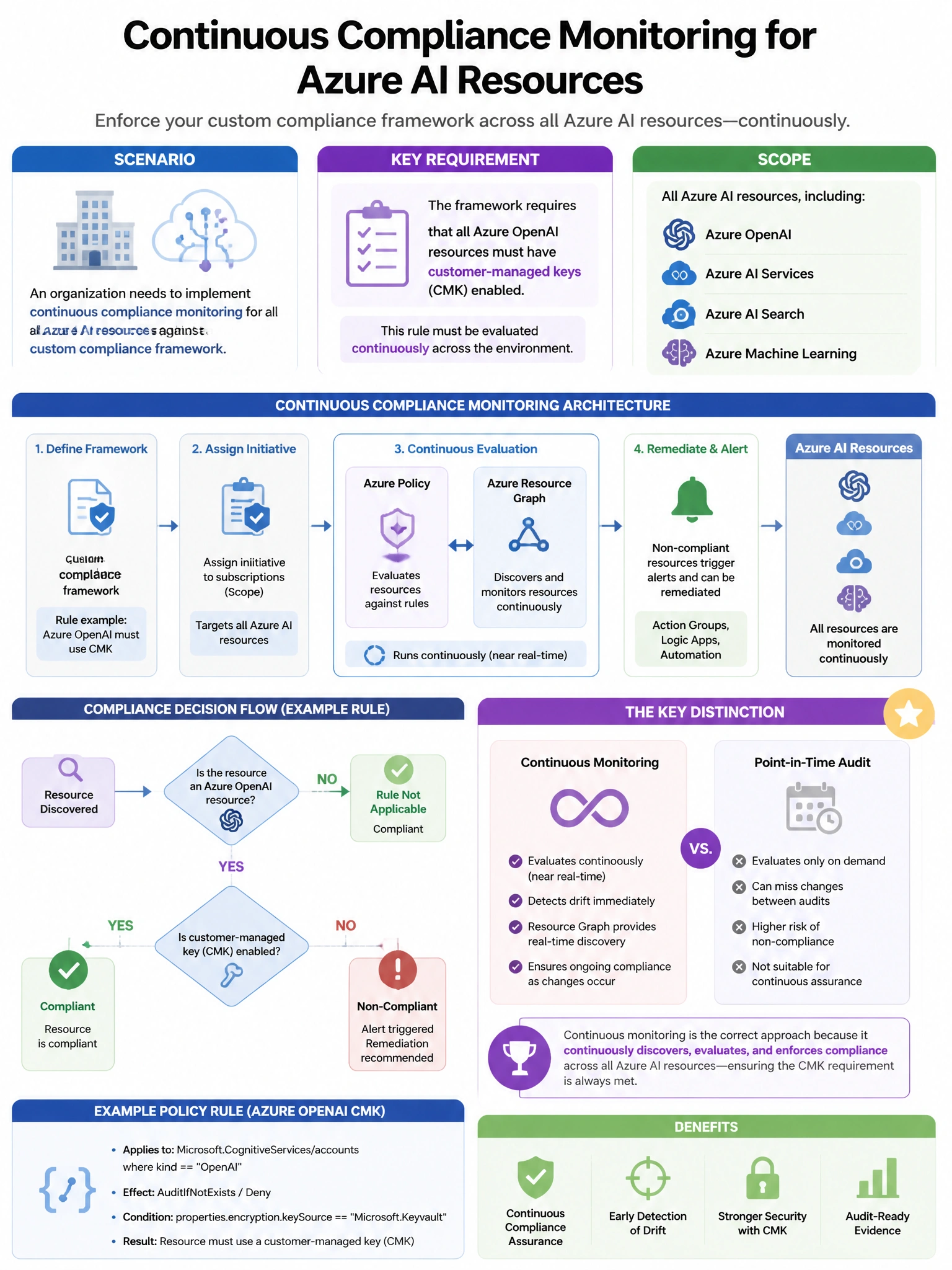
An organization needs to implement continuous compliance monitoring for all Azure AI resources against a custom compliance framework. The framework requires that all Azure OpenAI resources must have diagnostic logging enabled, use private endpoints, and be encrypted with customer-managed keys. Which Azure service provides continuous compliance monitoring and remediation for these requirements?
Select an answer to reveal the explanation.
Short Explanation and Infographic
Here's the deal — b is correct because Azure Policy provides continuous compliance monitoring for Azure resources. A compliance initiative (policy set) can include policies with 'audit' effect to identify non-compliant resources, 'deny' effect to prevent non-compliant deployments, and 'deployIfNotExists' effect to automatically remediate resources (e.g., deploy diagnostic settings).
Full explanation below image
Full Explanation
B is correct because Azure Policy provides continuous compliance monitoring for Azure resources. A compliance initiative (policy set) can include policies with 'audit' effect to identify non-compliant resources, 'deny' effect to prevent non-compliant deployments, and 'deployIfNotExists' effect to automatically remediate resources (e.g., deploy diagnostic settings). This combination provides both monitoring and remediation for all three requirements. C is incorrect because while Defender for Cloud security standards can incorporate Azure Policy definitions for compliance monitoring, Azure Policy itself is the underlying engine; Defender for Cloud provides the security posture layer, not remediation for resource configuration compliance. A is incorrect because Purview Compliance Manager tracks regulatory compliance and provides improvement actions, but does not perform technical enforcement or automated remediation of Azure resource configurations. D is incorrect because Azure Monitor compliance dashboards do not exist as a native compliance monitoring service for resource configuration requirements.