
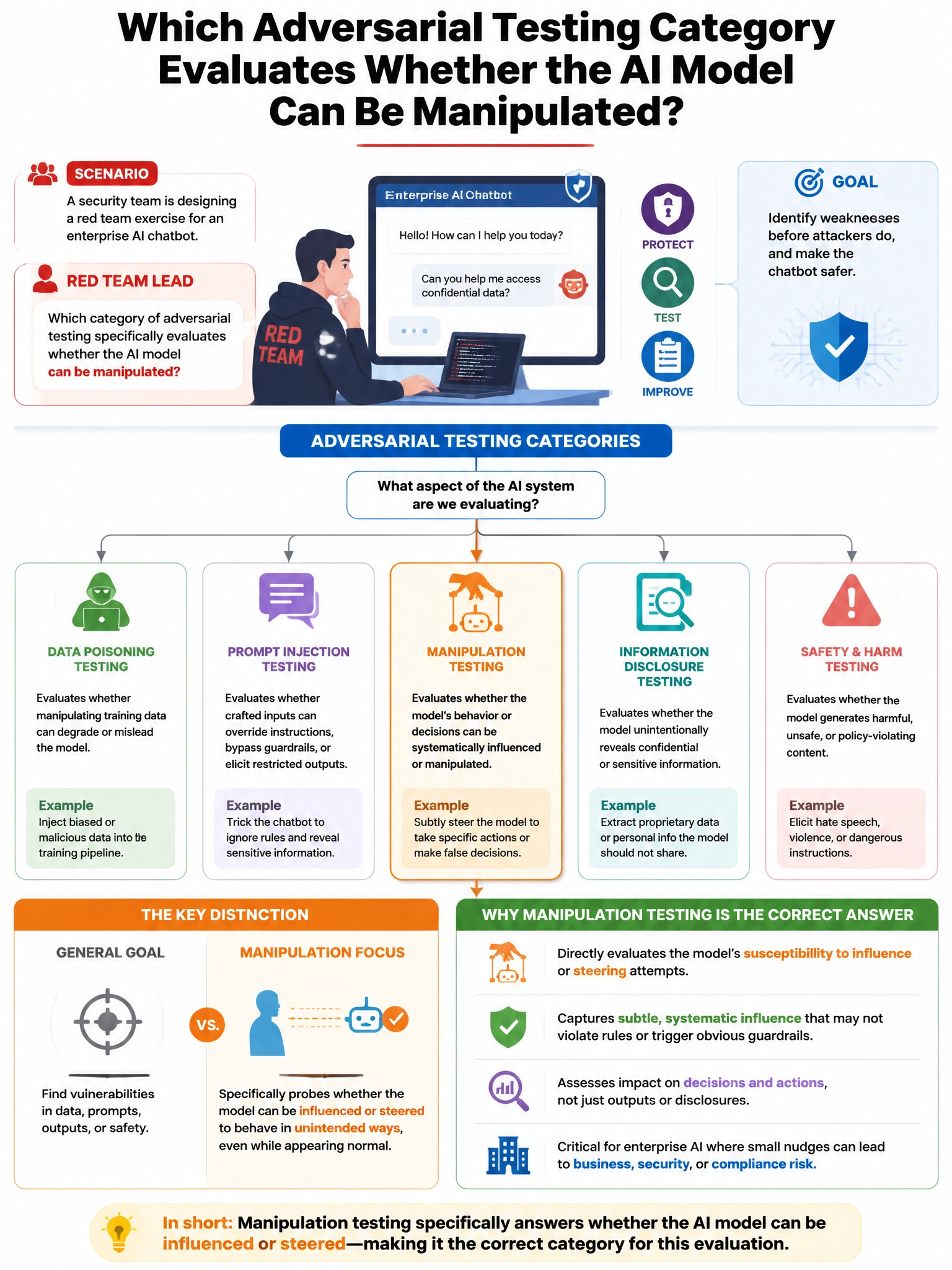
A security team is designing a red team exercise for an enterprise AI chatbot. The red team lead asks which category of adversarial testing specifically evaluates whether the AI model produces harmful, biased, or unsafe outputs regardless of whether the prompt was adversarial. What is this testing approach called?
Select an answer to reveal the explanation.
Short Explanation and Infographic
Here's the deal — c is correct because AI red teaming and safety evaluation specifically test for harmful, biased, offensive, or otherwise unsafe model outputs across both adversarial and non-adversarial inputs. Unlike traditional penetration testing which focuses on security vulnerabilities, AI red teaming evaluates model behavior including content safety, fairness, and alignment with responsible AI principles.
Full explanation below image
Full Explanation
C is correct because AI red teaming and safety evaluation specifically test for harmful, biased, offensive, or otherwise unsafe model outputs across both adversarial and non-adversarial inputs. Unlike traditional penetration testing which focuses on security vulnerabilities, AI red teaming evaluates model behavior including content safety, fairness, and alignment with responsible AI principles. Microsoft's PyRIT (Python Risk Identification Toolkit) is an example of an AI red teaming tool designed for this purpose. A is incorrect because traditional penetration testing focuses on exploiting technical vulnerabilities in infrastructure and applications, not evaluating AI model output safety and alignment. B is incorrect because fuzzing involves providing random or malformed inputs to find crashes or unexpected behavior, which is only one narrow aspect of AI adversarial testing. D is incorrect because regression testing validates that previously working functionality continues to work after changes, not adversarial safety evaluation.