
A security architect is reviewing the network architecture for an Azure AI solution. The solution includes an Azure OpenAI private endpoint in a spoke VNet, APIM in a hub VNet, and on-premises clients connected via ExpressRoute. The security team requires that DNS resolution for the Azure OpenAI private endpoint works correctly for on-premises clients. What DNS configuration is required?
Select an answer to reveal the explanation.
Short Explanation and Infographic
Here's the deal — a is correct because for on-premises clients to resolve Azure Private DNS Zones like privatelink.openai.azure.com, the Azure Private DNS Zone must be linked to a VNet reachable from the ExpressRoute path. On-premises DNS servers must be configured to conditionally forward queries for the privatelink.openai.azure.com zone to Azure DNS via a DNS resolver or forwarder VM in Azure, enabling private endpoint IP resolution.
Full explanation below image
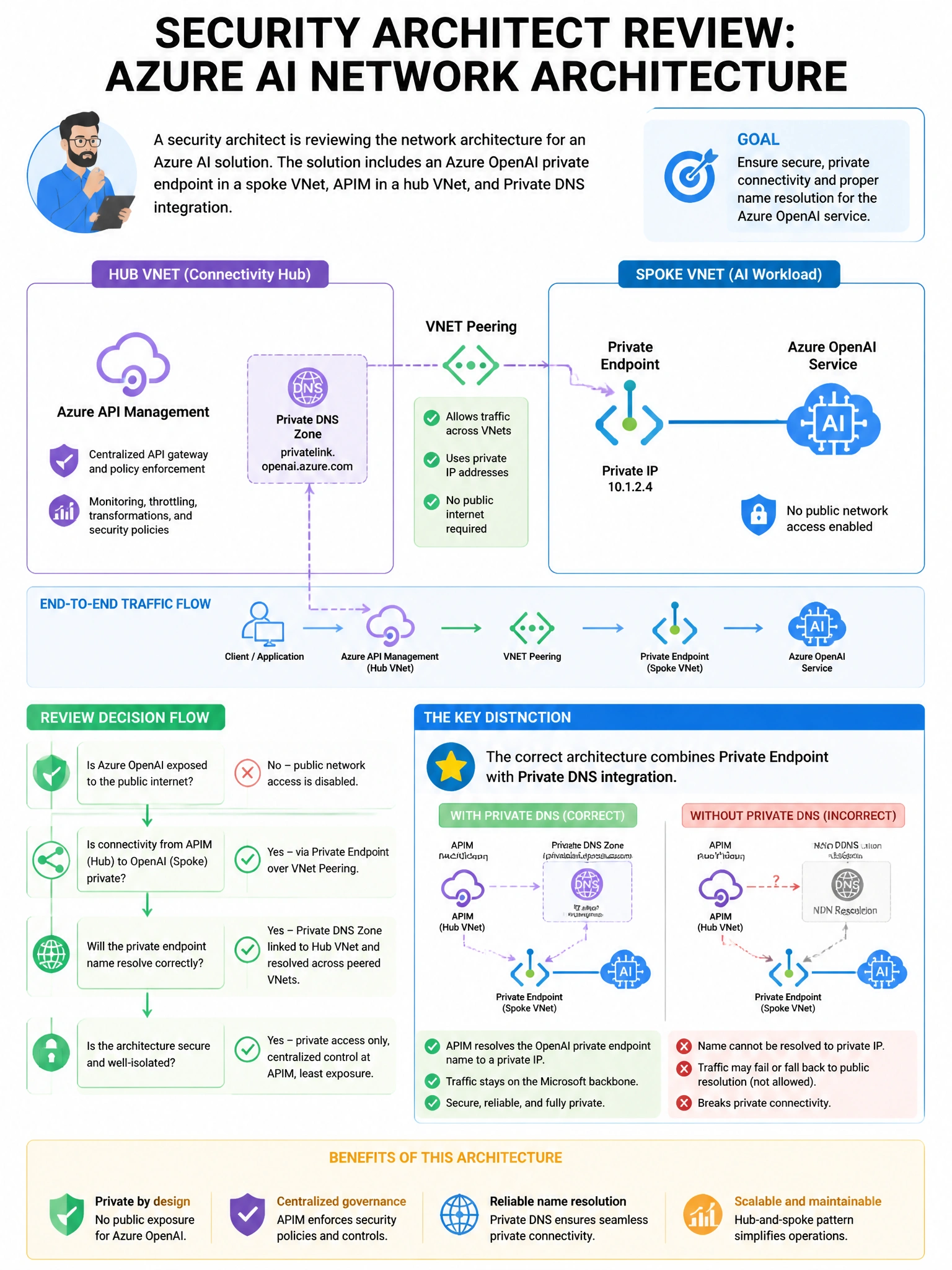
Full Explanation
A is correct because for on-premises clients to resolve Azure Private DNS Zones like privatelink.openai.azure.com, the Azure Private DNS Zone must be linked to a VNet reachable from the ExpressRoute path. On-premises DNS servers must be configured to conditionally forward queries for the privatelink.openai.azure.com zone to Azure DNS via a DNS resolver or forwarder VM in Azure, enabling private endpoint IP resolution. B is incorrect because hosts file entries are not scalable and do not update automatically if the private endpoint IP changes. C is incorrect because the DNS Private Resolver in the spoke VNet forwards Azure DNS queries to on-premises, not enabling on-premises clients to resolve Azure private DNS zones. D is incorrect because auto-registration registers VM hostnames in private DNS zones, not privatelink DNS zone records for private endpoints.