
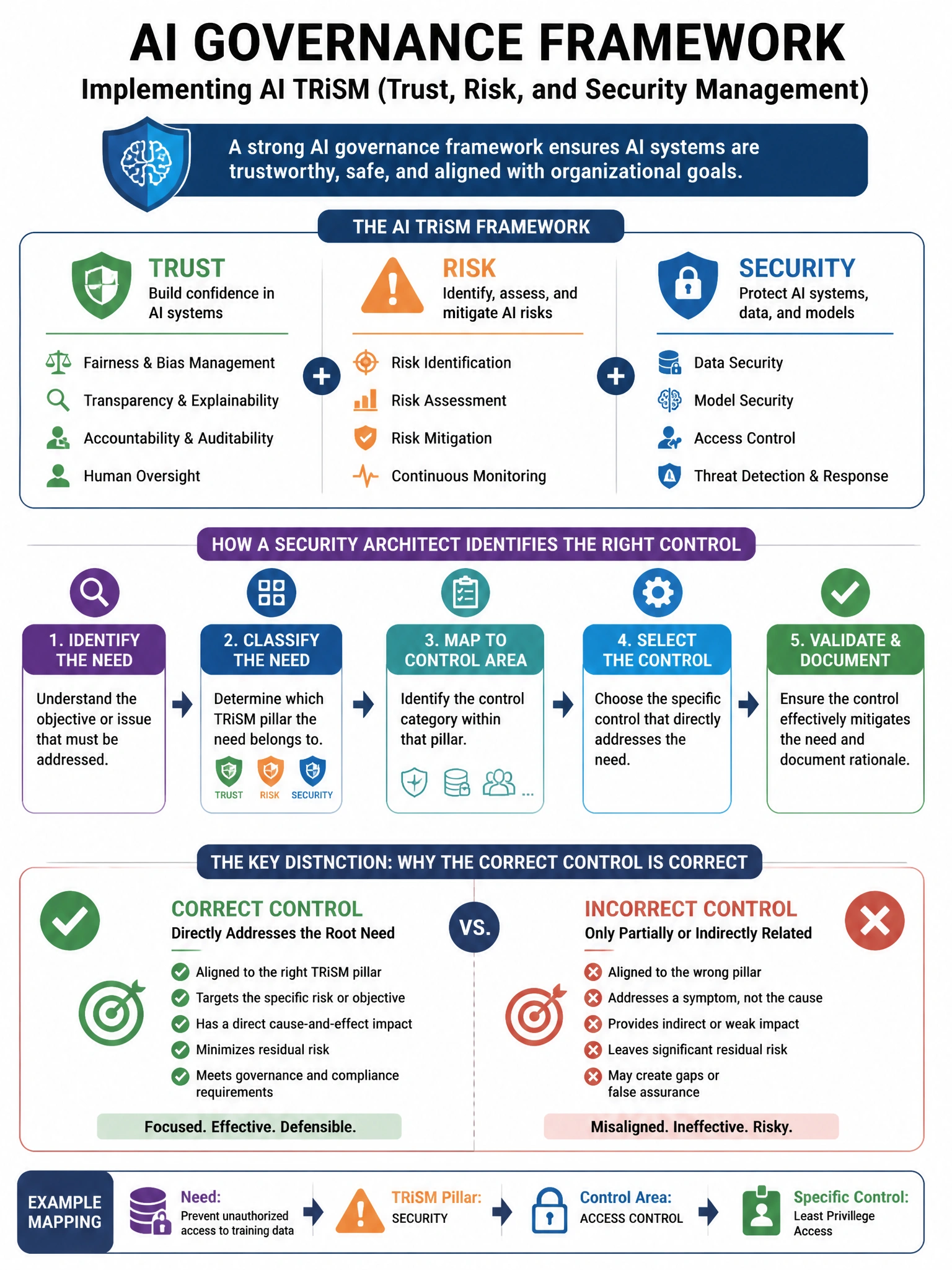
An organization's AI governance framework requires implementing AI TRiSM (Trust, Risk, and Security Management). A security architect must identify which control specifically addresses the risk that an AI model's decisions cannot be explained or audited. Which AI TRiSM pillar addresses this risk?
Select an answer to reveal the explanation.
Short Explanation and Infographic
Here's the deal — c is correct because AI Explainability is the AI TRiSM pillar that addresses the requirement for AI model decisions to be interpretable, understandable, and auditable. Controls under this pillar include model documentation, feature importance analysis, decision audit trails, and explainable AI techniques.
Full explanation below image
Full Explanation
C is correct because AI Explainability is the AI TRiSM pillar that addresses the requirement for AI model decisions to be interpretable, understandable, and auditable. Controls under this pillar include model documentation, feature importance analysis, decision audit trails, and explainable AI techniques. A is incorrect because AI Security focuses on protecting AI systems from attacks, data breaches, and adversarial inputs, not on decision explainability. B is incorrect because AI Privacy focuses on protecting personal data used in AI training and inference. D is incorrect because AI Reliability focuses on model performance consistency and uptime, not on decision explainability.