
A security team is conducting an incident response exercise for a scenario where an organization's AI model used for loan approval may have been manipulated through data poisoning to approve fraudulent applications. Which artifact should the incident response team prioritize collecting to determine if poisoning occurred?
Select an answer to reveal the explanation.
Short Explanation and Infographic
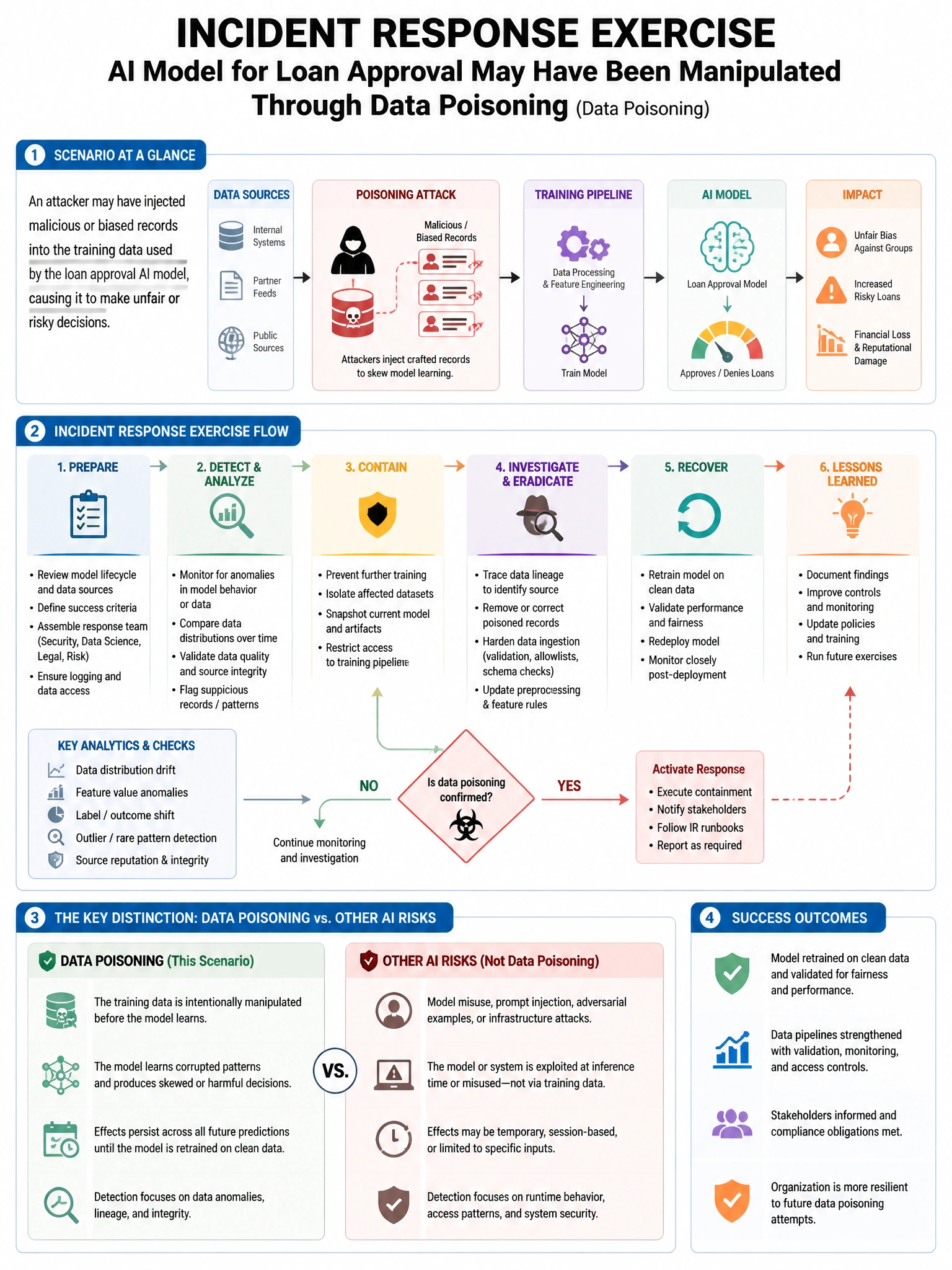
Here's the deal — b is correct because data poisoning attacks occur during the model training process by introducing malicious data into the training dataset. To investigate, the incident response team must review: (1) Azure Machine Learning training run logs to identify what data was used in each training iteration, (2) dataset version history in the AML data assets registry to identify when and what changed in the training data, and (3) data validation pipeline logs to find if validation was bypassed or failed.
Full explanation below image
Full Explanation
B is correct because data poisoning attacks occur during the model training process by introducing malicious data into the training dataset. To investigate, the incident response team must review: (1) Azure Machine Learning training run logs to identify what data was used in each training iteration, (2) dataset version history in the AML data assets registry to identify when and what changed in the training data, and (3) data validation pipeline logs to find if validation was bypassed or failed. These artifacts provide the forensic trail to determine whether poisoned data was introduced before the retraining that produced the suspect model. A is wrong because Azure Firewall logs show network connectivity to the training pipeline, which may reveal unauthorized data uploads, but the model training run logs and dataset history are more directly informative for data poisoning investigation. C is wrong because Azure OpenAI API request/response logs capture inference-time interactions; data poisoning occurs at training time, not inference time. D is wrong because Entra ID sign-in logs show who authenticated to the compute cluster, which is relevant for access investigation but does not directly reveal whether training data was poisoned.