
A company has experienced a security incident where an AI model in production was found to be generating harmful outputs after what appears to be a model update. The incident response team needs to quickly roll back to the previously known-good model version. Which Azure Machine Learning feature supports this rollback?
Select an answer to reveal the explanation.
Short Explanation and Infographic
Here's the deal — a is correct because Azure Machine Learning's model registry stores versioned model artifacts. Each registered model version is immutable and retained in the registry.
Full explanation below image
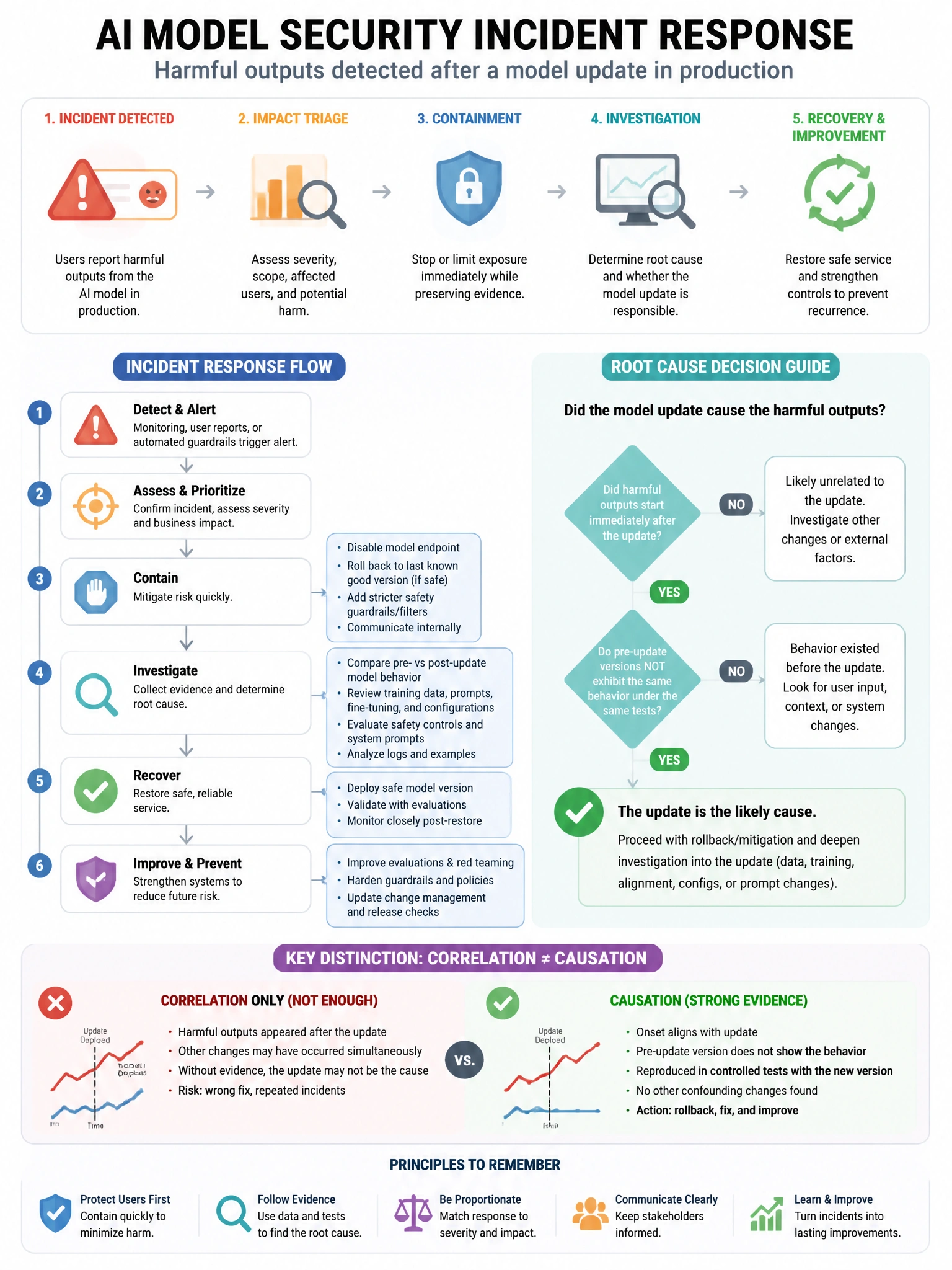
Full Explanation
A is correct because Azure Machine Learning's model registry stores versioned model artifacts. Each registered model version is immutable and retained in the registry. During an incident, the team can deploy a previous version of the model from the registry to the managed online endpoint, effectively rolling back to the known-good state. This is the purpose-built mechanism for AI model version management and rollback. B is wrong because Azure Backup for AML workspaces can back up workspace metadata, but model rollback is handled through the model registry versioning, not backup-restore operations. C is wrong because Azure Site Recovery handles disaster recovery for compute resources (VMs), not AI model version management. D is wrong because pipeline checkpoints save intermediate states during long training runs to allow resumption after failures; they are training-phase artifacts, not deployed model versions suitable for production rollback.