
A healthcare organization needs to automatically detect medical record numbers (MRN) in content processed by Azure OpenAI Service via the Azure OpenAI REST API. The organization has a proprietary MRN format that does not match any built-in Microsoft sensitive information types. Which Purview feature enables this custom detection?
Select an answer to reveal the explanation.
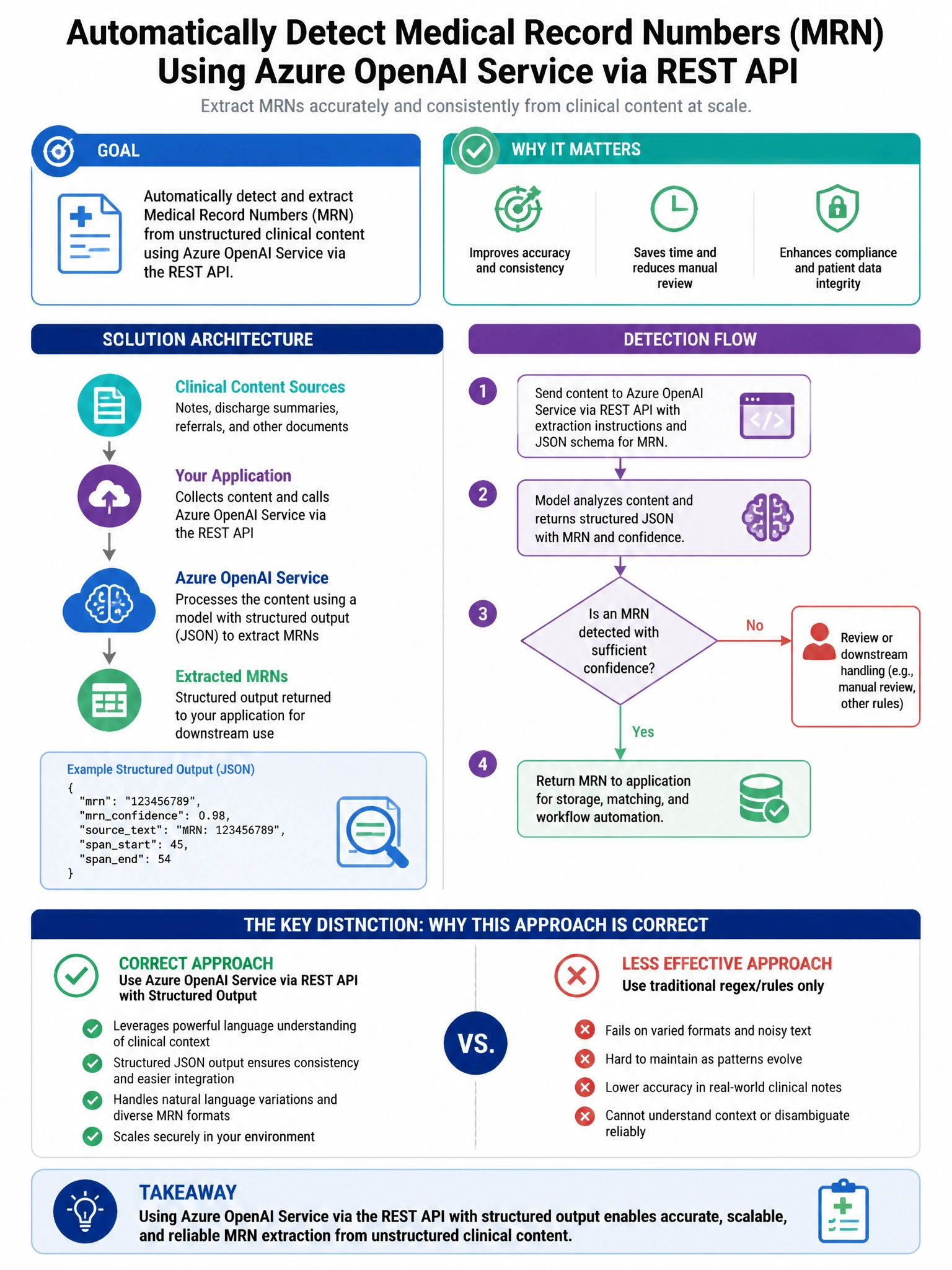
Short Explanation and Infographic
Here's the deal — b is correct because Microsoft Purview allows creating custom Sensitive Information Types (SITs) using regular expressions and keyword dictionaries. Since the MRN format is proprietary (e.g., a specific pattern like 'MRN-XXXXXXXX'), a custom SIT with a regex pattern matching that format can be created.
Full explanation below image
Full Explanation
B is correct because Microsoft Purview allows creating custom Sensitive Information Types (SITs) using regular expressions and keyword dictionaries. Since the MRN format is proprietary (e.g., a specific pattern like 'MRN-XXXXXXXX'), a custom SIT with a regex pattern matching that format can be created. This custom SIT can then be used in DLP policies targeting Azure OpenAI or content inspection to detect and protect MRNs. A is wrong because a trainable classifier uses machine learning trained on document examples to recognize content by context and language patterns, not by structured patterns like record numbers—it is better suited for content like 'financial documents' or 'HR policies.' C is wrong because EDM is used when you need to detect exact values from a specific database (e.g., exact patient names and SSNs that exist in your patient database), not for detecting any value matching a format pattern. D is wrong because Content Explorer is a read-only tool for viewing how content is classified across the organization; it does not create detection capabilities.