
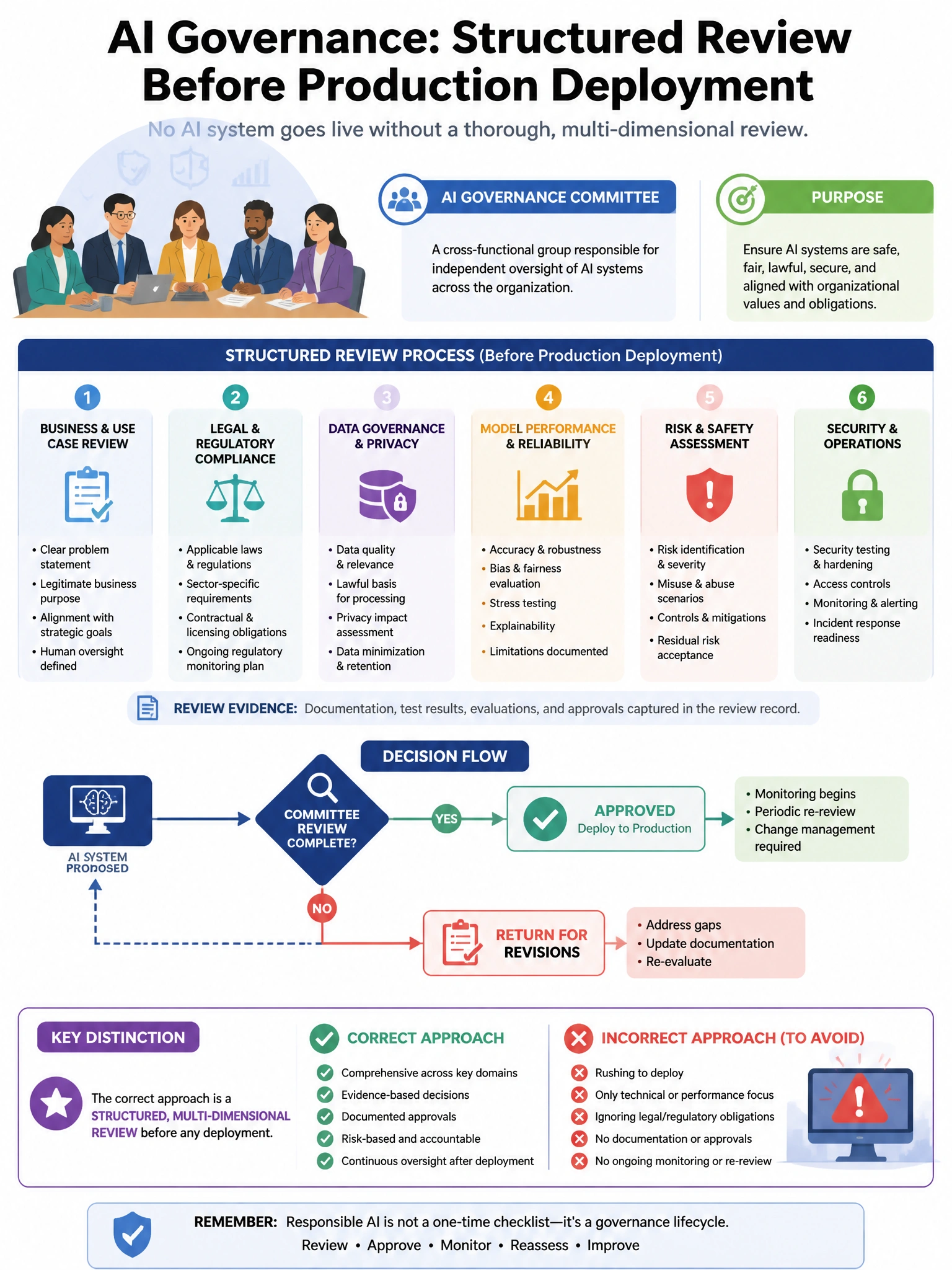
An organization's AI governance committee needs to implement a structured review process before any AI system can be deployed in production. The review must assess legal and regulatory compliance, data privacy, security risks, and ethical implications. Which Microsoft framework provides guidance for structuring this governance process?
Select an answer to reveal the explanation.
Short Explanation and Infographic
Here's the deal — b is correct because Microsoft's Responsible AI Standard is a comprehensive governance framework that defines requirements across six core principles (fairness, reliability and safety, privacy and security, inclusiveness, transparency, and accountability). The associated Responsible AI Impact Assessment process provides structured templates for evaluating an AI system's potential impacts across legal, ethical, data privacy, and safety dimensions before deployment.
Full explanation below image
Full Explanation
B is correct because Microsoft's Responsible AI Standard is a comprehensive governance framework that defines requirements across six core principles (fairness, reliability and safety, privacy and security, inclusiveness, transparency, and accountability). The associated Responsible AI Impact Assessment process provides structured templates for evaluating an AI system's potential impacts across legal, ethical, data privacy, and safety dimensions before deployment. A is wrong because the Microsoft SDL (Security Development Lifecycle) for AI focuses specifically on security engineering practices during AI system development, not the full breadth of ethical, legal, and compliance governance. C is wrong because the Cloud Adoption Framework provides cloud strategy and migration guidance, not AI system governance and ethics review processes. D is wrong because the Azure Well-Architected Framework provides architectural best practices for reliability, security, and performance, not AI impact and ethics assessments.