
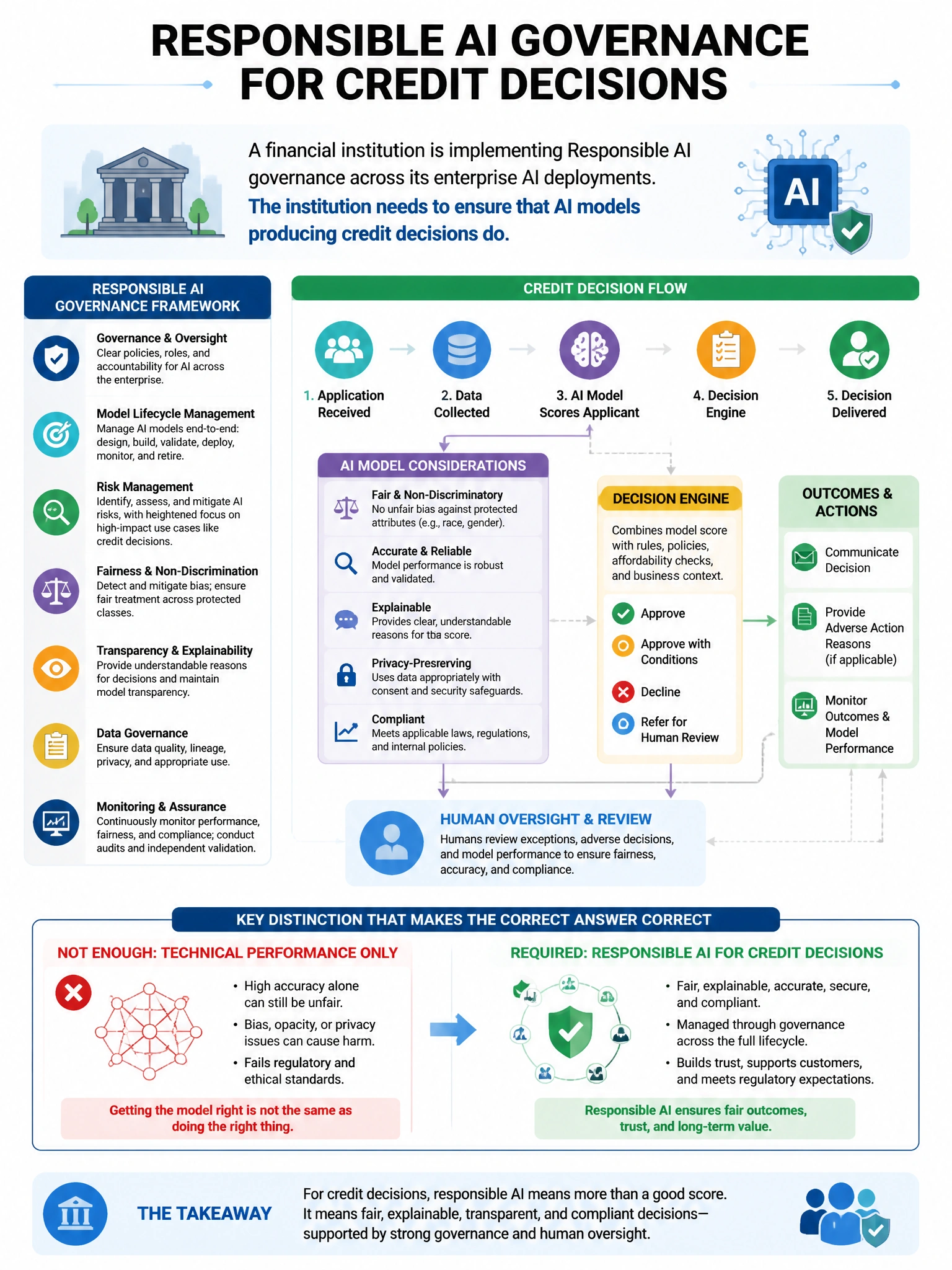
A financial institution is implementing Responsible AI governance across its enterprise AI deployments. The institution needs to ensure that AI models producing credit decisions do not exhibit unfair bias against protected demographic groups. Which Microsoft tool provides fairness assessment capabilities for AI models?
Select an answer to reveal the explanation.
Short Explanation and Infographic
Here's the deal — a is correct because the Azure Responsible AI dashboard integrates several open-source tools including Fairlearn, which provides fairness assessment metrics for machine learning models. Fairlearn evaluates model predictions across demographic groups, identifying disparities in error rates, false positive rates, and other performance metrics that could indicate discriminatory bias in credit decisions.
Full explanation below image
Full Explanation
A is correct because the Azure Responsible AI dashboard integrates several open-source tools including Fairlearn, which provides fairness assessment metrics for machine learning models. Fairlearn evaluates model predictions across demographic groups, identifying disparities in error rates, false positive rates, and other performance metrics that could indicate discriminatory bias in credit decisions. B is wrong because Purview Compliance Manager is used for regulatory compliance assessments and control tracking, not for analyzing model fairness metrics. C is wrong because Microsoft Sentinel UEBA analyzes user behavioral patterns for security threats, not AI model prediction fairness. D is wrong because Azure Policy for AI enforces infrastructure configuration standards; it does not analyze model outputs for demographic bias.