
An organization is designing a Zero Trust architecture for an internal AI assistant built on Azure OpenAI Service. The AI assistant processes confidential business data. Which Zero Trust principle is most critical to apply when a user request reaches the AI inference layer?
Select an answer to reveal the explanation.
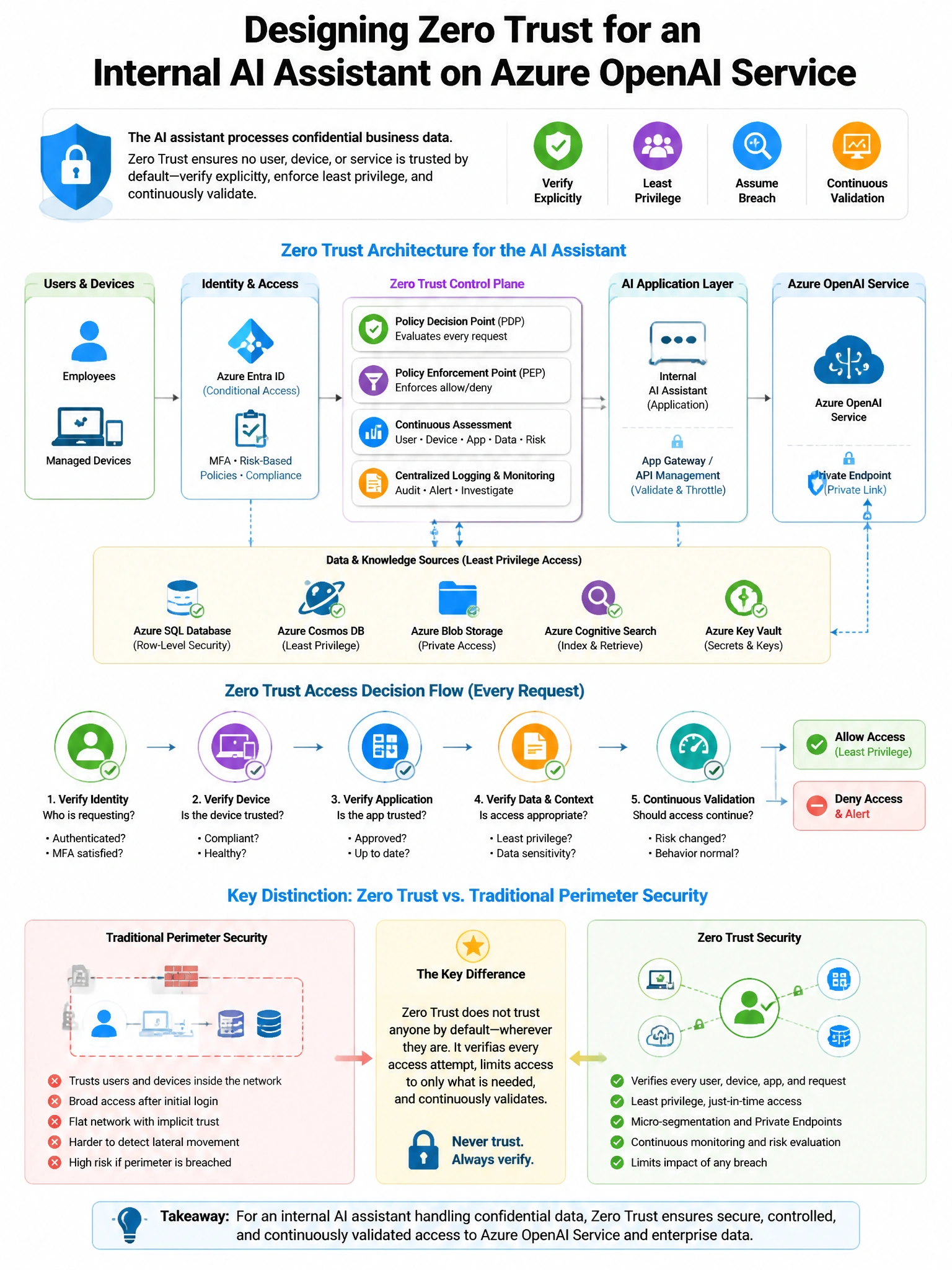
Short Explanation and Infographic
Here's the deal — a is correct because the Zero Trust 'Assume breach' principle requires treating all requests as potentially compromised, even from inside the network. At the AI inference layer, this means continuously validating the caller's Entra ID token on every request, enforcing scope restrictions to authorized models/deployments, and applying content validation (e.g., prompt shield) to catch injection attacks.
Full explanation below image
Full Explanation
A is correct because the Zero Trust 'Assume breach' principle requires treating all requests as potentially compromised, even from inside the network. At the AI inference layer, this means continuously validating the caller's Entra ID token on every request, enforcing scope restrictions to authorized models/deployments, and applying content validation (e.g., prompt shield) to catch injection attacks. This is in contrast to implicit trust granted after network perimeter authentication. B is wrong because verifying only at the edge and implicitly trusting downstream calls violates Zero Trust by creating a trusted interior zone. C is wrong because assigning all users read access to all models violates the 'Use least privilege' principle—the principle means granting minimum necessary access, not universal access. D is wrong because trusting all corporate network traffic is the legacy perimeter model and directly contradicts the 'Assume breach' principle of Zero Trust.