
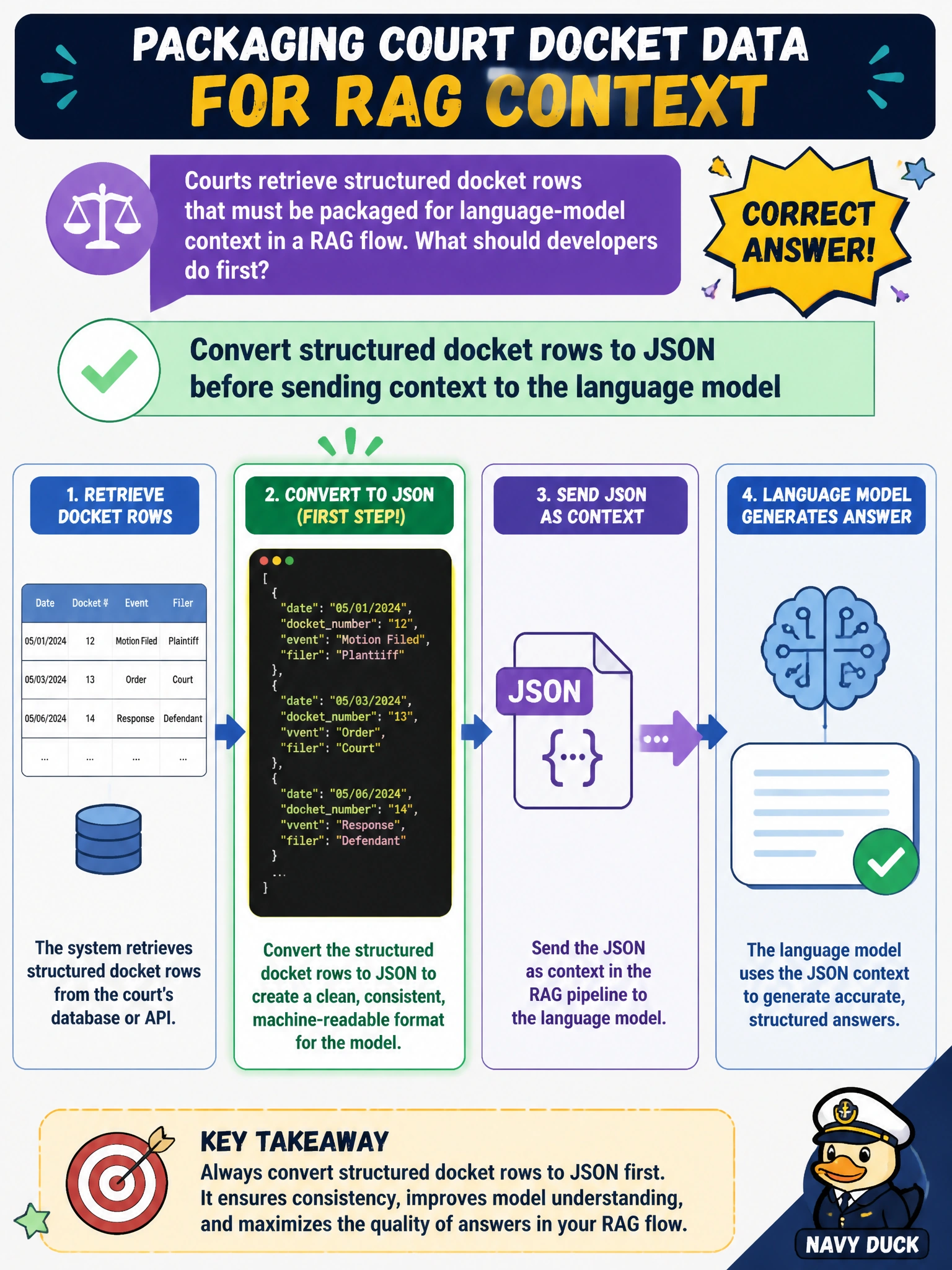
Courts retrieve structured docket rows that must be packaged for language-model context in a RAG flow. What should developers do first?
Select an answer to reveal the explanation.
Short Explanation
Before the model sees docket facts, courts wrap the rows as JSON—like bagging evidence labels so the assistant can actually read them.
Full Explanation
Developers should convert structured docket rows to JSON before sending context to the language model in a courts RAG flow. JSON packaging makes fields explicit and machine-readable in the prompt context window, which is the standard way to present structured municipal records to models that must reason over case attributes. Sending binary page dumps with no JSON packaging fails by concept because opaque binaries are poor prompt citizens and often cannot be interpreted as discrete docket fields. Omitting docket fields entirely so the model receives an empty context fails by removing the retrieved evidence RAG depends on. Transmitting only a random GUID with no structured case content fails because an identifier without attributes supplies no factual docket context for grounded answers. Exam caveat: JSON conversion should include only fields the assistant is authorized to see—packaging must respect courts privacy and least-privilege rules, not dump entire sealed rows. Operationally, map permitted docket columns to a stable JSON schema, validate serialization on sample cases, insert the JSON into the RAG prompt with the user question, and verify the model cites the provided fields rather than inventing case facts.