
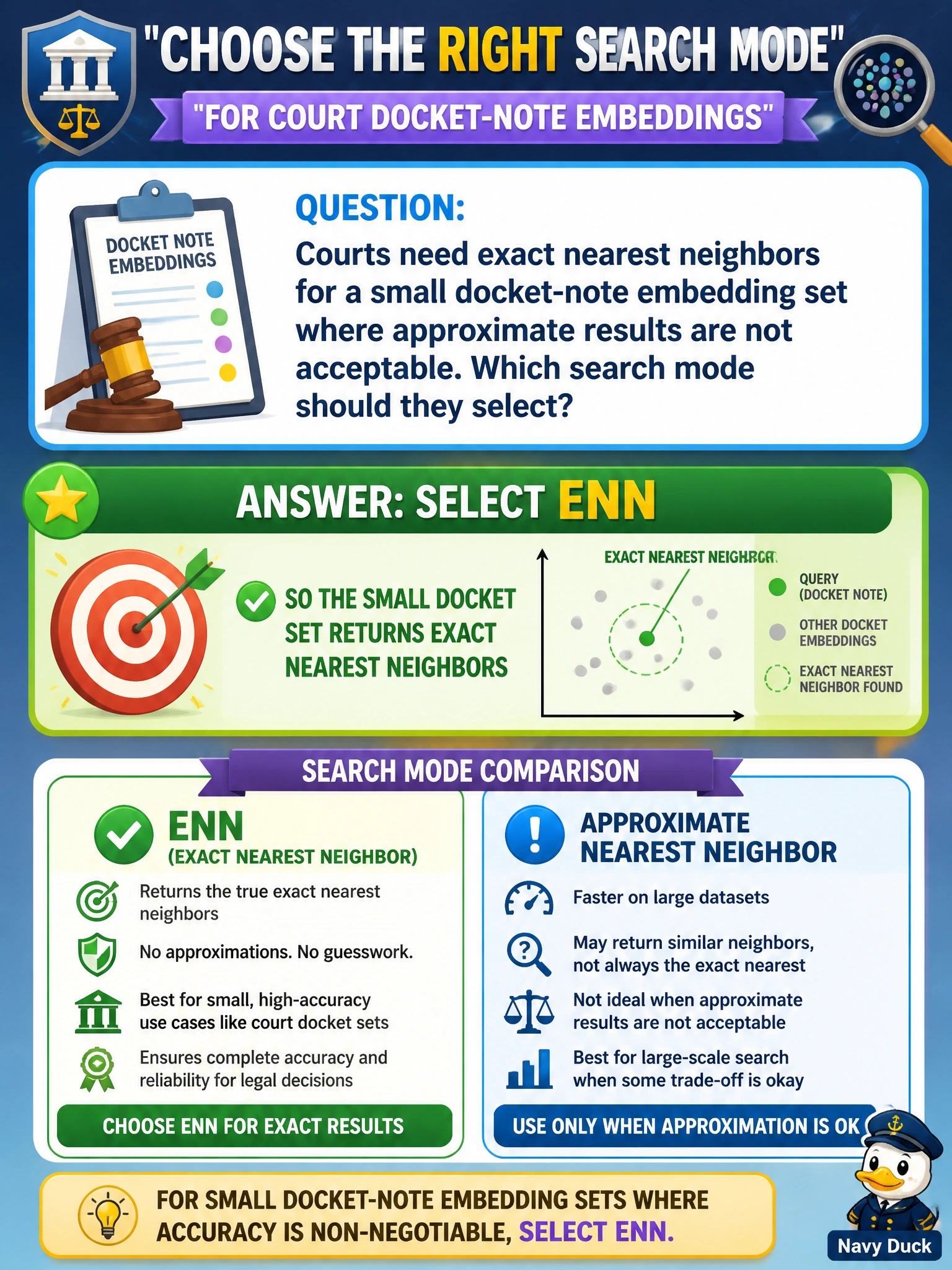
Courts need exact nearest neighbors for a small docket-note embedding set where approximate results are not acceptable. Which search mode should they select?
Select an answer to reveal the explanation.
Short Explanation
On a small docket pile that must be exact, ENN is the “no almost—give me the real nearest neighbors” setting.
Full Explanation
Exact nearest neighbor (ENN) search is the correct mode when courts have a small docket-note embedding set and approximate neighbors are not acceptable. On small corpora, exact search remains feasible and guarantees the true nearest neighbors under the chosen distance metric, which matches legal workflows that cannot tolerate “close enough” semantic misses. Selecting ANN only, even when exact neighbors are required on a small set, fails by concept because ANN intentionally approximates and can miss true neighbors—the stem forbids that tradeoff. Disabling neighbor search and sorting docket notes by clerk last name only fails because alphabetical clerk metadata is unrelated to embedding similarity and does not implement semantic nearest-neighbor retrieval. Replacing embeddings with a single shared constant vector for every note fails by collapsing the embedding space so every note appears identical and neighbor ranking becomes meaningless. Exam caveat: ENN versus ANN is a requirements and scale decision—ENN on a huge corpus can be operationally impractical even if theoretically desirable; here the stem specifies a small set that needs exactness. Operationally, confirm docket-note volume stays in the ENN-friendly range, verify the distance metric matches how embeddings were trained or normalized, spot-check that returned neighbors match clerk expectations on sensitive matters, and document when growth would force a revisit of ANN.