
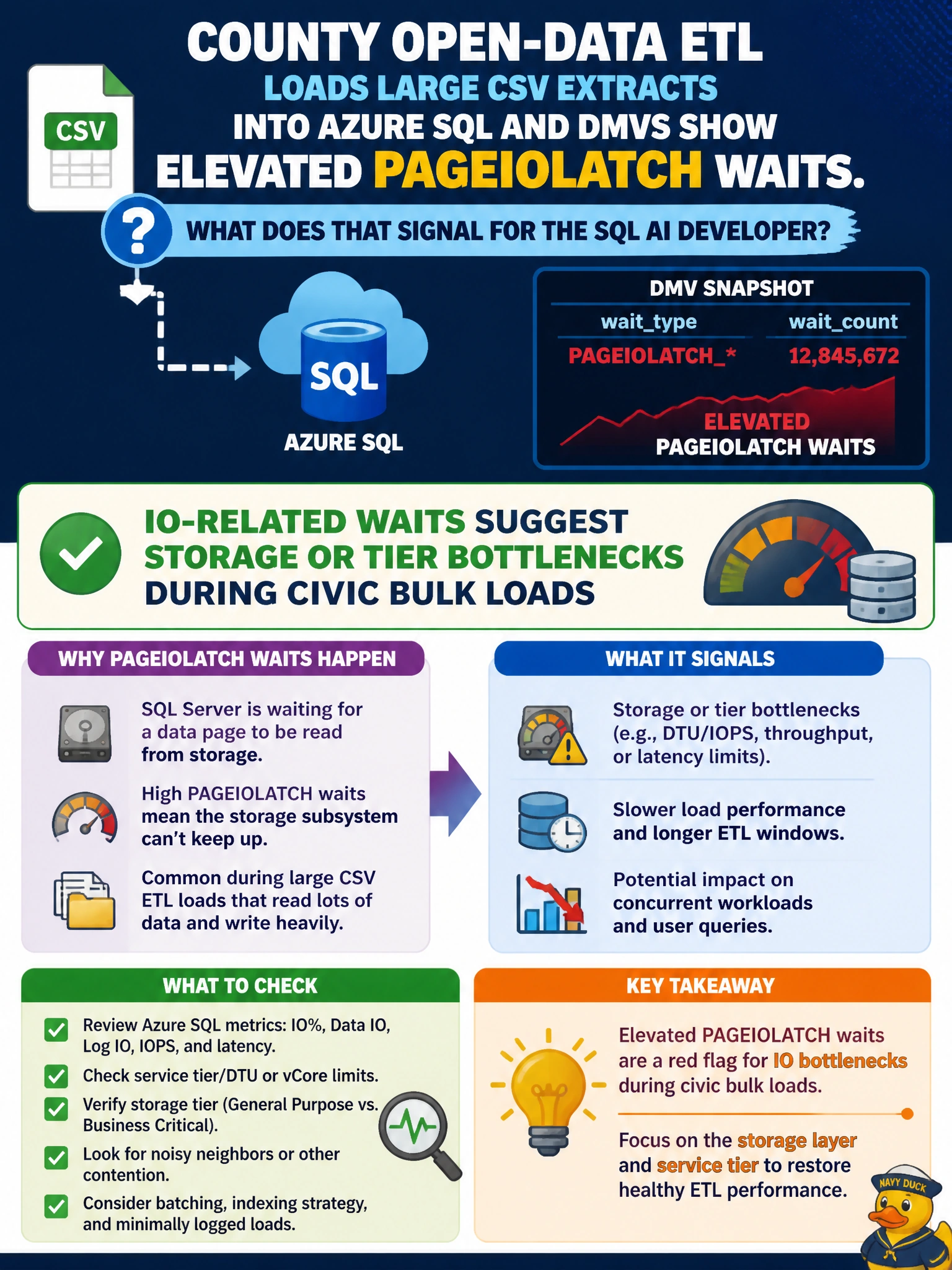
County open-data ETL loads large CSV extracts into Azure SQL and DMVs show elevated PAGEIOLATCH waits. What does that signal for the SQL AI developer?
Select an answer to reveal the explanation.
Short Explanation
PAGEIOLATCH waits mean SQL is tapping its foot waiting on storage—like the open-data truck backed up because the loading dock is too small for those giant CSV dumps.
Full Explanation
Elevated PAGEIOLATCH waits during county open-data ETL that loads large CSV extracts into Azure SQL signal that sessions are spending time waiting for page reads from storage into buffer pool—an IO-bound pattern. For civic bulk loads, that commonly means the data tier’s IO throughput, file layout, or service objective cannot keep up with the read/write rate of the import, or that queries/scans during load thrash the buffer pool. The SQL AI developer should treat PAGEIOLATCH as an IO/storage/tier capacity clue, then correlate with DTU/vCore IO metrics and load batching. Deadlock victim selection misconfiguration is unrelated to latch waits on page IO; deadlocks surface as error 1205 and deadlock graphs, not PAGEIOLATCH dominance. Row-Level Security predicates add CPU/filter cost when queries access protected rows; they are not the primary meaning of page IO latch waits during CSV bulk load. Query Store plan forcing is a plan-stability tool and is not a prerequisite that must run before any CSV import, nor does it explain IO latch accumulation. Exam caveat: PAGEIOLATCH_ is not PAGEIOLATCH’s cousin PAGELATCH_ (buffer latch contention without IO) and not WRITELOG (log flush). Misreading the wait type leads to wrong fixes. On Azure SQL, you scale tier or tune load patterns rather than adding raw disks as on-prem; also verify whether the wait is during heap/index build, CHECK constraints, or post-load queries. Operational check: capture top waits during ETL; confirm PAGEIOLATCH_* dominance; review Azure metrics for data IO percentage and successful/failed connections; test smaller batches, minimal indexing during load, or a higher service objective; re-measure waits and load duration on a representative civic CSV to prove IO pressure dropped.