
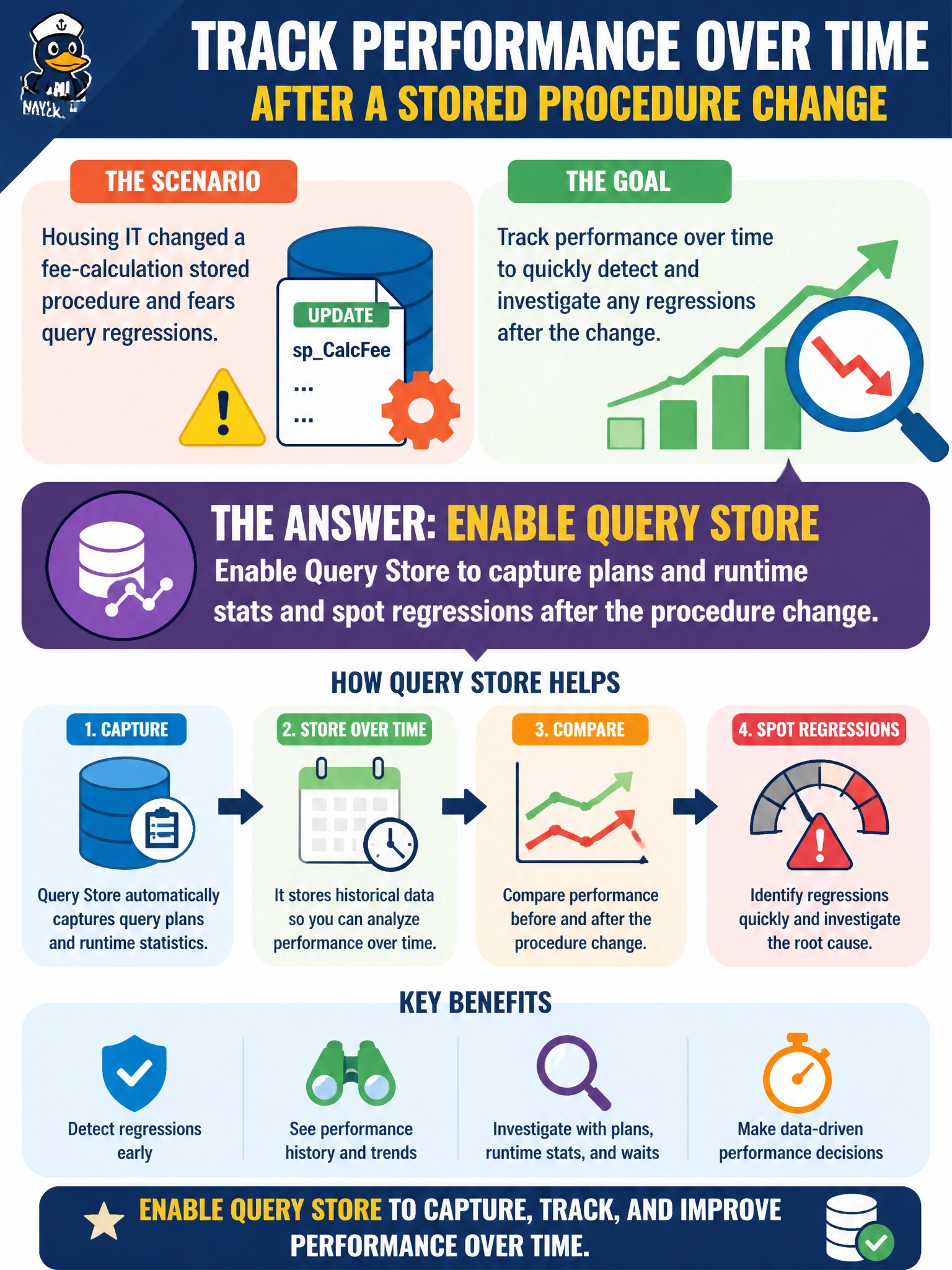
Housing IT changed a fee-calculation stored procedure and fears query regressions. Which feature should they enable to track performance over time?
Select an answer to reveal the explanation.
Short Explanation
Query Store is the black box recorder for that fee-calc proc—flip it on so housing can see if the new version got slower, not wait for angry emails.
Full Explanation
Enabling Query Store to capture plans and runtime stats and spot regressions after the procedure change is the feature Housing IT should use when a fee-calculation stored procedure may have slowed down. Query Store persists query texts, plans, and runtime statistics across executions so teams can compare pre- and post-change duration, CPU, and logical reads, and can force a prior known-good plan if a regression is confirmed. It is the black-box recorder for municipal procedure changes.
Disabling plan caching entirely so every execution is forced to compile without history fails by concept: you add CPU compile cost and destroy the historical signal needed to detect regressions. Relying only on end-user email complaints as the performance monitoring system is lagging, incomplete, and non-quantitative. Deleting historical wait stats daily so regressions cannot be compared removes diagnostic baselines that complement Query Store.
Exam caveat: Query Store must be enabled with adequate capture settings and storage; it does not replace indexing fundamentals or proper change testing in staging. Plan forcing is a mitigation, not a substitute for fixing the procedure or statistics. On DP-800, Query Store is the primary tool for plan regression identification after deployments.
Operational check: Ensure Query Store is on in the housing database before deploying the fee-calculation procedure change, note the query IDs for fee calc, deploy, then compare runtime aggregates and plans for those IDs. If regression appears, analyze the new plan (scans, spills, cardinality) and either correct the procedure/indexes or temporarily force the prior plan while fixing root cause. Keep wait-stat history and avoid disabling the cache. Report findings with Query Store evidence rather than mailbox anecdotes.