
Courts want Copilot-assisted SQL work against a staging database through an MCP endpoint. How should that MCP endpoint be secured?
Select an answer to reveal the explanation.
Short Explanation
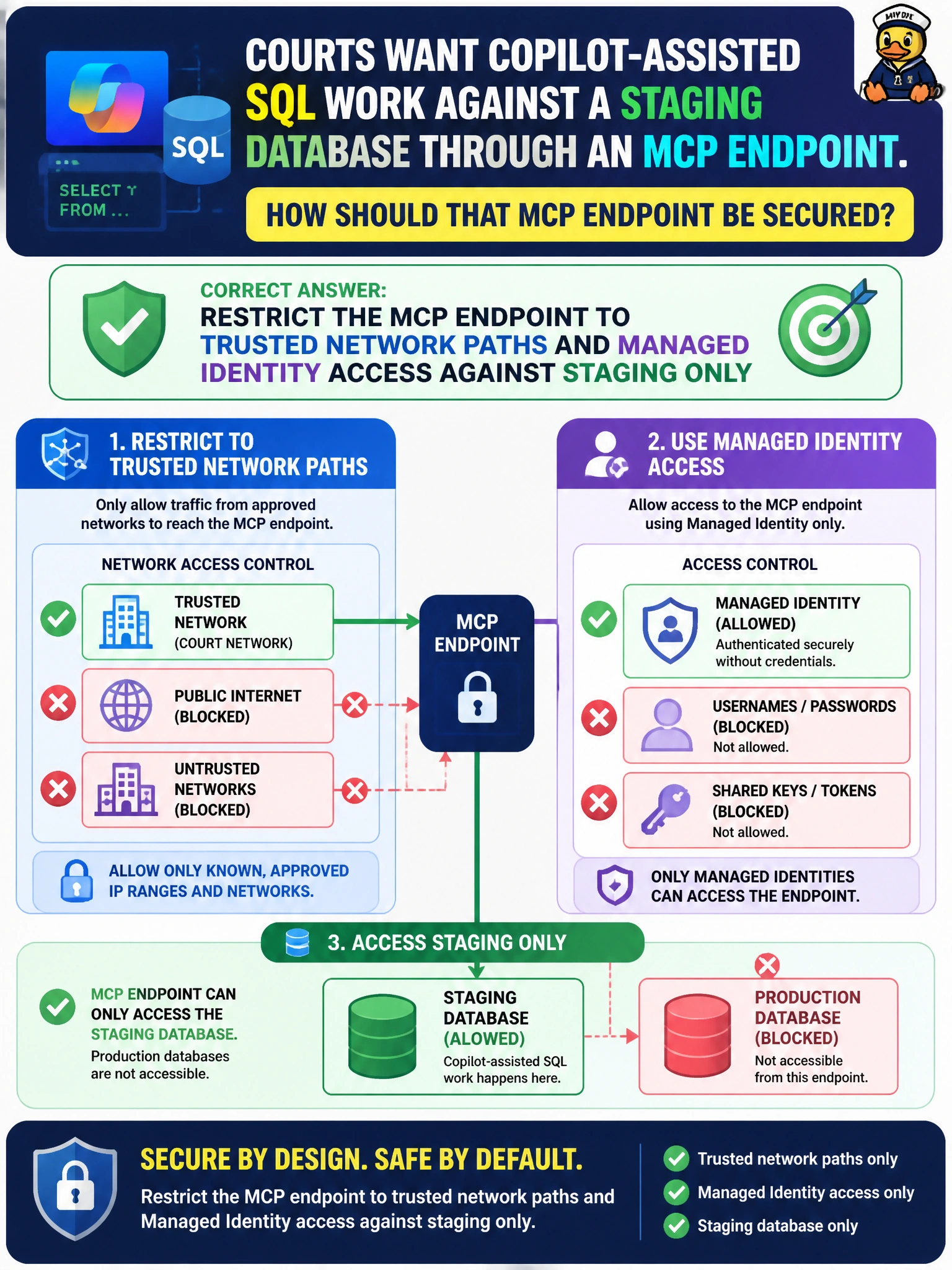
You want a locked staging workshop for Copilot-assisted SQL: keep the MCP endpoint on trusted network paths and use Managed Identity against staging only. That gives you strong access boundaries without opening production to risky changes.
Full Explanation
Restricting the MCP endpoint to trusted network paths and using Managed Identity against staging only is the secure pattern for Copilot-assisted SQL work. An MCP endpoint that can run database tools should not be a casual internet service: restrict its network access, authenticate callers with Managed Identity, and target staging so experimentation cannot mutate production dockets by default. Exposing the endpoint publicly with a shared static token in chat history fails because tokens in chats can leak through logs and transcripts, while public access invites scanning. Pointing tools at production with unrestricted write access and plaintext SQL passwords creates a large blast radius: prompt injection or a mistaken command could alter live court data, and the credentials are exposed in plain text. Disabling identity checks and allowing any laptop on guest Wi-Fi to call MCP tools removes both network and identity boundaries. Exam caveat: security questions like this combine network restriction, strong identity, and environment separation; a static shared token is not equivalent to Managed Identity. Practical check: confirm the endpoint is reachable only through trusted network paths, invocation requires Managed Identity, and the configured database is staging only; verify guest Wi-Fi clients cannot connect and remove SQL passwords from tool configurations.