
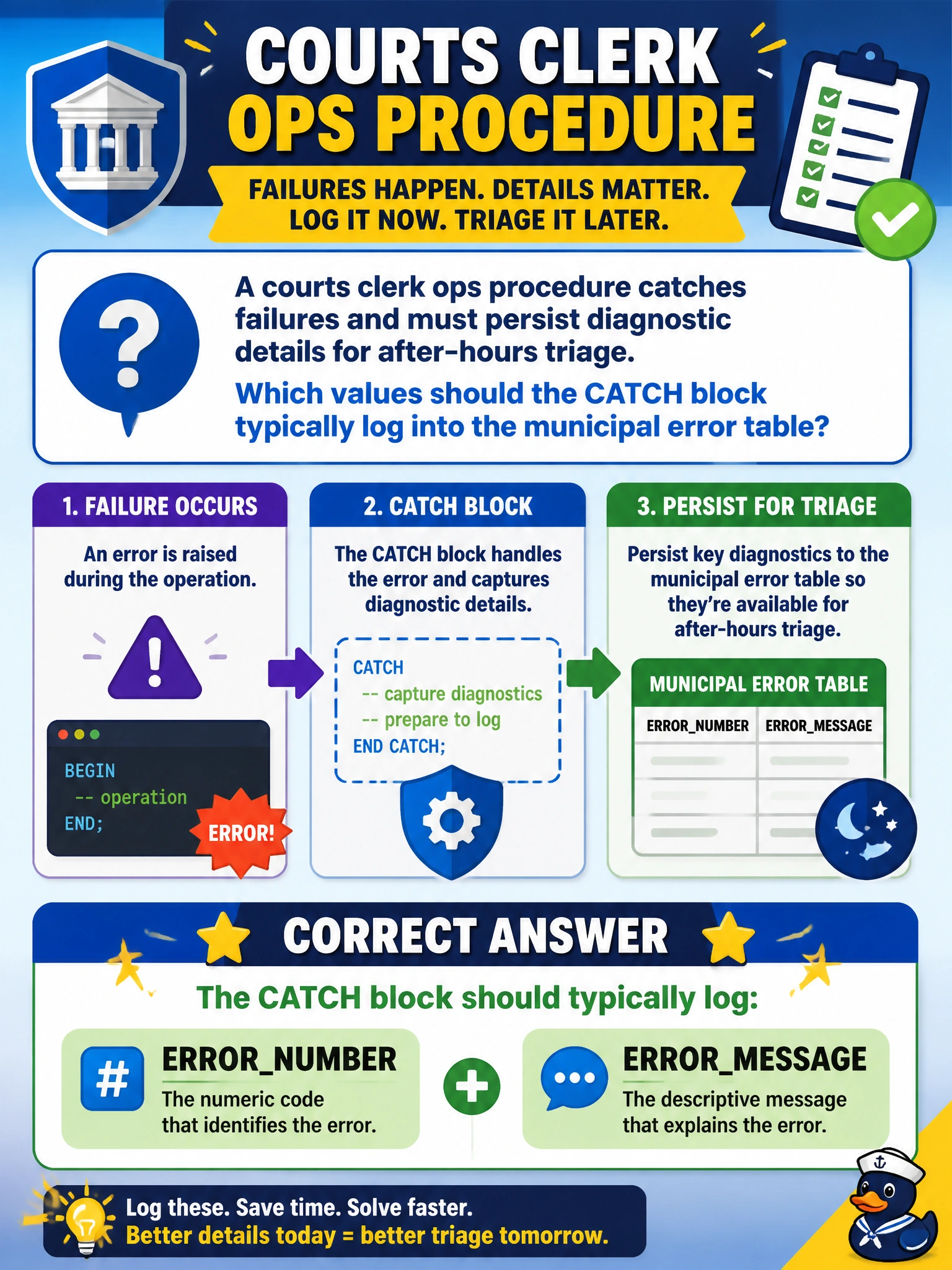
A courts clerk ops procedure catches failures and must persist diagnostic details for after-hours triage. Which values should the CATCH block typically log into the municipal error table?
Select an answer to reveal the explanation.
Short Explanation
When a docket write fails, you need the error code and plain-English message on the clerk ops clipboard. ERROR_NUMBER and ERROR_MESSAGE give you both for after-hours triage.
Full Explanation
ERROR_NUMBER and ERROR_MESSAGE are the values a courts clerk ops CATCH block should typically log into the municipal error table for after-hours triage. Together, they capture the structured identity of the error and a human-readable description, helping overnight support diagnose docket write problems without reproducing every session live. VECTORPROPERTY and VECTOR_NORMALIZE concern vector data properties and normalization, not SQL error diagnostics exposed by the failed statement in CATCH. JSON_ARRAY and JSON_OBJECT construct JSON structures; they do not replace capturing the actual T-SQL error number and message. PAGEIOLATCH wait stats from an unrelated session describe resource waits elsewhere and do not identify the error that fired in this procedure’s CATCH path. Exam caveat: error-handling questions expect you to distinguish error metadata available to CATCH from telemetry or data-construction features; focus on what identifies and describes the caught failure. Practical check: force a controlled failure in non-production clerk ops, confirm the municipal error table stores ERROR_NUMBER and ERROR_MESSAGE with useful incident context, and verify after-hours staff can triage from that row without relying on production chat pastes.