
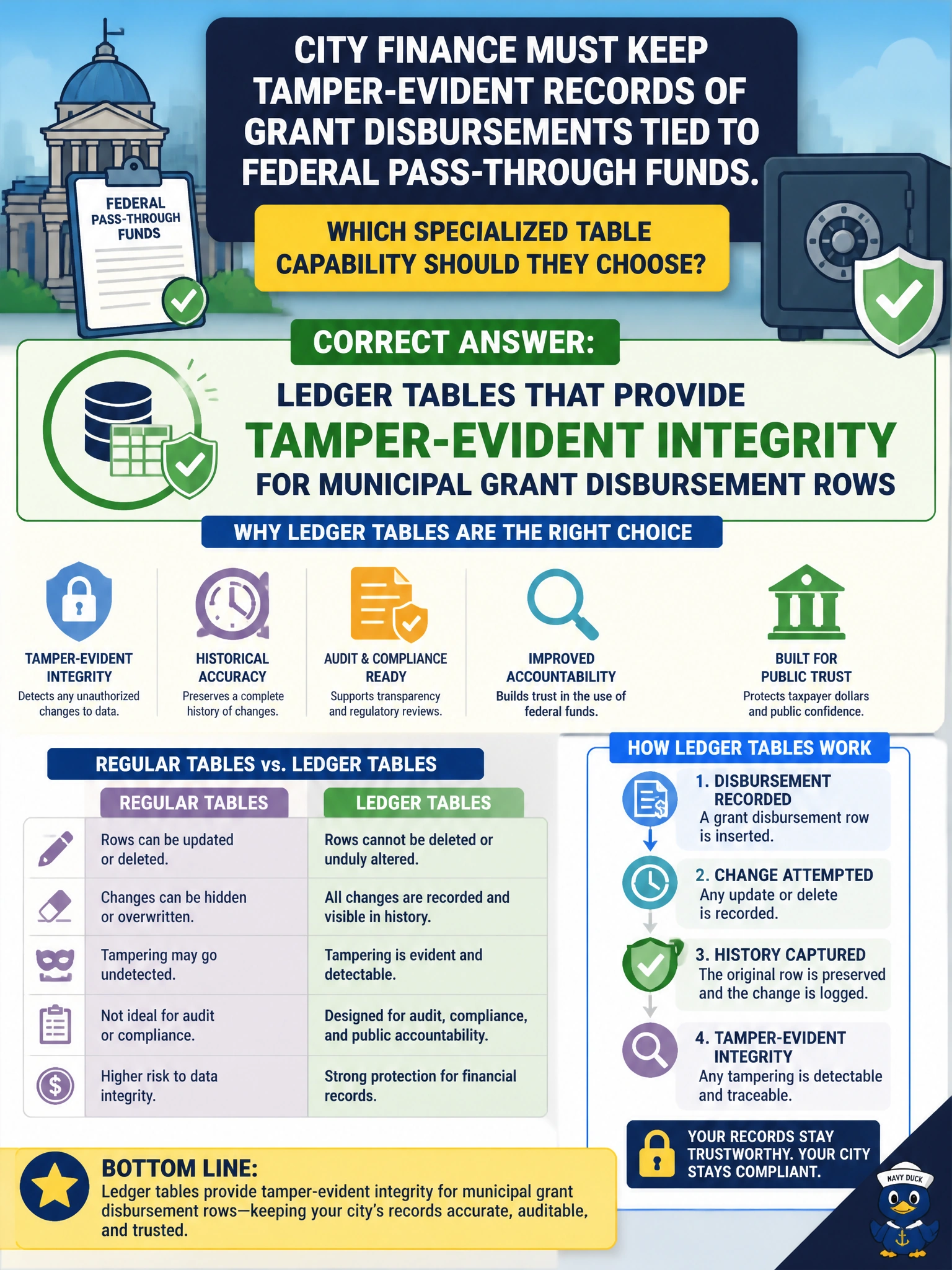
City finance must keep tamper-evident records of grant disbursements tied to federal pass-through funds. Which specialized table capability should they choose?
Select an answer to reveal the explanation.
Short Explanation
Ledger tables put a cryptographic wax seal on each grant disbursement row—if someone quietly edits a pass-through payment, the seal breaks. Temporal history helps with “what changed,” but ledger is the civic answer when finance needs tamper evidence for federal funds.
Full Explanation
Federal pass-through grant disbursements demand more than soft history: finance must detect unauthorized alteration of payment rows. SQL ledger tables maintain cryptographic digests (and related ledger views) so that changes to protected data become tamper-evident. That capability aligns with municipal grant integrity requirements where auditors ask not only “what changed” but “can we prove the stored row was not silently rewritten.” A heap with a soft-delete bit only marks rows inactive; it offers no cryptographic verification if someone updates amount or payee fields. A view that unions live and archived disbursements reshapes data for reporting but does not hash integrity. Temporal tables retain historical versions and are excellent for “as of” reconstruction, yet history alone does not cryptographically prove that neither current nor historical rows were tampered with outside the temporal mechanism’s guarantees—ledger is the feature aimed at tamper evidence. Caveat: ledger has performance and operational overhead (digests, ledger views, and management of ledger databases/tables); apply it to high-integrity financial sets rather than every municipal table by default. Operational check: insert a disbursement into a ledger table, capture the ledger digest or verify path documented for your Azure SQL ledger configuration, attempt an unauthorized update path in a controlled test, and confirm verification reports the inconsistency.