
County analysis shows executor loss on a noisy-neighbor pool leaving a workload stuck. What operational response fits?
Select an answer to reveal the explanation.
Short Explanation
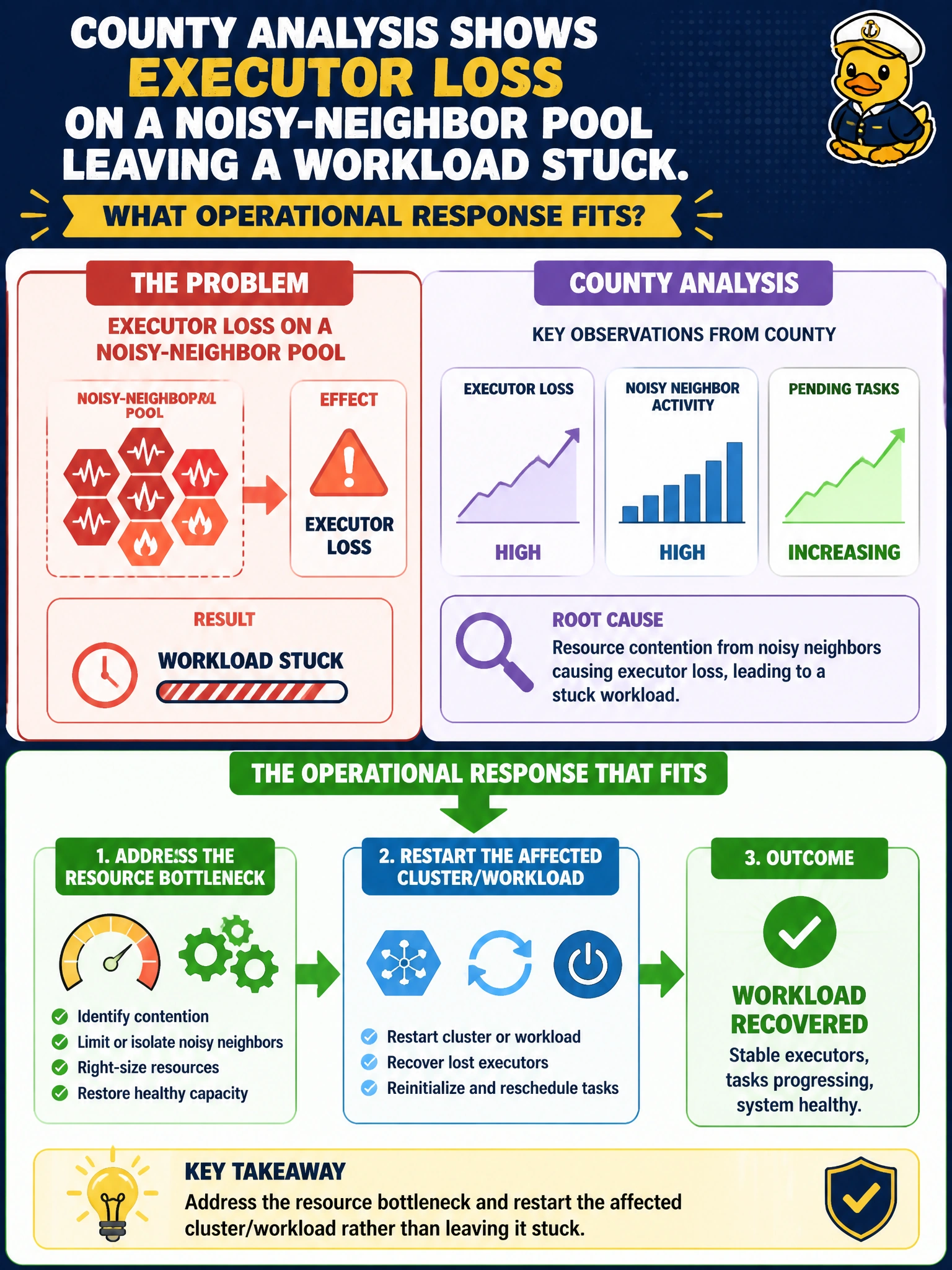
If a noisy neighbor knocks your executors offline, fix the bottleneck and restart the stuck cluster. Don't just tune memory overhead and restart while blocked, hoping it'll clear itself. You'll stay stuck if you enable autoscaling or tweak shuffle partitions and just restart while queued or stalled, since neither brings your lost executors back.
Full Explanation
When county analysis shows executor loss on a noisy-neighbor pool leaving a workload stuck, the operational response is to address the resource bottleneck and restart the affected cluster or workload rather than leaving it stuck. Noisy neighbors starve executors; remediation may include isolation (job clusters or separate pools), quota adjustments, or pool separation, then a managed restart lets the stuck civic job proceed cleanly. Tuning executor memory overhead and restarting the affected cluster/workload rather than leaving it blocked fails because memory settings do not relieve noisy-neighbor contention or bring back lost executors; it simply restarts the stuck workload where resources remain starved. Enabling cluster autoscaling and restarting the affected cluster/workload rather than leaving it queued fails because autoscaling does not isolate the noisy-neighbor pressure or restore lost executors promptly, and restarting without addressing the bottleneck just repeats the stall on congested capacity. Adjusting shuffle partitions and restarting the affected cluster/workload rather than leaving it stalled fails because shuffle tuning optimizes data distribution but does not fix executor loss or pool contention, and restarting in place without relieving contention leaves the workload starved for resources. Exam caveat: DP-750 ops scenarios expect bottleneck remediation plus restart of affected compute—not memory-overhead tuning, autoscaling enablement, or shuffle-partition adjustments that restart without relieving contention. Operational check: identify the noisy-neighbor pool contention, isolate or resize capacity, restart the stuck cluster or workload, and confirm executors remain healthy under Azure Monitor and Spark UI.
Prefer to study offline? Printable PDF study book + test engine ($7.50, unofficial). These questions stay free here.