
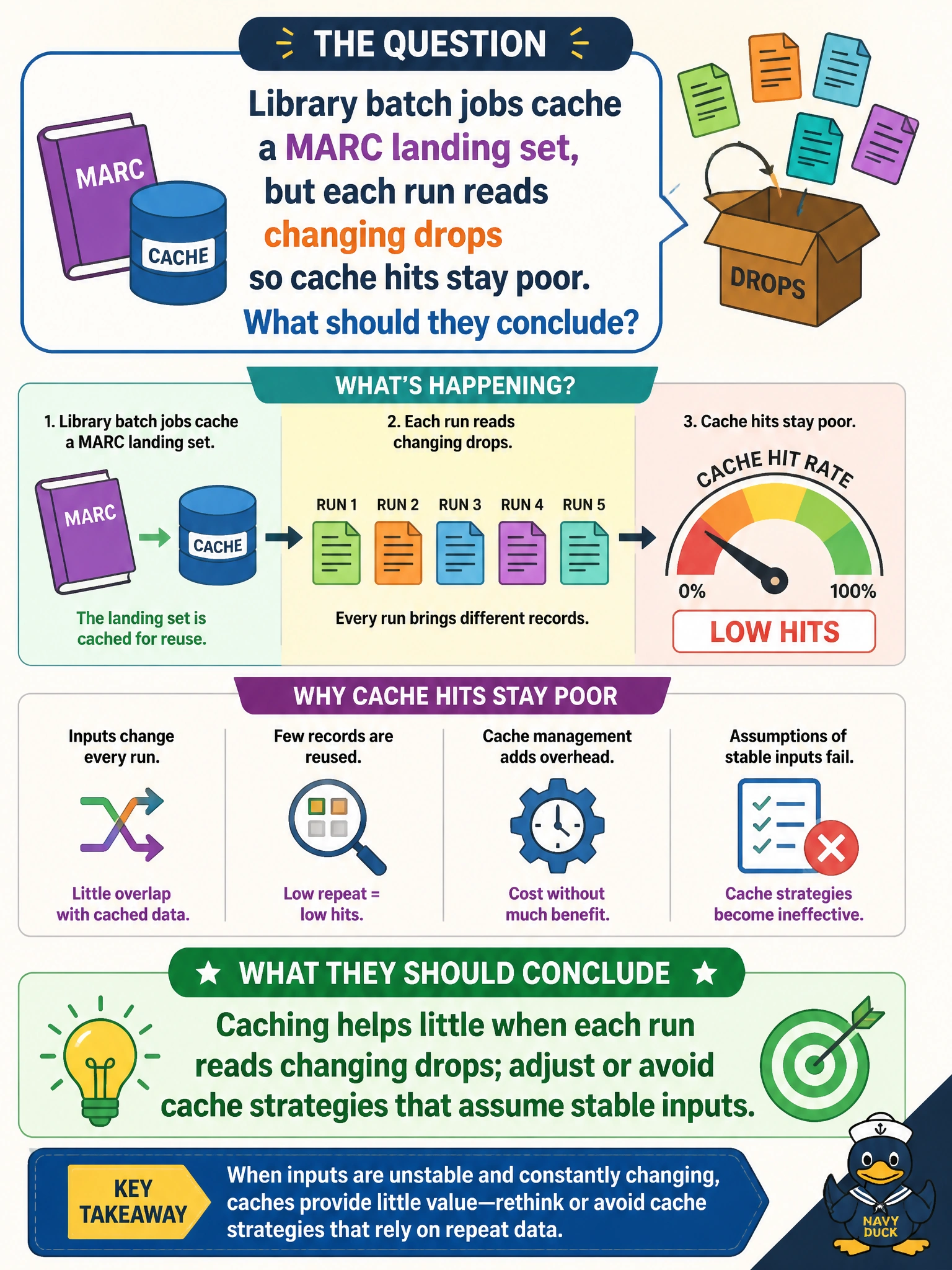
Library batch jobs cache a MARC landing set, but each run reads changing drops so cache hits stay poor. What should they conclude?
Select an answer to reveal the explanation.
Short Explanation
If every night's MARC drop is a new box of books for you, you'll see switching to MEMORY_AND_DISK won't create stable reuse when misses come from changing drops, not MEMORY_ONLY eviction. You'll want to adjust the cache plan since caching helps little when inputs keep moving.
Full Explanation
Library batch jobs that cache a MARC landing set but read changing drops each run will see poor cache hits; engineers should conclude that caching helps little when inputs churn and should adjust or avoid cache strategies that assume stable reused datasets. Spark caching pays off when the same DataFrame is reused repeatedly within or across stages without changing source bytes; nightly-changing MARC drops invalidate that assumption for municipal catalog loads. Recommending persisting with MEMORY_AND_DISK for stable reuse across runs on the theory that misses stem from MEMORY_ONLY eviction on large drops fails because the misses come from nightly-changing source bytes invalidating the cached dataset, not from storage-level eviction, so changing the storage level cannot create reuse across runs. Recommending running OPTIMIZE and VACUUM to improve cached block stability on the theory that poor reuse reflects small-file overhead fails because OPTIMIZE and VACUUM improve Delta file layout and retention, not Spark cache validity, so compacted files still produce misses when each run reads new drops. Recommending enabling Delta caching with Z-ORDER to stabilize join reuse on the theory that low hits come from skew on record ID fails because Z-ORDER addresses data layout and join locality, not cache persistence across changing inputs, so new files each run still miss in cache for downstream joins. Exam caveat: DP-750 cache questions expect situational judgment—cache when reuse is real, skip when nightly drops invalidate the working set. Operational check: measure cache hit rate across runs, confirm landing drops change nightly, remove or narrow caching, and compare job duration and cluster memory after the change.
Prefer to study offline? Printable PDF study book + test engine ($7.50, unofficial). These questions stay free here.