
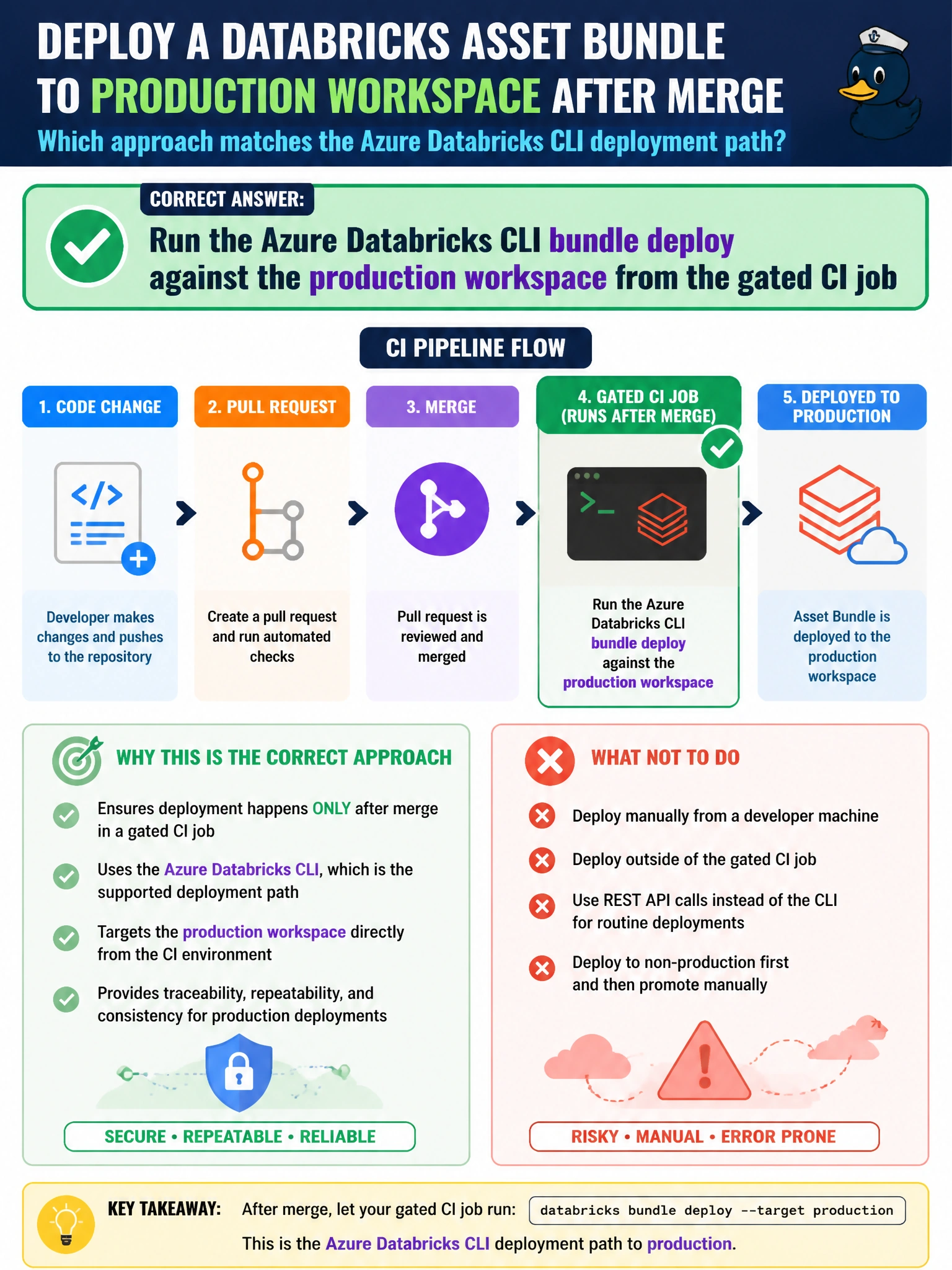
A city CI pipeline must deploy a Databricks Asset Bundle into the production workspace after merge. Which approach matches the Azure Databricks CLI deployment path?
Select an answer to reveal the explanation.
Short Explanation
Think of the CLI as the city's forklift: after the PR is approved, it carts the whole Asset Bundle into the production warehouse aisle. If you only run bundle validate against production, you're checking the config but not promoting anything, so the new jobs and pipelines never show up.
Full Explanation
Databricks Asset Bundles are the supported packaging model for jobs, pipelines, notebooks, and related workspace assets, so a city CI pipeline that must promote into production should invoke the Azure Databricks CLI bundle deploy against the production workspace only after merge gates succeed. That path keeps municipal configuration as code, applies the same bundle definition reviewers already approved, and avoids drift between what lives in Git and what actually runs in the production workspace. Running the Azure Databricks CLI bundle validate against the production workspace from the gated CI job fails because validation only checks the bundle configuration and does not deploy or promote assets, so production never receives the approved jobs, pipelines, or notebooks. Running the Azure Databricks CLI bundle deploy against the development workspace from the gated CI job fails because the question requires promotion to the production workspace, and deploying to development does not update production jobs, pipelines, or notebooks. Syncing bundle files to the production workspace with Databricks Repos git pull from the gated CI job fails because Repos file sync is not the governed bundle deployment path and does not reliably create or update jobs and pipelines as defined in the bundle. Exam caveat: DP-750 expects candidates to recognize CLI-driven bundle deploy as the governed Azure Databricks promotion mechanism, not informal file movement. Operational check: confirm the gated CI job authenticates to the production workspace, runs bundle deploy after required approvals and tests, and verifies the resulting jobs and pipelines match the merged bundle revision.
Prefer to study offline? Printable PDF study book + test engine ($7.50, unofficial). These questions stay free here.