
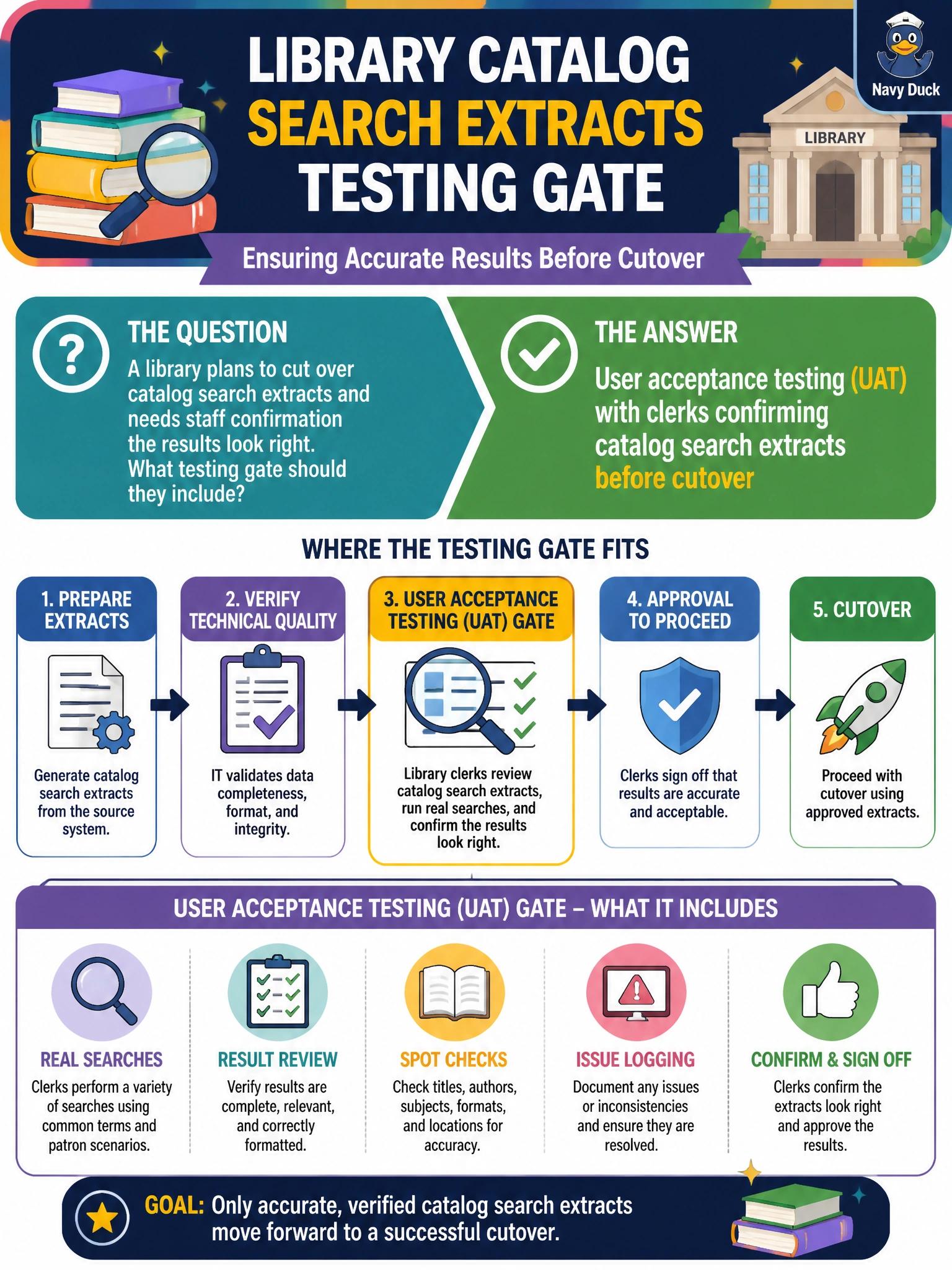
A library plans to cut over catalog search extracts and needs staff confirmation the results look right. What testing gate should they include?
Select an answer to reveal the explanation.
Short Explanation
Before you flip the switch, let the clerks try the search extracts themselves—that's UAT, the “does this actually work for the desk?” check. Calling that same clerk check integration, unit, or performance testing doesn't change what you've confirmed — you'll still need it to count as UAT for everyday desk use.
Full Explanation
A library cutting over catalog search extracts needs staff confirmation that results look right—user acceptance testing (UAT) with clerks who actually work the catalog desk. UAT validates fitness for operational use: search relevance, holdings display, hours, and edge cases engineers may not prioritize. Civic data products that desk staff rely on should not cut over on engineer preference alone.
Integration testing (SIT) with clerks confirming catalog search extracts before cutover fails by label because clerk confirmation that results look right is acceptance, not system-to-system integration verification; SIT proves feeds connect, while this gate needs fitness for desk use and sign-off. Unit testing (UT) with clerks confirming library catalog search extracts before cutover fails by label because UT validates isolated code units in dev by developers, not operational fitness judged by clerks; relabeling clerk acceptance as unit testing does not make it unit testing. Performance testing (PT) with clerks confirming catalog search extracts before cutover fails by label because PT measures speed and behavior under load, not whether staff accept the extracts as correct; clerk review of correctness is acceptance, not a performance result.
Exam caveat: Labeling clerk confirmation of catalog search extracts as Integration testing (SIT), Unit testing (UT), or Performance testing (PT) still misses UAT — UAT is the distinct human acceptance gate for fitness for use, not a rename of technical checks. Sequence is typically automate first, then UAT for human-facing confirmation before cutover. Document UAT participants, scenarios, and sign-off for change control.
Operational check: run UAT sessions with clerks against non-prod or staged extracts, capture written acceptance on critical search scenarios, and block cutover until sign-off. Do not treat engineer-only demo approval as UAT.
Prefer to study offline? Printable PDF study book + test engine ($7.50, unofficial). These questions stay free here.