
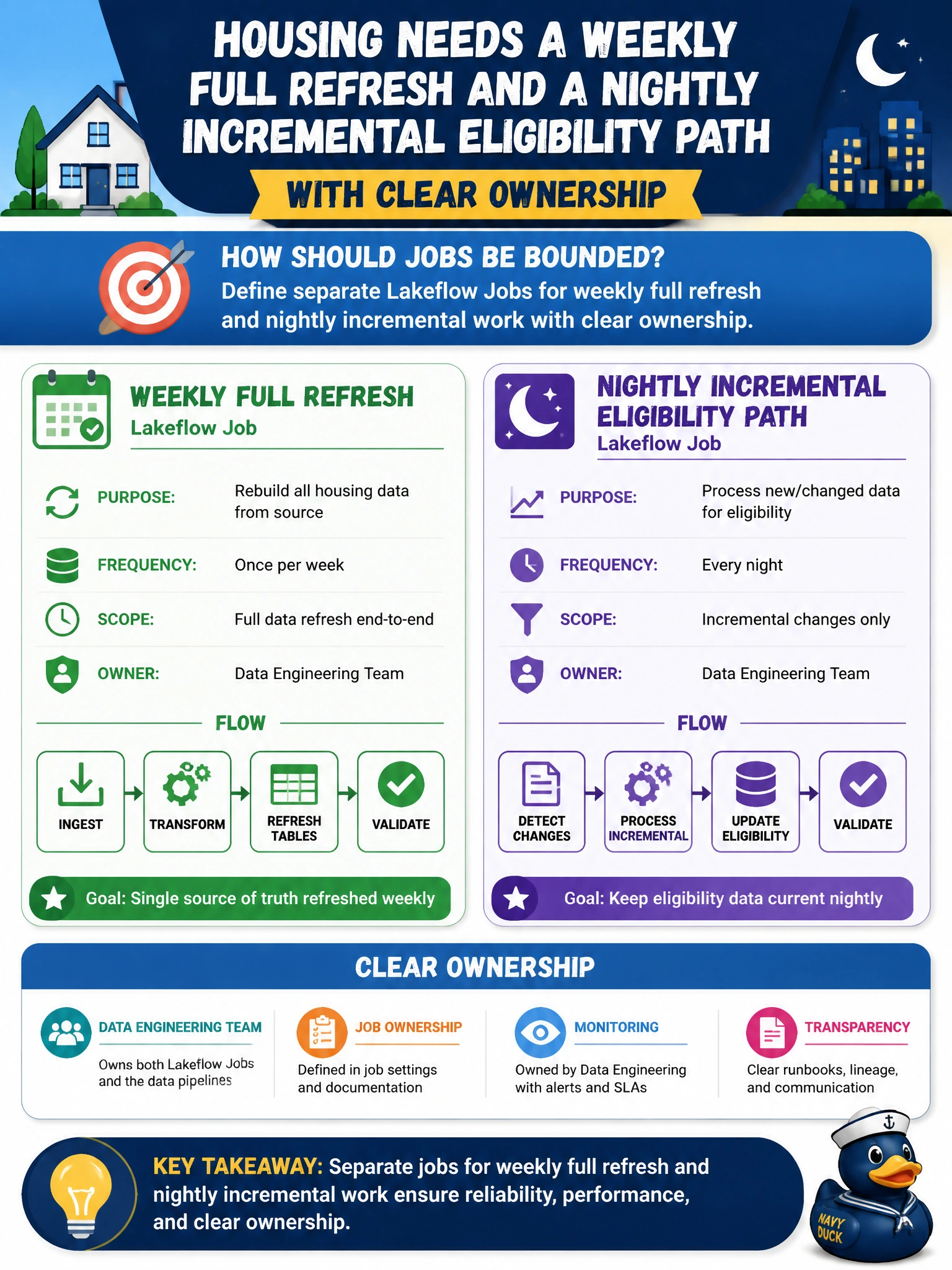
Housing needs a weekly full refresh and a nightly incremental eligibility path with clear ownership. How should jobs be bounded?
Select an answer to reveal the explanation.
Short Explanation
You should give the weekly deep clean and nightly tidy-up their own Lakeflow Jobs and owners. Putting them in a single Lakeflow Job with clear ownership still mixes two cadences, so you'll blur SLAs and it's a fast way to miss alerts.
Full Explanation
Housing workloads that need both a weekly full refresh and a nightly incremental eligibility path with clear ownership should be bounded as separate Lakeflow Jobs—one for weekly full refresh, one for nightly incremental—each with explicit owners. Separate jobs clarify schedules, SLAs, compute sizing, alert routes, and who is paged when something breaks. Municipal housing operations typically cannot afford a single Lakeflow Job for weekly full refresh and nightly incremental work with clear ownership where weekly rebuild logic and nightly deltas share one schedule and failure domain. Defining a single Lakeflow Job for weekly full refresh and nightly incremental work with clear ownership fails because it merges divergent cadences under one schedule and failure domain, preventing independent SLAs, compute sizing, alert routes, and accountability. Defining Lakeflow Declarative Pipelines for weekly full refresh and nightly incremental work with clear ownership fails because pipelines define data transformations rather than separate Lakeflow Jobs, leaving each cadence without its own schedule, alert route, and SLA. Managing weekly full refresh and nightly incremental work in Git-versioned notebooks with clear ownership fails because notebooks alone, even when versioned in Git, are not Lakeflow Jobs with named owners, alert policies, schedules, and independent failure domains. Exam caveat: separate jobs by cadence/ownership when requirements diverge; use parameters when the same logic must run for different dates. Do not over-split into chaos, but weekly-full vs nightly-incremental is a classic split. Document owners in job descriptions and alert routes.
Operational check: verify two Lakeflow Jobs exist with distinct schedules (weekly vs nightly), named owners, and independent alert policies. Confirm a failure in the weekly full job does not silently skip the nightly incremental path, and that runbooks name the correct job for each mode.
Prefer to study offline? Printable PDF study book + test engine ($7.50, unofficial). These questions stay free here.