
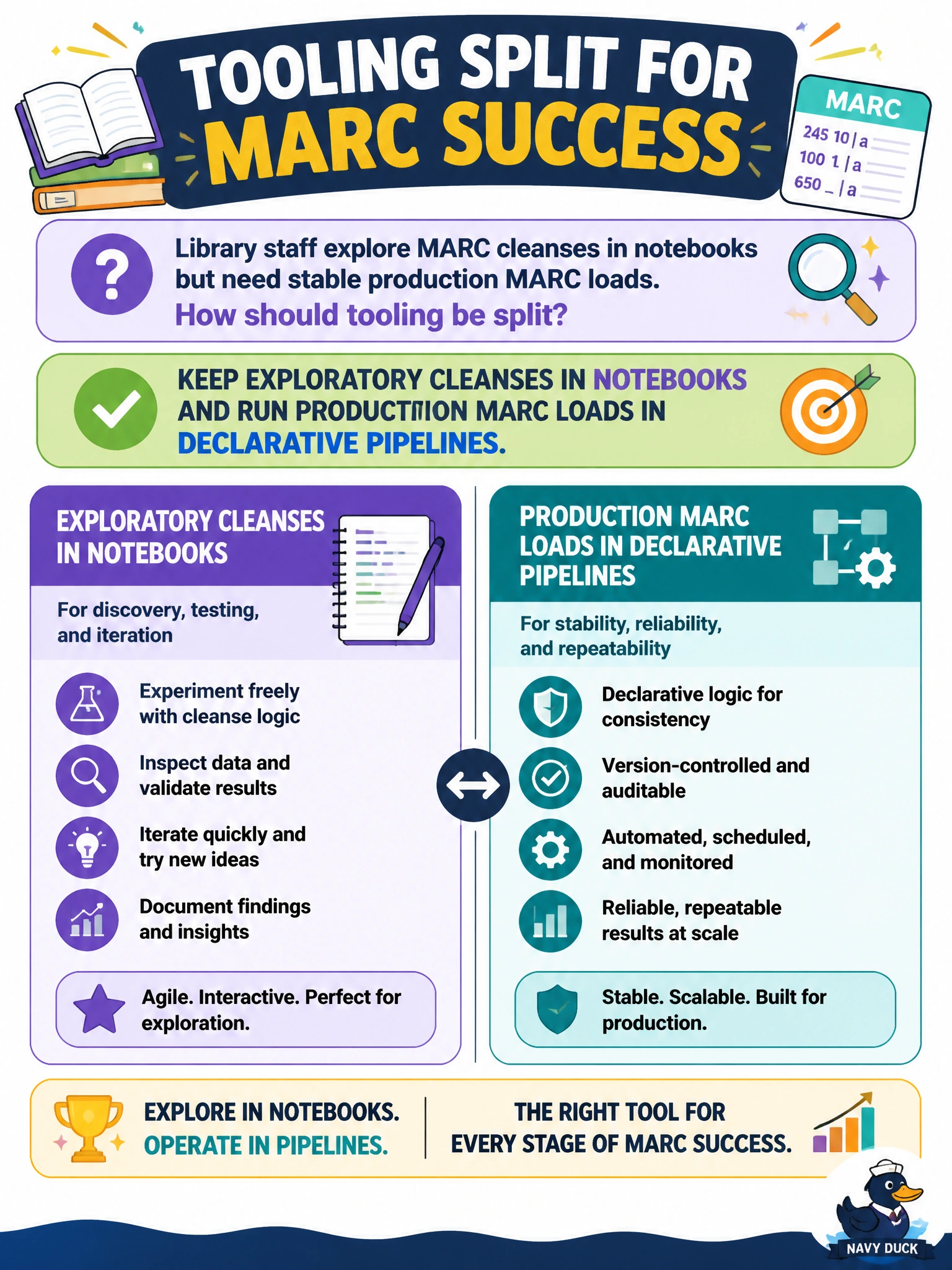
Library staff explore MARC cleanses in notebooks but need stable production MARC loads. How should tooling be split?
Select an answer to reveal the explanation.
Short Explanation
Notebooks are the reading-room whiteboard; declarative pipelines are the catalog that actually shelves the books for the public. You'll keep exploration agile but you'll make production fragile if you run those loads in interactive dashboard extracts, manual export scripts, or ad-hoc query exports because they're missing expectations and governance.
Full Explanation
Matching tooling to civic workload maturity means notebooks for exploration and declarative pipelines for production loads. Library staff should keep exploratory MARC cleanses in notebooks—fast iteration, sampling, research—while stable production MARC loads run in declarative pipelines with expectations, schedules, and governed tables. That split preserves researcher agility without making scratch cells the system of record for the public catalog path.
Keeping exploratory cleanses in notebooks and running production MARC loads in interactive dashboard extracts leaves production tied to manual interaction: dashboard extracts lack the schedules, expectations, data quality checks, and governed tables needed for stable catalog loads. Keeping exploratory cleanses in notebooks and running production MARC loads in manual export scripts keeps production fragile and ungoverned: manual scripts do not provide the scheduled declarative expectations, data quality checks, and governed promotion required for stable catalog loads. Keeping exploratory cleanses in notebooks and running production MARC loads in ad-hoc query exports leaves nightly loads unreliable: ad-hoc exports are unrepeatable and do not provide the declarative expectations, lineage, and governed tables required for stable public catalog loads.
Exam caveat: promoting a notebook pattern into a declarative pipeline is a deliberate hardening step—do not copy every research cell into production without tests and expectations. Operational check: confirm nightly MARC production runs via the declarative pipeline with quality metrics; keep a sandbox notebook for cleanser experiments that cannot write to production gold; review library change control that requires pipeline promotion for catalog-affecting logic.
Prefer to study offline? Printable PDF study book + test engine ($7.50, unofficial). These questions stay free here.